
Quiz
Unit 1
Dieses Quiz enthält Fragetypen, die sich im gewohnten Player öffnen.
Fragen in diesem Quiz (36)
1Viruses are [blank_start]sub[blank_end]microscopic, [blank_start]obligate[blank_end] [blank_start]intra[blank_end]cellular parasites.
- Asub
- Bobligate
- Cintra
2One view is that inside the host cell, viruses are [blank_start]alive[blank_end], but outside it they are complex assemblages of [blank_start]inert chemicals[blank_end], like a seed or a spore.
- Aalive
- Binert chemicals
3scientists generally accept that the biological manifestation of life exhibits the following phenomena:
[blank_start]Homeostasis[blank_end]: Regulation of the internal environment to maintain a constant state; for example, electrolyte concentration or sweating to reduce temperature.
[blank_start]Organization[blank_end]: Being structurally composed of one or more cells, which are the basic units of life.
[blank_start]Metabolism[blank_end]: Consumption of energy by converting chemicals and energy into cellular components (anabolism) and decomposing organic matter (catabolism). Living things require energy to maintain internal organization (homeostasis) and to produce the other phenomena associated with life.
[blank_start]Growth[blank_end]: Maintenance of a higher rate of synthesis than catabolism. A growing organism increases in size in all of its parts, rather than simply accumulating matter. The particular species begins to multiply and expand as the evolution continues to flourish.
[blank_start]Adaption[blank_end]: The ability to change over a period of time in response to the environment. This ability is fundamental to the process of evolution and is determined by the organism's heredity as well as the composition of metabolized substances, and external factors present.
[blank_start]Response to stimuli[blank_end]: A response can take many forms, from the contraction of a unicellular organism to external chemicals, to complex reactions involving all the senses of higher animals. A response is often expressed by motion, for example, the leaves of a plant turning toward the sun (phototropism) and chemotaxis.
[blank_start]Reproduction[blank_end]: The ability to produce new organisms. Reproduction can be the division of one cell to form two new cells. Usually the term is applied to the production of a new individual (either asexually, from a single parent organism, or sexually, from at least two differing parent organisms), although strictly speaking it also describes the production of new cells in the process of growth.- AHomeostasis
- BOrganization
- CMetabolism
- DGrowth
- EAdaption
- FResponse to stimuli
- GReproduction
4[blank_start]Regressive[blank_end] evolution:
Viruses are [blank_start]degenerate[blank_end] life-forms which have lost many functions that other organisms possess and have only retained the genetic information essential to their [blank_start]parasitic[blank_end] way of life?
[blank_start]Cellular[blank_end] origins:
Viruses are [blank_start]subcellular[blank_end], functional assemblies of macromolecules which have escaped their origins inside [blank_start]cells[blank_end]?
[blank_start]Independent[blank_end] entities:
Viruses evolved on a [blank_start]parallel[blank_end] course to cellular organisms from the self-[blank_start]replicating[blank_end] molecules which existed in the primitive prebiotic 'RNA world’?- ARegressive
- Bdegenerate
- Cparasitic
- DCellular
- Esubcellular
- Fcells
- GIndependent
- Hparallel
- Ireplicating
5Viruses are extremely successful parasites. Every organism in nature is subject to infection by viruses.
- ARichtig
- BFalsch
6There is a lot of biological diversity between viruses.
Due to this variety, viruses have extremely unique natures that must be accounted for in a taxonomic system.- ARichtig
- BFalsch
7The ICTV – [blank_start]International Committee[blank_end] on [blank_start]Taxonomy of Viruses[blank_end] was formed.
- AInternational Committee
- BTaxonomy of Viruses
8The taxonomy starts with the type of capsid.
- ARichtig
- BFalsch
9Label the following picture.
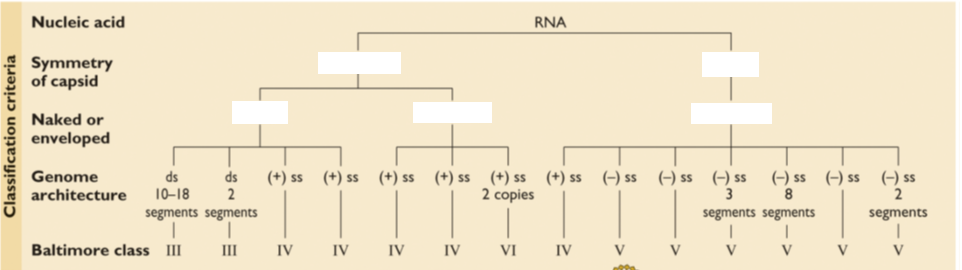
- Aicosahedral
- Bnaked
- Cenveloped
- Dhelical
- Eenveloped
10Label picture. HINT: if "cytoplasmic" then denote this with a space followed by "(cytoplasmic)".
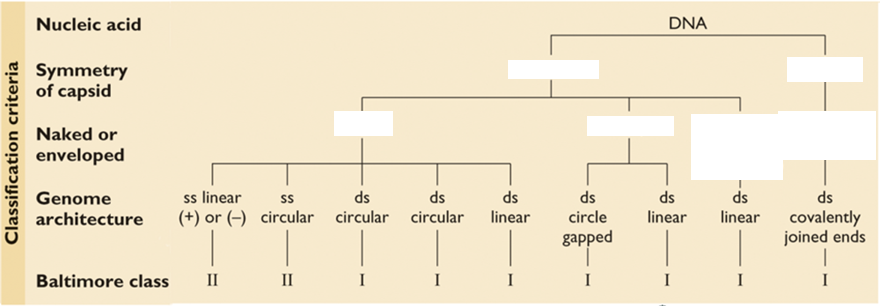
- Aicosahedral
- Bnaked
- Cenveloped
- Dnaked/enveloped (cytoplasmic)
- Ecomplex
- Fenveloped (cytoplasmic)
11Label Picture.
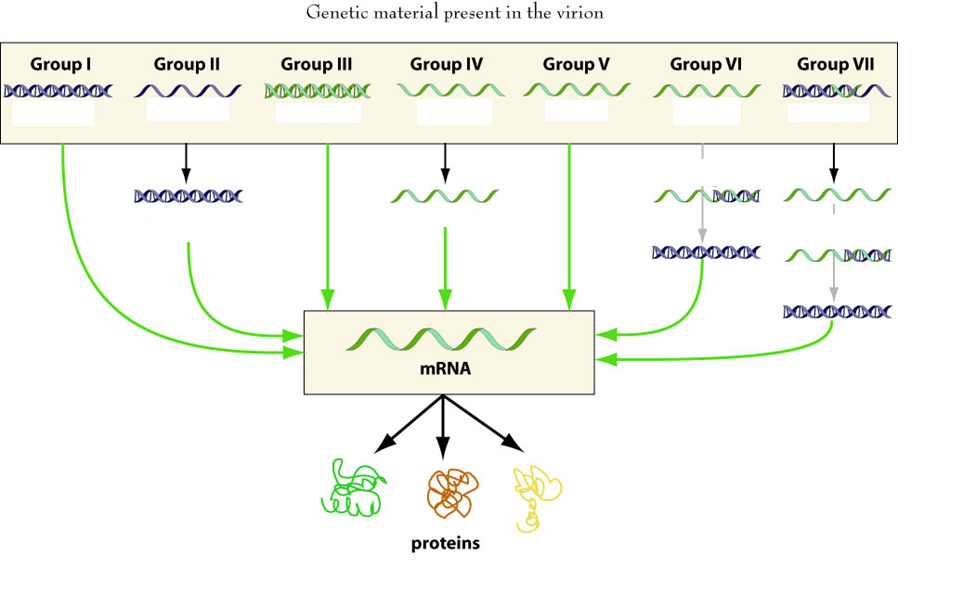
- ADNA(+/-)
- BDNA(+)
- CRNA(+/-)
- DRNA(+)
- ERNA(-)
- FRightmost RNA(+)
- GRightmost DNA(+/-)
- HBottommost DNA(+/-)
- IBottommost RNA(-)
- JReverse transcription
- KRight most reverse transcription
12Koch's Postulates
The agent must be present in every [blank_start]case[blank_end] of the disease.
The agent must be [blank_start]isolated[blank_end] from the host and grown [blank_start]in vitro[blank_end].
The disease must be [blank_start]reproduced[blank_end] when a pure culture of the agent is inoculated into a healthy susceptible [blank_start]host[blank_end].
The same agent must be [blank_start]recovered[blank_end] once again from the experimentally [blank_start]infected[blank_end] host.- Acase
- Bisolated
- Cin vitro
- Dreproduced
- Ehost
- Frecovered
- Ginfected
13Once a virus has been found, a genetically [blank_start]pure[blank_end] sample is obtained either through limited [blank_start]dilution[blank_end] or though [blank_start]plaque purification[blank_end].
- Apure
- Bdilution
- Cplaque purification
14Today, the vast bulk of viral work is done in [blank_start]cell culture[blank_end].
However, for growth of [blank_start]high titer[blank_end] stocks for labs as well as for [blank_start]vaccines[blank_end], embryonated eggs are still used.- Acell culture
- Bhigh titer
- Cvaccines
15Animal hosts still have their uses in virology:
For viruses which cannot be propagated [blank_start]in vitro[blank_end]
[blank_start]Pathogenesis[blank_end] experiments
Vaccine [blank_start]safety[blank_end]
[blank_start]Attenuation[blank_end]
Nevertheless, they are increasingly being discarded:
[blank_start]Expensive[blank_end]
[blank_start]Complex[blank_end] and difficult to interpret
Host [blank_start]variation[blank_end]
Ethical?
Overtaken by [blank_start]cell culture[blank_end] and molecular biology- Ain vitro
- BPathogenesis
- Csafety
- DAttenuation
- EExpensive
- FComplex
- Gvariation
- Hcell culture
16Primary cell culture:
From the [blank_start]original[blank_end] tissue.
Human, monkey, hamsters, rats, mice, chickens are the most common.
The tissue is [blank_start]minced[blank_end] and treated with [blank_start]proteases[blank_end] and/or [blank_start]collagenases[blank_end] to free the individual [blank_start]cells[blank_end] from the connective tissue.- Aoriginal
- Bminced
- Cproteases
- Dcollagenases
- Ecells
17Secondary cell culture:
From a [blank_start]primary[blank_end] culture.
Basically, once the cells in the flask reach the edges, this is called [blank_start]confluence[blank_end]. At [blank_start]confluence[blank_end], most cell cultures stop growing – contact [blank_start]inhibition[blank_end].
Disruption of the confluent primary culture, removal of a portion of the cells, and reculturing of the rest results in “[blank_start]passage[blank_end]”. [blank_start]Passaging[blank_end] a primary culture makes it a [blank_start]secondary[blank_end] culture.
Normal vertebrate cells cannot be passaged [blank_start]indefinitely[blank_end].- Aprimary
- Bconfluence
- Cconfluence
- Dinhibition
- Epassage
- FPassaging
- Gindefinitely
- Hsecondary
18Primary and secondary cultures can be immortalized, making a cell line that can be passaged [blank_start]indefinitely[blank_end]. The immortalization process ([blank_start]transformation[blank_end]) is varied, but included treatment with [blank_start]mutagenic[blank_end] agents, infection with [blank_start]tumorigenic[blank_end] viruses, or transfection with [blank_start]oncogenes[blank_end].
- Aindefinitely
- Btransformation
- Cmutagenic
- Dtumorigenic
- Eoncogenes
19Transformation can really screw up the cells, so when cell lines are generated, they are tested to make sure they have the same general characteristics as the original cells. However, you still ultimately end up with Frankin-cells.
Three main properties that appear, which are not necessarily interrelated are:
Lost of [blank_start]contact inhibition[blank_end]
Anchorage [blank_start]independence[blank_end]
[blank_start]Tumorigenicity[blank_end]
These properties tend to describe a [blank_start]continuum[blank_end] of changes of cell transformation.- Acontact inhibition
- Bindependence
- CTumorigenicity
- Dcontinuum
20Not all viruses will grow in cell lines. The lines may be too different from the [blank_start]original[blank_end] host, or the virus may require a specific [blank_start]metabolic[blank_end] state that the cell line does not replicate.
- Aoriginal
- Bmetabolic
21Ultimately some viruses won’t grow in [blank_start]primary[blank_end] culture and researchers are forced to use [blank_start]older[blank_end] methods.
- Aprimary
- Bolder
22[blank_start]Cytopathic effects[blank_end] (CPE)
Cellular phenomena such as rounding, shrinkage, fusion, aggregation, loss of adherence, or lysis.
A specific virus can cause multiple CPE, however, those CPE are very reproducible. Thus, CPE can be a way of identifying viruses.- ACytopathic effects
23Plaque Assay
-General properties
The most [blank_start]quantitative[blank_end] biological assay for viruses.
It allows for cloning of individual genetic [blank_start]variants[blank_end] of a virus.
-The assay
[blank_start]Monolayers[blank_end] of cells are grown on various plates and a series dilution of virus is added to the plates.
Infected cells are then coated with a semi-solid layer of agar. This restricts the diffusion of the virus to the [blank_start]lateral[blank_end] direction.
As the virus kills the cells and expands outwards, they leave an empty zone of killing called a [blank_start]plaque[blank_end].
-Various issues
The assay measures [blank_start]infectivity[blank_end], but this doesn’t necessarily correspond to number of viral particles. As many as 1:10 and as few as 1:10,000 particles may be [blank_start]infectious[blank_end] in a viral sample. The plaque assay can only measure [blank_start]functional[blank_end] virus.
Some viruses will not grow under these conditions, and thus plaque assays cannot be performed.- Aquantitative
- Bvariants
- CMonolayers
- Dlateral
- Eplaque
- Finfectivity
- Ginfectious
- Hfunctional
24Focus assay
Similar to the plaque assay.
Some isolates [blank_start]transform[blank_end] cells instead of kill them. These transformed cells lose [blank_start]contact inhibition[blank_end] and grow in piles. The piles are enumerated similar to plaques.- Atransform
- Bcontact inhibition
25Biological Assays – Endpoint Method
Uses various [blank_start]CPE[blank_end] that can be enumerated with serial dilutions of virus.
Infectious dose 50 or ID50s are calculated to determine the dilution of virus that will result in 50% of the targets becoming [blank_start]infected[blank_end]. These are also called tissue culture ID50 or TCID50.
There is also a LD50 or [blank_start]lethal[blank_end] dose 50.- ACPE
- Binfected
- Clethal
26Physical Assays
Direct particle count
Using EM, a known concentration of a microscopic marker, such as latex beads, is mixed with a pure viral preparation.
Both the virus and the marker are counted within the same field and using the known marker [blank_start]concentration[blank_end], the [blank_start]viral[blank_end] concentration can be obtained.- Aconcentration
- Bviral
27Two types of electron microscope, the [blank_start]transmission[blank_end] electron microscope (TEM) and the [blank_start]scanning[blank_end] electron microscope (SEM).
- Atransmission
- Bscanning
28Hemagglutination
Many viruses make proteins that allow them to attach to cell membranes. These tend to bind to [blank_start]sialic acid[blank_end]. Since viruses and cells, such as erythrocytes (RBC) contain multiple binding sites, they will tend to [blank_start]agglutinate[blank_end] in the appropriate [blank_start]dilutions[blank_end]. This allows a means for enumeration of the viral stock. [blank_start]HA[blank_end] units/ml is the common notation of this.- Asialic acid
- Bagglutinate
- Cdilutions
- DHA
29Comparison of quantitative assay efficiency
EM counts look at total [blank_start]physical[blank_end] particles.
Pock assay allows for “[blank_start]colonies[blank_end]” to form within a favored tissue. It is slightly [blank_start]more[blank_end] sensitive than the plaque formation. It measures [blank_start]functional[blank_end] virions.
Plaque formation is not the most sensitive technique, but the sensitivity is still very good and it is much easier than the other techniques. It measures [blank_start]functional[blank_end] virions.
HA is based off physical [blank_start]binding[blank_end] of virions to RBC. Thus, a lot of virions are required for [blank_start]agglutination[blank_end] to occur.- Aphysical
- Bcolonies
- Cfunctional
- Dmore
- Efunctional
- Fbinding
- Gagglutination
30Multiplicity of Infection (moi):
The average number of virus particles that infect a [blank_start]single[blank_end] cell in an infection.
This is based on the statistical fact that when you add a viral stock to a cell culture, the viruses will not necessarily [blank_start]disperse[blank_end] and infect the target cells [blank_start]evenly[blank_end].
Requires that you have some [blank_start]quantitative[blank_end] measure of the virus stock.
moi can be expressed as particles/cell, HA units/cell, TCID50/cell, or pfu/cell
Various experiments require more or less moi.
-Viral passage may require lower moi, maybe 1 moi, or even 0.01 moi to make sure that the infecting virus and subsequent progeny that are collected are [blank_start]functional[blank_end] virus.
-[blank_start]Metabolic[blank_end] labeling experiments may require 10 moi or more to make sure that each cell is truly infected so that you can measure your [blank_start]metabolic[blank_end] effects more accurately.- Asingle
- Bdisperse
- Cevenly
- Dquantitative
- Efunctional
- FMetabolic
- Gmetabolic
31Differential Centrifugation to concentration virions
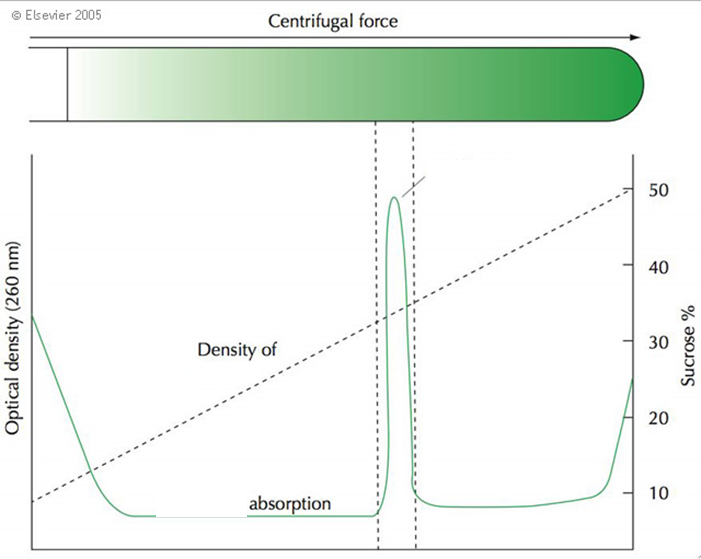
- Asucrose
- Bpurified virus
- Cultraviolet
32Physical Methods
-Spectroscopy
-Electrophoresis
-X-ray diffraction by [blank_start]crystalline[blank_end] forms of purified virus
-Nuclear magnetic resonance (NMR), Only relatively [blank_start]small[blank_end] molecules can be analysed with NMR technology.
-[blank_start]Atomic force microscopy[blank_end] (AFM)- Acrystalline
- Bsmall
- CAtomic force microscopy
33Sequencing is extremely cheap and powerful at this point. It’s relatively easy to sequence an entire virus.
Testing environmental samples is easy because of this as well to determine what viruses are present in a sample.
There are plenty of powerful algorithms now that recognize common viral sequences.
-open [blank_start]reading[blank_end] frames
-amino acid [blank_start]sequences[blank_end] of proteins
-[blank_start]control[blank_end] regions of genes
-[blank_start]secondary[blank_end] structure of proteins and nucleic acids
-molecular [blank_start]modeling[blank_end]- Areading
- Bsequences
- Ccontrol
- Dsecondary
- Emodeling
34Sequencing is extremely expensive. It’s an accurate way to sequence a virus but it comes at high cost.
- ARichtig
- BFalsch
35Viral Metagenomics
While using PCR to detect known viral genes specific to a virus, or common to multiple viruses works, it’s [blank_start]biased[blank_end].
An unbiased (or at least less biased) approach is to sequence everything in a sample.
However, most of the nucleic acid in a sample by mass is likely to be of [blank_start]non[blank_end]-viral origin.
Thus, the sample has to be prepared to maximize the chances of finding [blank_start]viral[blank_end] genome.- Abiased
- Bnon
- Cviral
36Viral Metagenomics
This has resulted in an explosion of viral data.
Most of the sequences found are not [blank_start]similar[blank_end] to any other sequences in our current databases.
This is an excellent tool to find new viruses and sequences we didn’t know existed, but it introduces a new problem. “What are these things?”- Asimilar
Informationen
- Beschreibung
- Virology (Exam I) Quiz am Unit 1, erstellt von Brooks Johnson am 25/09/2020.
- Autor
- Brooks Johnson
- Sprache
- English
- Aufrufe
- 2
- Schlagwörter
- Bewertung
- Noch keine Bewertungen Bewerte dieses Quiz