
Quiz
Chamberlain's policy of appeasement and the outbreak of WWII Quiz
Dieses Quiz enthält Fragetypen, die sich im gewohnten Player öffnen.
Fragen in diesem Quiz (19)
1Appeasement is the name often given to British foreign policy in the years 1919 to 1939, but it is particularly associated with Neville Chamberlain who became Prime Minister in 1937.
- ARichtig
- BFalsch
2What did Chamberlain want to achieve through appeasement?
- AChamberlain felt that Germany had good reason to be upset at many of the terms of the Treaty of Versailles. What he wanted to do was to find out exactly what Hitler wanted and show him that reasonable claims could be met by negotiation instead of force, thus avoiding war.
- BHe wanted to allow Hitler to increase his strength and power.
- CHe wanted to delay the outbreak of a war because economically, Britain was still suffering from the depression and could not afford any rearmament programme.
3What risks were involved in appeasement?
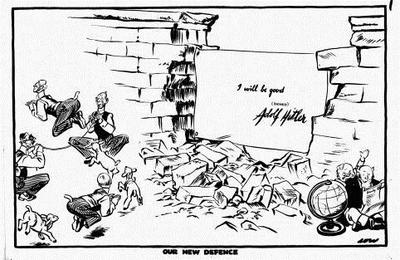
- AIt depended on Hitler’s aims being reasonable.
- BIt meant trusting Hitler and believing that he was telling the truth.
- CIt was not supported by other countries.
4Why did Hitler want to take over the Sudetenland?
- AIt was inhabited by more than 3 million German-speaking people.
- BCzechoslovakia was one of the strongest of the new states created by the treaties of 1919. It had strong, well-fortified frontiers especially in the west.
- CHe had family there.
- DThe Nazi Party in the Sudetenland had invited him to take it.
5Hitler encouraged [blank_start]Henlein[blank_end], the leader of the Nazis in the Sudetenland, to campaign for [blank_start]independence[blank_end] and riots broke out. Hitler promised Henlein that he could depend on the support of [blank_start]Germany[blank_end].
On [blank_start]15[blank_end] September 1938, Chamberlain flew to Germany to find out what Hitler wanted and met him at Berchtesgaden. There Hitler told Chamberlain that he wanted all the German-speaking parts of the Sudetenland to join Germany, but only after [blank_start]plebiscites[blank_end]. Chamberlain then got the [blank_start]support[blank_end] of France of this and Britain and France forced President [blank_start]Benes[blank_end] of Czechoslovakia to accept the deal. Bene realised that he could not depend on the support of Britain and France if Hitler invaded; only [blank_start]Soviet[blank_end] Russia promised to help Czechoslovakia.
Chamberlain then returned to Germany and, on [blank_start]22[blank_end] September, met Hitler at [blank_start]Godesberg[blank_end]. Hitler was taken by surprise; he did not expect Chamberlain to persuade France and Czechoslovakia to accept his demands. So he asked for more: the [blank_start]immediate[blank_end] occupation of the Sudetenland by Germany. There would be no plebiscites. Chamberlain, disappointed, returned to London and Britain prepared for war. In London, preparations were made for defence against [blank_start]air raids[blank_end]: trenches were dug, children were evacuated and gas masks given out. It was at this moment that Chamberlain received a note from Hitler inviting him to a conference of four powers to be held in [blank_start]Munich[blank_end].- AHenlein
- Bindependence
- CGermany
- D15
- E22
- Fplebiscites
- Gsupport
- HBenes
- ISoviet
- JGodesberg
- Kimmediate
- Lair raids
- MMunich
6Which four powers were invited to Munich?
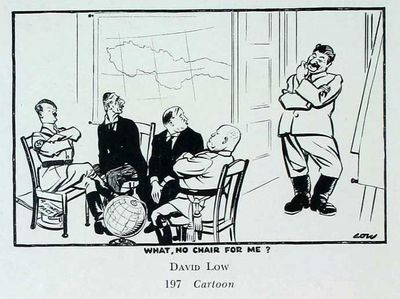
- AItaly (represented by Mussolini)
- BGermany (represented by Hitler)
- CBritain (represented by Chamberlain)
- DFrance (represented by Daladier)
- EUSSR (represented by Stalin)
- FCzechoslovakia (represented by Benes)
7At Munich on [blank_start]30[blank_end] September it was agreed that the Sudetenland would become [blank_start]German[blank_end]. Britain and France guaranteed the remaining part of Czechoslovakia. The Czechs were [blank_start]forced[blank_end] to accept this. Chamberlain then met Hitler [blank_start]privately[blank_end] and Hitler agreed to a declaration that Britain and Germany would never go to war again and that [blank_start]consultation[blank_end] not war would solve all future [blank_start]disagreements[blank_end] between them. This is the piece of paper that Chamberlain had in his hand when he returned to Britain on [blank_start]1[blank_end] October.
- A30
- B1
- CGerman
- Dforced
- Eprivately
- Fconsultation
- Gdisagreements
8The importance of the Munich Agreement
• Hitler had gained the Sudetenland without fighting.
• Czechoslovakia had been betrayed.
• Peace had been maintained by Chamberlain.
• Czechoslovakia had lost its defensive frontier and became vulnerable to invasion.
• Germany had gained the armaments and mineral resources of the Sudetenland.
• Britain speeded up rearmament.
• The USSR had been left out and felt betrayed.- ARichtig
- BFalsch
9How much of its heavy industry did Czechoslovakia lose at Munich?
- A50%
- B70%
- C90%
10Which countries, other than Germany, also began to take land from Czechoslovakia?
- APoland
- BHungary
- CLithuania
- DRomania
11In 1939, encouraged by Hitler, the Slovaks began to press for independence and, in March 1939, the Czech President, Hacha, was forced to hand Czechoslovakia over to Hitler. Hitler marched in, claiming to be restoring order. Most of Czechoslovakia came under German rule.
- ARichtig
- BFalsch
12The effect of Hitler’s takeover of Czechoslovakia
• It marked the end of [blank_start]appeasement[blank_end]: Hitler could not justify taking Czechoslovakia. There were no German speakers living there and there was no [blank_start]demand[blank_end] from the people to join Germany. Hitler could not argue that he was [blank_start]reversing[blank_end] the wrongs of the Treaty of Versailles.
• Hitler had proved to [blank_start]Chamberlain[blank_end] that he could not be trusted. Chamberlain felt personally upset with Hitler as he had not only broken the Munich agreement but had also broken the promise he made personally with Chamberlain to [blank_start]consult[blank_end] Britain before taking action that could lead to war.
• Lithuania was forced to surrender the province of [blank_start]Memel[blank_end], which had a mostly German population, to Germany. Hitler made it clear that he wanted the [blank_start]restoration[blank_end] of Danzig.
• Britain did not help Czechoslovakia but, supported by France, signed an [blank_start]agreement[blank_end] with Poland promising to help if [blank_start]Poland[blank_end] was invaded.
• Mussolini, Hitler’s ally, conquered Albania.
• Britain guaranteed the [blank_start]independence[blank_end] of Romania and Greece.
• [blank_start]Conscription[blank_end] was introduced into Britain during peace time.
• Hitler strengthened his relationship with Mussolini by signing the [blank_start]Pact of Steel[blank_end].
• Hitler withdrew Germany’s [blank_start]non-aggression[blank_end] pact of [blank_start]1934[blank_end] with Poland and the Anglo-German Naval Agreement of [blank_start]1935[blank_end].- Aappeasement
- Bdemand
- Creversing
- DChamberlain
- Econsult
- FMemel
- Grestoration
- Hagreement
- IPoland
- Jindependence
- KConscription
- LPact of Steel
- Mnon-aggression
- N1935
- O1934
13Britain and France guaranteed the frontiers of Poland against any attack however....
- A....there was no way that they could have helped Poland if it had been attacked because of the distance away from the West
- B....they did not have the money to help
- C....they did not really want to help
14Which was the only country actually able to defend Poland from attack?
- AUSSR
- BUSA
- CItaly
- DGermany
15What problem did Britain and France face during their talks with the USSR?
- AThey knew Poland was just as afraid of Soviet ambitions as they were of German plans and they did not want help from the Soviet Union. The Poles felt that is a Soviet army entered Poland to defend them against Germany, it would not leave.
- BThe USSR had no desire to help due to their suspicions of the West.
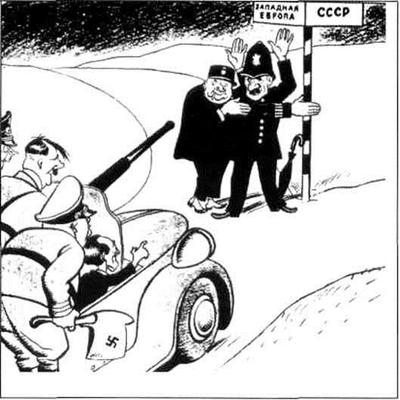
16Throughout the [blank_start]1930[blank_end]s the USSR had felt Britain had been trying to direct Hitler to the East and it is true that there were many in Britain who feared [blank_start]Communism[blank_end] more than Fascism. Evidence of this was the USSR’s [blank_start]exclusion[blank_end] from the [blank_start]Munich[blank_end] Conference when clearly the future of Czechoslovakia was important to it. In 1939 [blank_start]Britain[blank_end] and France showed no urgency in making and agreement with the USSR. This made [blank_start]Stalin[blank_end], the Soviet leader, more [blank_start]suspicious[blank_end] of their aims and led him to signing the [blank_start]Nazi-Soviet[blank_end] Pact with Hitler in August [blank_start]1939[blank_end].
- A1930
- BCommunism
- Cexclusion
- DMunich
- EBritain
- FStalin
- Gsuspicious
- H1939
- INazi-Soviet
17Why did the Nazi-Soviet Pact come as a surprise?
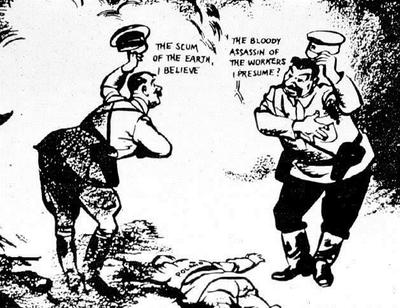
- AFascism and Communism were sworn enemies - Hitler had never hidden his opposition to Communism as expressed in Mein Kampf.
- BHitler’s ideas of Lebensraum were partly at the expense of the USSR.
- CThe Nazi-Soviet Pact went against the Anti-Comintern Pact that Hitler had signed with Italy and Japan in 1937.
- DHitler had promised not to start a war.
- EStalin was incredibly suspicious and so would never have signed a pact with Hitler.
18The Nazi-Soviet Pact meant that Hitler’s attack on Poland was inevitable. Hitler had prevented the danger of a war on two fronts, which had been the downfall of Germany in the First World War.
- ARichtig
- BFalsch
19Hitler had long wanted [blank_start]Danzig[blank_end] as its population was over [blank_start]90[blank_end] per cent German. As early as April 1939 he demanded that the Poles handed it over. Hitler believed that if he kept the [blank_start]pressure[blank_end] on Poland, Britain and France would come to a similar agreement with him as they had at [blank_start]Munich[blank_end] over the Sudetenland. He still believed that Britain and France were so [blank_start]afraid[blank_end] of war that they would back down, especially as his claim to Danzig was far more [blank_start]justified[blank_end] than any claim he had to [blank_start]Czechoslovakia[blank_end], and they had not opposed him over that. Poland, strengthened by the guarantee of [blank_start]independence[blank_end] given to them by Britain and France after the collapse of Czechoslovakia earlier in 19[blank_start]39[blank_end], refused to give in to Hitler’s demands.
Much to Hitler’s surprise, Britain warned him that it would join the war if [blank_start]Germany[blank_end] invaded Poland. There was no hope of another Munich. Hitler had gone too far. The collapse of Czechoslovakia in [blank_start]March[blank_end] 1939 proved to be the last straw for the appeasers. [blank_start]Public opinion[blank_end] in Britain was in favour of opposing Hitler. On 1 [blank_start]September[blank_end] 1939 German troops invaded Poland. On 3 September Britain [blank_start]declared[blank_end] war on Germany. Britain was unable to defend Poland, which was overrun by Germany and the [blank_start]USSR[blank_end] within four weeks. Hitler was convinced even then that Britain would accept his gains in [blank_start]Poland[blank_end] and not continue the war. He was [blank_start]mistaken[blank_end].- ADanzig
- B90
- C39
- Dpressure
- EMunich
- Fafraid
- Gjustified
- HCzechoslovakia
- Iindependence
- JGermany
- KMarch
- LPublic opinion
- MSeptember
- Ndeclared
- OUSSR
- Pmistaken
- QPoland
Informationen
- Beschreibung
- GCSE History (Steps to War) Quiz am Chamberlain's policy of appeasement and the outbreak of WWII Quiz, erstellt von Leah Firmstone am 31/10/2015.
- Autor
- Leah Firmstone
- Sprache
- English
- Aufrufe
- 826
- Schlagwörter
- Bewertung
- 4,0 von 5 · 1 Bewertung Bewerte dieses Quiz