
Quiz
EXAM 1
Dieses Quiz enthält Fragetypen, die sich im gewohnten Player öffnen.
Fragen in diesem Quiz (105)
1A theory that has won virtually universal acceptance is a:
- Amodel.
- Bhypothesis
- Claw.
- Dvariable.
2When we are forced to make choices we are facing the concept of:
- Aceteris paribus.
- Bfree goods
- Cscarcity
- Dthe margin.
3Statements that are a hypothesis or statement of fact are:
- Apecuniary.
- Bpositive.
- Cnominal.
- Dnormative
4The economic way of thinking includes:
- Amore attention paid to benefits rather than the costs involved in any choice.
- Bthe assumption that individuals choose to average out some objective.
- Cemphasis on how choices are made at the margin.
- Dthe notion that the industrialized nations have solved the problem of scarcity
5A feature that distinguishes economists' approach to making choices is (are):
- Aassigning opportunity costs a major role in their analyses of choices.
- Bassuming individuals make choices to maximize objectives
- Cemphasizing that choices are made at the margin
- Dall of the above.
6The statement that the minimum wage needs to be increased is a:
- Apositive statement.
- Bnormative statement
- Ccondition contained in the fallacy of false cause.
- Dscientific conclusion based on marginal analysis.
7Economics, generally speaking, is primarily concerned with:
- Athe operation of the bond and stock markets.
- Bhow people choose among the alternatives available to them.
- Cthe issues of income inequality or income equality.
- Dceteris paribus, the scientific method, and the margin
8The use of controlled experiments using particular substances to test hypotheses is most likely to be found in:
- Achemistry.
- Beconomics.
- Chistory.
- Dthe humanities
9Scarcity is determined by the existence of bad alternatives
- ARichtig
- BFalsch
10The value of the next-best choice not chosen is called opportunity cost.
- ARichtig
- BFalsch
11Economists are:
- Aconcerned with developing theories but not interested in solving problems.
- Binterested in solving problems but not concerned with developing theories.
- Creluctant to predict changes in variables such as prices, employment, and spending.
- Dnot always in agreement on the best way to implement policy decisions.
12Unemployment and inflation are major topics in macroeconomics.
- ARichtig
- BFalsch
13The best example of an increase in capital is:
- AThe discovery of new oil reserves.
- Bnew computer software.
- Clegal immigration of computer programmers.
- Dconversion of military facilities to civilian use
14The slope of a production possibilities curve is based on opportunity cost.
- ARichtig
- BFalsch
15The slope of a typical production possibilities curve is:
- A0.
- Bvertical.
- Cpositive.
- Dnegative.
16Suppose the economy is operating at point C. The opportunity cost of producing the fourth freight train would be:
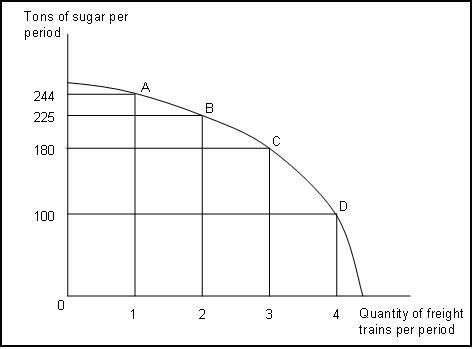
- A19 tons of sugar.
- B45 tons of sugar.
- C80 tons of sugar
- D3 freight trains.
17An economy that has the lowest cost for producing a particular good is said to have a(n):
- Atechnological advantage
- Bcomparative advantage.
- Cconvex news production possibilities curve.
- Dall of the above are correct
18A factor of production that has been produced for use in the production of other goods and services is:
- Alabor.
- Bmoney.
- Ccapital.
- Dnatural resources.
19Which of the following explains why the U.S. economy produces more than the Chinese economy?
- AThe United States buys more goods from China than China buys from the United States.
- BIn comparison to China, the United States has stronger environmental protection rules.
- CThe population of the United States is less than 1/4 the population of China.
- DThe United States has more capital per worker available than China.
20If the opportunity cost of manufacturing machinery is lower in the United States than in Britain and the opportunity cost of manufacturing sweaters is higher in the United States than in Britain, then the United States will:
- Aexport both sweaters and machinery to Britain
- Bimport both sweaters and machinery from Britain.
- Cexport sweaters to Britain and import machinery from Britain.
- Dimport sweaters from Britain and export machinery to Britain.
21Which of the following statements is false?
- AImprovements in technology make most workers worse off because they lose their jobs to capital.
- BTechnological improvements affect most industries, including oil exploration, fast-food restaurants, and pet stores.
- CWhen technology improves or changes, some jobs are lost
- DTechnological improvements that make capital more productive often leads to higher wages for labor.
22Suppose the economy is operating at point B. The opportunity cost of producing the third freight train would be:
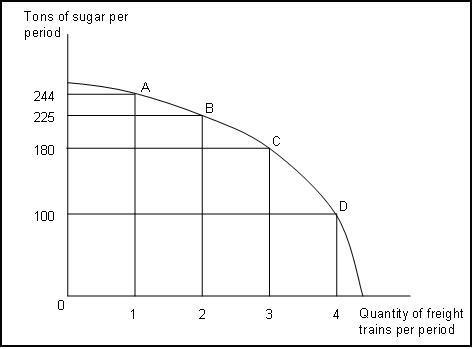
- A6 tons of sugar.
- B19 tons of sugar.
- C45 tons of sugar.
- D80 tons of sugar.
23An economy is said to have a comparative advantage in the production of a good if it can:
- Aproduce that good with more resources than another economy.
- Bproduce that good with a higher opportunity cost than another economy.
- Cproduce that good outside its production possibilities curve.
- Dproduce the good at a lower opportunity cost than another economy.
24The difference between iron ore deposits and the steel produced from these deposits that is later used to make factory equipment illustrates the difference between:
- Alabor and a natural resource.
- Blabor and capital.
- Ca natural resource and capital.
- Da natural resource and entrepreneurship.
25Britain imports some goods and exports other goods primarily because of:
- Afree goods.
- Bspecialization.
- Cunemployment.
- Dself-sufficiency.
26The North Korean economy is currently classified as a mixed economy.
- ARichtig
- BFalsch
27The concept of comparative advantage is based upon:
- Aabsolute labor productivity
- Brelative labor costs.
- Cdollar prices of labor.
- Drelative opportunity costs
28One of the two criteria for a resource to be considered capital is that it must:
- Aoccur naturally.
- Bbe part of a factory or building.
- Cbe a skill or talent possessed by a person.
- Dbe possible to use it to produce other goods and services.
29The textbook classifies technology as knowledge and entrepreneurs as persons who seek profit.
- ARichtig
- BFalsch
30In a market capitalist economy:
- Afactors of production are owned privately and decisions about their use are basically made by individuals.
- Bfactors of production are owned by the government but decisions about their use are made privately.
- Cprivate ownership exists but decisions about resource allocation are usually made centrally by the government.
- Dthere is no role for the government.
31In the textbook, the prices of the factors of production, returns from related goods, technology, expectations regarding future prices, and the number of sellers are called:
- Ademand shifters.
- Bsupply prices.
- Cmarket realities
- Dsupply shifters.
32If the price of chocolate-covered peanuts is 40 cents, the price will:
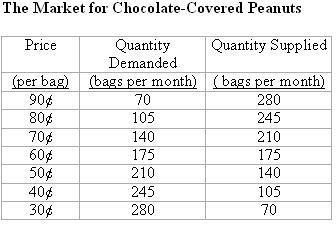
- Aremain unchanged.
- Bfall to 30 cents.
- Crise to 50 cents.
- Drise to 60 cents.
33In a competitive market, when price is below the equilibrium price, there will be pressure for the price to:
- Afall.
- Bstay the same
- Crise
- Dchange only if demand and/or supply change
34A decrease in the fee charged for videotape rentals would result in a change illustrated by:
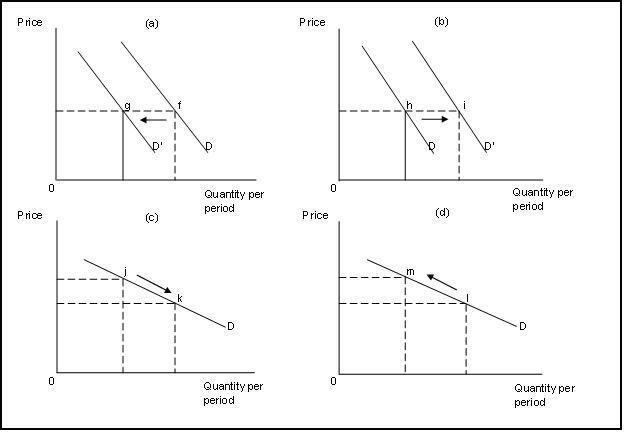
- Athe move from f to g in Figure (a).
- Bthe move from h to i in Figure (b).
- Cthe move from j to k in Figure (c).
- Dthe move from l to m in Figure (d).
35In the 1990s, the Monks of St. Benedict's the Monks determined that their [blank_start]opportunity costs[blank_end] were [blank_start]too high[blank_end] in the egg and cookie business, so they [blank_start]switched to providing private retreats .[blank_end]
- Aopportunity costs
- Bprofits
- Coperating costs
- Dtoo low
- Etoo high
- Fwent out of business
- Gopened a new business
- Hswitched to providing private retreats .
36An increase in supply is caused by:
- Aan increase in resource prices.
- Ba decrease in the number of sellers in the market.
- Csuppliers' expectations of higher prices in the future.
- Dan advancement in the technology for producing the good.
37Which of the following will not cause the demand for milk (a normal good) to increase in the current time period?
- Aa fall in the price of milk
- Ban increase in income
- Can expected increase in milk prices
- Da decrease in the price of cookies (a complement)
38If a demand curve shifts to the left, then:
- Athe equilibrium price would go up and the equilibrium quantity would go down.
- Bthe equilibrium price would go down and the equilibrium quantity would go up.
- Ca lower equilibrium price and quantity would result.
- Da higher equilibrium price and quantity would result.
39A decrease in supply is caused by:
- Aa decrease in resource prices.
- Ba decrease in the number of sellers in the market.
- Csuppliers' expectations of lower prices in the future.
- Dan advancement in the technology for producing the good.
40The price of cotton rises. What happens in the market for cotton shirts?
- AThe equilibrium price falls and the equilibrium quantity rises.
- BThe equilibrium price rises and the equilibrium quantity falls
- CThe equilibrium price and quantity rise.
- DThe equilibrium price and quantity fall.
41An increase in demand and a decrease in supply, will lead to a(n) ________ in equilibrium quantity and a(n) ________ in equilibrium price.
- Adecrease; decrease
- Bindeterminate change; increase
- Cindeterminate change; decrease
- Dincrease; indeterminate change
42A shortage will exert pressures for the price to decrease.
- ARichtig
- BFalsch
43Which of the following would result in a movement along the demand curve?
- Aa change in preferences
- Ban increase in the number of buyers
- Can increase in the number of suppliers
- Da decrease in income
44According to the textbook, demand and supply determine prices, and prices allocate scarce resources in the economy.
- ARichtig
- BFalsch
45If both the demand for a product and the supply of it increase, then the equilibrium quantity will ________ and the equilibrium price will ________.
- Adecrease; increase
- Bdecrease; decrease
- Cdecrease; remain constant
- Dincrease; either increase, decrease, or remain constant
46A negative relationship between the quantity demanded and price is called the law of ______.
- Ademand
- Bdiminishing marginal returns
- Cmarket clearing
- Dsupply
47Given the demand curve, what is the price some buyers are willing and able to pay for 3 units?
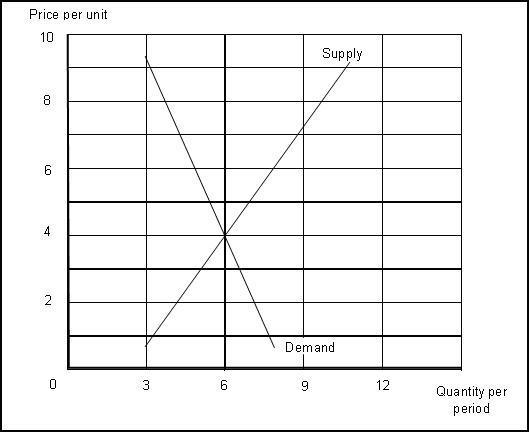
- A$2
- B$4
- C$6
- D$8
48Given the initial equilibrium of S1 and D, any price lower than ________ will create pressure for the price to ________ .
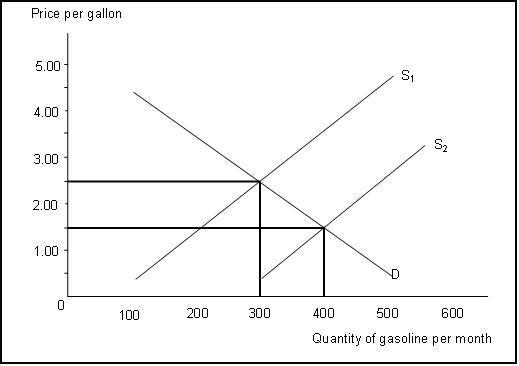
- A$2.00; fall
- B$2.50; rise
- C$3.00; rise
- Dnone of the above are true
49A price above the equilibrium price will:
- Aresult in quantity supplied being less than quantity demanded.
- Bresult in a shortage
- Ccreate pressure for price to fall.
- Dtend to rise over time..
50The equilibrium quantity and the equilibrium price are ________ bags and ________ cents.
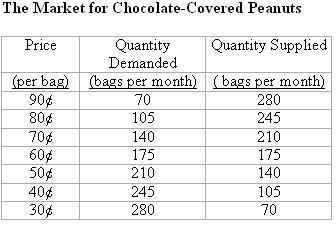
- A140; 40
- B175; 60
- C175; 80
- D210; 50
51Which of the following is a demand factor in the health-care market?
- Aproductivity in health care
- Btreatment decisions of doctors
- Cchanges in health care technology
- DAll of the above are demand factors.
52The equilibrium price established by supply and demand could be called a "just right" price because:
- Aany price above it would be "too high" and cause a shortage.
- Bany price below it would be "too low" and cause a surplus.
- Cit is the only price where the quantity demanded and the quantity supplied are equal.
- Dof all of the above.
53According to the textbook, which of the following are suggestions to limit health-care spending?
- Arequiring patients to pay a larger share
- Bgovernment regulation
- Cthe use of insurance companies that limit spending
- Dall of the above
54Technological improvements in the health-care industry have been a primary factor in the increase in health-care costs.
- ARichtig
- BFalsch
55The United States is confronted with two significant problems in health care. They are:
- Aincreasing the demand for health care and decreasing the supply of health care.
- Bthe need to build more hospitals and the slow rate of technological change in health care.
- Chealth-care cost and how to limit spending on health care.
- Dall of the above
56Third-party payer systems for health-care services include payments made by:
- Adoctors.
- Bpatients.
- Chospitals.
- Dinsurance companies.
57A market price support policy attempts to assist the farm industry by:
- Ataxing the incomes of farmers.
- Bdirectly subsidizing the incomes of farmers
- Cestablishing price floors in farm output markets.
- Dreducing the amount of resources used in farm production.
58When the price of P2 becomes available to the consumer because of insurance:
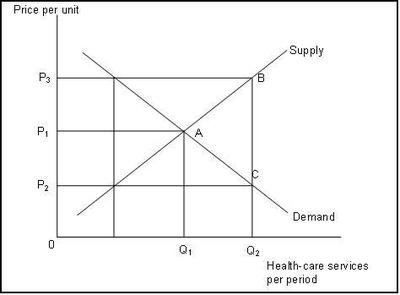
- Ahealth-care costs are now OP3BQ2, of which OP3CQ2 is paid by consumers and P2P3BQ2 is paid by insurance.
- Bhealth-care costs are now OP3BQ2, of which P2P3BQ2 is paid by consumers and OP2CQ2 is paid by insurance.
- Cthe new quantity of health care is Q2.
- Dthe new quantity of health care is Q1.
59In terms of equity, existing farm policies tend to help:
- Aall farmers equally
- Bnone of the farmers.
- Cpoor farmers more than wealthy farmers.
- Dwealthy farmers more than poor farmers
60If the government sets out to help low-income people by establishing a maximum amount for rent:
- Aa price floor has been set and a shortage of rental units may occur.
- Ba price ceiling has been set and a shortage of rental units may occur.
- Cin the long run more rental units will appear.
- Dpoor people will definitely be helped.
61The increase in the cost of health care was caused in part:
- Aby technology, which has created new and costly treatments.
- Bby doctors' receiving incomes above the market level.
- Cby the government's fixing prices in health care.
- Dbecause insurance companies have been left out of health care.
62In the market for health care:
- Aequilibrium occurs at the intersection of supply and demand, just as it does with most goods.
- Bthe effect of third-party payers decreases the price that consumers pay.
- Cproviders are encouraged to supply a greater quantity than they would without third-party payers.
- DB and C are true.
63During the 1930s, the role of the federal government in the U.S. agricultural industry:
- Aremained unchanged from the earlier decades.
- Bdecreased substantially.
- Cincreased substantially.
- Ddecreased marginally.
64A market price support policy attempts to assist the farm industry by:
- Ataxing the incomes of farmers.
- Bdirectly subsidizing the incomes of farmers.
- Cestablishing price floors in farm output markets.
- Dreducing the amount of resources used in farm production.
65Third-party payer systems are most likely to ________ the quantity of health care ________.
- Aincrease; demanded
- Bdecrease; demanded
- Cnot change; supplied
- Ddecrease; supplied
66In the stock market the demand for stocks in recent years has been greatly affected by demographic change and rising incomes.
- ARichtig
- BFalsch
67In the personal computer industry, the reason for the fall in prices and the increase in quantity after 1980 was primarily due to technological change and an increase in the number of sellers.
- ARichtig
- BFalsch
6820 percent of total health-care spending is paid by private and government insurance
- ARichtig
- BFalsch
69An arrangement in which consumers choose their health-care services while other institutions pay a share of the cost of those services is called a(n) ________ payer system.
- Aprovider fees
- Bthird-party
- Cinsurance premiums
- Dcatastrophic insurance
70The Case in Point on the Oregon Plan makes it clear that the state sets a limit on how much it will spend but not on what procedures it will cover.
- ARichtig
- BFalsch
71During the Great Depression:
- Aagriculture was hit particularly hard.
- Bprices received by farmers rose by nearly 2/3 between 1930 and 1933.
- Cfarm legislation in the 1930s sought to reduce the number of farms and farm income
- Dall of the above are true.
72Although health-care costs have increased recently in absolute terms, they have fallen as a percentage of total output.
- ARichtig
- BFalsch
73When the price of $20 per visit becomes available to the consumer because of insurance:
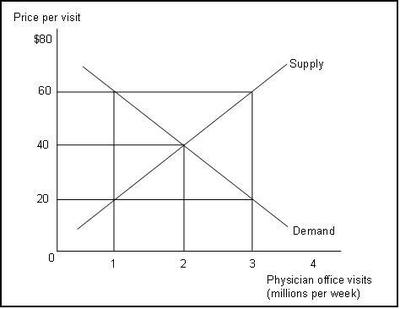
- Ahealth-care costs become $180 million, of which $60 million is paid by consumers and $120 million is paid by insurance.
- Bhealth-care costs become $180 million, of which $120 million is paid by consumers and $60 million is paid by insurance .
- Cthe new quantity of physician office visits is 1 million visits per week.
- Dboth A and C are true.
74Farm legislation has historically tried to increase farm income by:
- Aguaranteeing a minimum price to farmers.
- Bimposing limits on production.
- Cinsulating farmers from fluctuations in prices
- Ddoing all of the above.
75The price elasticity of demand for lettuce has been estimated to be -2.58. If an insect infestation destroys 10 percent of the nation's lettuce crop, how will that affect total expenditures on lettuce, all other things unchanged?
- Atotal expenditures will remain unchanged
- Btotal expenditures will fall
- Ctotal expenditures will rise
- Dnot enough information is given to answer the question
76The income elasticity of demand for peaches has been estimated to be 1.43. If income grows by 15 percent in a period, how will that affect total expenditures on peaches in that period, all other things unchanged?
- Atotal expenditures will rise
- Btotal expenditures will fall
- Ctotal expenditures will remain unchanged
- Dnot enough information is given to answer the question
77The price elasticity of demand for the segment FG is:
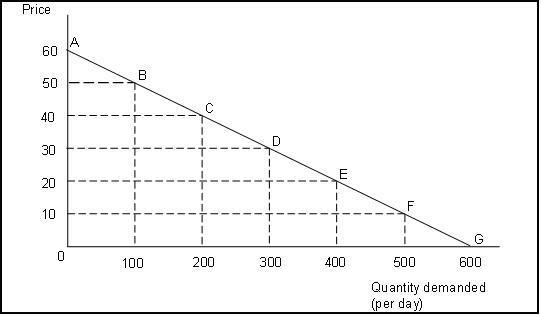
- A0.
- B0.09
- C-0.5
- Dgreater than 1 (absolute value).
78The concept of cross price elasticity of demand refers to the:
- Aratio of the percentage change in the quantity demanded of a good at a specific price to the percentage change in the price of a related good.
- Bratio of the percentage change in the price of one good to the percentage change in the quantity demanded of a related good at a specific price.
- Cratio of the price elasticity of a normal good to the price elasticity of a related good.
- Dchange in income due to a change in the price of a related good.
79If the income elasticity of demand for a good is positive, the good is said to be a(n):
- Ainferior good
- Bsubstitute good.
- Cnormal good.
- Dpositive good
80A shirt manufacturer sold 10 dozen shirts per day when the price was $4 per shirt but sold 15 dozen shirts per day when the price was $3 per shirt. Hence, the absolute value of the price elasticity of demand is:
- Agreater than zero but less than 1.
- Bequal to 1.
- Cgreater than 1 but less than 3.
- Dgreater than 3
81If the price of chocolate-covered peanuts increases and the demand for strawberries does not change, this indicates that these two goods are:
- Aunrelated goods
- Binferior goods.
- Csubstitute goods
- Dcomplementary goods.
82If an increase in income leads to a decrease in the demand for a good, then the good is said to be:
- Anormal.
- Ba luxury.
- Cinferior.
- Da staple or necessity.
83If your purchases of shoes decrease from 11 pairs per year to 9 pairs per year when the price of shirts increases from $8 to $12, then, for you, shoes and shirts are considered:
- Ainferior goods.
- Bsuperior goods.
- Csubstitute goods
- Dcomplementary goods
84The concept of price elasticity of supply can be applied to labor:
- Ato show the amount of income earned at different wage rates.
- Bto show how the quantity of labor supplied responds to changes in wages and salaries.
- Cto determine how responsive the demand for labor is to changes in wages and salaries.
- Dto do all of the above.
85An important determinant of the price elasticity of demand is the:
- Aimportance in household budgets.
- Blevel of technology
- Cquantity of the good supplied.
- Dextent of government regulation.
86Suppose the demand curve has a slope equal to negative 1. The price elasticity of demand at any point on this demand curve is:
- Ainfinite.
- Bequal to zero.
- Cgreater than 1, but less than infinite.
- Dnot described by any of the above.
87Assume the supply curve shifts to the right by a given amount at each price. Price in the market will decline the most if demand is more:
- Aprice elastic and supply is more price inelastic
- Bprice inelastic and supply is more price inelastic.
- Cprice elastic and supply is more price elastic.
- Dprice inelastic and supply is more price elastic.
88Demand is price inelastic between:

- A$0.40 and $0.50.
- B$0.50 and $0.60.
- C$0.60 and $0.70.
- D$0.70 and $0.80.
89If an increase in the price of a good leads to an increase in total revenue, then:
- Athe supply curve must be price inelastic.
- Bthe demand curve must be price elastic.
- Cthe supply curve is price elastic
- Dnone of the above is necessarily true; there is no information given regarding the price elasticity of supply.
90The cross price elasticity of demand for substitutes goods is:
- Anegative.
- Bpositive.
- Cequal to 1.
- Dpositive only for normal goods.
91If the price of emergency visits to the doctor were to rise, we would expect:
- Aa significant decline in the number of emergency visits to the doctor
- Bonly a slight decline is the number of emergency visits to the doctor.
- Cthe number of emergency visits to the doctor to stay the same.
- Dthe total income of doctors to fall dramatically.
92When the percentage change in quantity demanded is larger than the percentage change in price, demand is said to be price inelastic
- ARichtig
- BFalsch
93The price elasticity of demand for the segment BC is:
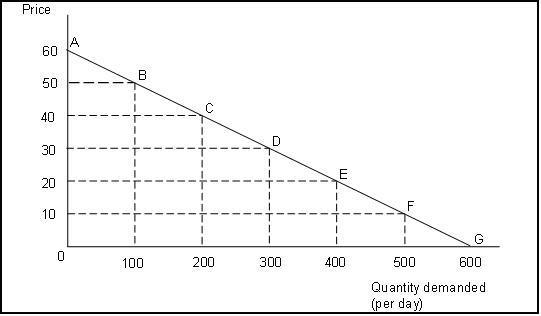
- Agreater than 3.33 (absolute value).
- B-3.33.
- C-3.
- D-0.33.
94Suppose that the cross price elasticity of demand for Mountain Dew with respect to the price of Coke is 0.7. A 10 percent increase in the price of Coke would:
- Areduce the demand for Mountain Dew by 10 percent.
- Breduce the demand for Mountain Dew by 7 percent.
- Cincrease the demand for Mountain Dew by 7 percent.
- Dincrease the demand for Mountain Dew by 10 percent.
95The income elasticity of demand for ground beef has been estimated to be -0.197. If income falls by 10 percent in a period, how will that affect total expenditures on ground beef in that period, all other things unchanged?
- Atotal expenditures will rise
- Btotal expenditures will remain unchanged
- Ctotal expenditures will fall
- Dnot enough information is given to answer the question
96Because individuals are unlikely to reveal their demand for public goods, private firms will produce a _______ quantity of public goods than is _______ .
- Asmaller; efficient
- Bsmaller; inefficient
- Cgreater; efficient
- Dgreater; inefficient
97An efficient allocation of resources implies _______ allocation of goods and services.
- Aan equitable
- Ban inequitable
- Cneither an equitable nor an inequitable
- Da maximum
98Maximizing choices must be made within parameters imposed by:
- Aa constraint.
- Ba boundary.
- Ca limit.
- Dall of the above.
99To be effective in facilitating exchange, property rights must be:
- Aexclusive.
- Bnontransferable
- Cnonexclusive.
- Ddefined to give complete freedom to the owner to use the property in any way the owner chooses.
100Suppose that the expected exam scores from studying economics for 0, 1, 2, or 3 hours are 65, 80, 90, and 95 points, respectively, while the expected exam scores for studying 0, 1, 2, or 3 hours of accounting are 50, 65, 70, and 70 points, respectively. With 3 total hours of study time, your combined scores can be maximized by spending _______ hours studying accounting.
- A0
- B1
- C2
- D3
101Common property resources have never been a serious problem in the efficient allocation of resources.
- ARichtig
- BFalsch
102Utility is the difference between a firm's revenue and its total economic cost.
- ARichtig
- BFalsch
103Which of the following statements is (are) true?
- AAn efficient allocation of resources maximizes the net benefit of each activity.
- BAn efficient allocation of resources implies that the distribution of income is equitable.
- CJudgments about equity are positive judgments.
- DA and B are true.
104A normal market supply curve reflects:
- Aprivate benefits to sellers.
- Bprivate costs to sellers.
- Csocial benefits to buyers.
- Dexternal benefits to sellers.
105If the price of popcorn is $0.50 per box and the price of peanuts is $0.25 per bag, and you have $10 to spend on both goods, the maximum quantity of popcorn that you can purchase is _______ boxes.
- A5
- B10
- C20
- D40
Informationen
- Beschreibung
- Chapters 1 - 6
- Autor
- Mau Family
- Sprache
- English
- Aufrufe
- 287
- Schlagwörter
- Bewertung
- Noch keine Bewertungen Bewerte dieses Quiz