
Quiz
S377 Chapter 16
Dieses Quiz enthält Fragetypen, die sich im gewohnten Player öffnen.
Fragen in diesem Quiz (49)
1Cell adhesion is a property of many cell types which position themselves by attaching to other cells or to the [blank_start]extracellular[blank_end] matrix using adhesion molecules in the [blank_start]plasma membrane.[blank_end]
- Aextracellular
- Bintracellular
- Cplasma membrane.
- Dcytoplasm
2Some adhesion molecules also [blank_start]transduce[blank_end] signals from the [blank_start]extracellular[blank_end] environment to the cell
- Atransduce
- Bemit
- Cextracellular
- Dintracellular
3Cell migration involves both the interaction of adhesion molecules with elements of the [blank_start]cytoskeleton[blank_end], and the coordinated attachment, [blank_start]movement[blank_end] and detachment of adhesion molecules from the extracellular matrix.
- Acytoskeleton
- Bmatrix
- Cmovement
- Dabsorbtion
4Cell [blank_start]migration[blank_end] is central to the development of eukaryotic organisms, but also occurs during tissue [blank_start]regeneration[blank_end] and repair.
- Amigration
- Bregeneration
5Many cells have the potential for motility. The [blank_start]direction[blank_end] of cell migration is determined by chemotactic signalling molecules.
- Adirection
- Bstrength
- Cspeed
6The slime mould Dictyostelium discoideum and mammalian [blank_start]leukocytes[blank_end] are the best-studied examples of mobile eukaryotic cells. The basic processes of motility are similar in all [blank_start]eukaryotes[blank_end].
- Aleukocytes
- Bepithelial
- Ceukaryotes
- Dprokaryotes
7If cells are not connected to the basal lamina or other cells as they should be (i.e. They are incorrectly positioned) , CAMs that also act as signalling molecules do not receive the survival signals. This leads to....
- ACell death by apoptosis or cell migration to the correct place
- BNothing happens
- CA party
- DCell division by mitosis
8Cadherins are adhesion molecules important in
- AOrganisation of tissues
- BMaintaining correct cell-cell contact
- CCell migration
- DImmune system
9Label the following
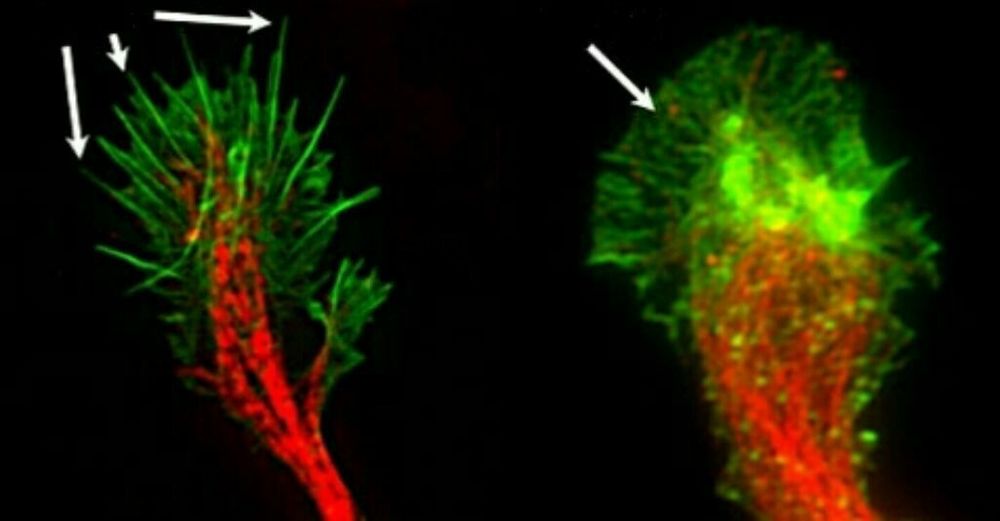
- AFilopodia
- BLamellipodia
- CPseudopodia
- DLamellipodia
- EFilopodia
- FPseudopodia
10What are these in the picture?
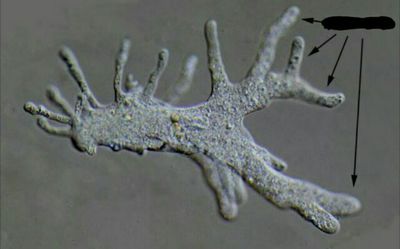
- APseudopodia
- BLamellipodia
- CFilopodia
11Put the labels in the right place
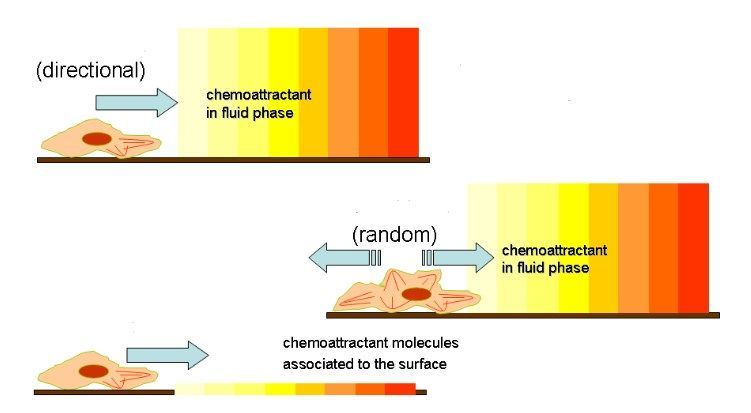
- AChemotaxis
- Bchemokinesis
- Chaptotaxis
12[blank_start]Avidity[blank_end] is the overall strength of cellular [blank_start]adhesiveness[blank_end], which is determined by the [blank_start]density and distribution[blank_end] of adhesion molecules in a localized region of the plasma membrane, and by the affinity of [blank_start]individual[blank_end] adhesion molecules.
- AAvidity
- BAffinity
- Cadhesiveness
- Ddensity and distribution
- Eindividual
13Adhesion molecules allow cells to attach to each other or the [blank_start]substratum[blank_end] or [blank_start]extracellular[blank_end] matrix.
- Asubstratum
- Bsubmarine
- Cextracellular
- Dintracellular
14[blank_start]Cadherins[blank_end] mediate cell–cell junctional adhesion via [blank_start]homophilic[blank_end] interactions, and are associated with the [blank_start]cytoskeleton[blank_end] via anchoring proteins called [blank_start]catenins[blank_end].
- ACadherins
- BIntegrins
- Chomophilic
- Dheterophilic
- Ecytoskeleton
- Fcatenins
15Cadherins interact with identical cadherins on other cells
- ARichtig
- BFalsch
16[blank_start]Integrins[blank_end] bind to other [blank_start]molecules[blank_end], not other integrins. This is [blank_start]heterophilic[blank_end] binding.
- AIntegrins
- BCadherins
- Cmolecules
- Dglues
- Eheterophilic
- Fhomophilic
17Loss of [blank_start]cadherin[blank_end] function in tumours is associated with [blank_start]malignancy[blank_end], as it means a loss of [blank_start]homologous[blank_end] cell adhesion.
- Acadherin
- Bintegrin
- Cmalignancy
- Dbenign
- Ehomologous
- Fheterologous
18Which of these are integrins present in?
- Aplants

- Bfungi

- Cmulticellular animals
- Dbacteria
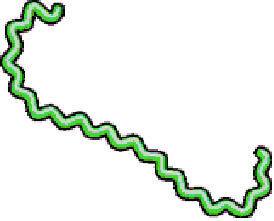
- Aplants
19Cadherins bind to [blank_start]cadherins[blank_end]. Integrins bind to [blank_start]proteins[blank_end]. Lectins bind to [blank_start]carbohydrates on glycoproteins[blank_end]. [blank_start]Selectins[blank_end] are a type of lectin.
- Acadherins
- Bintegrins
- Cproteins
- Dsugars
- Ecarbohydrates on glycoproteins
- Fnucleic acids
- GSelectins
- HCatenins
20Adhesion molecules allow cells to attach to each other or the substratum or extracellular matrix.
- ARichtig
- BFalsch
21Cadherins mediate cell–cell junctional adhesion via homophilic interactions, and are associated with the cytoskeleton via anchoring proteins called [blank_start]catenins[blank_end].
- Acatenins
22Integrins are very important in controlling cell [blank_start]adhesion[blank_end], as their affinity may be modulated by [blank_start]inside-out[blank_end] signalling.
The [blank_start]metal ion[blank_end] dependent adhesion site on the [blank_start]I/A domain[blank_end] of integrins can be present in an open or closed form, which determines whether the integrin can bind to its substrate(s).- Aadhesion
- Bmigration
- Cinside-out
- Dupside-down
- EI/A domain
- Fmetal ion
23Different integrins can bind to components of the [blank_start]extracellular matrix[blank_end] or adhesion molecules on [blank_start]other cells[blank_end]. Some integrins also transduce [blank_start]survival signals[blank_end] for anchorage-dependent cells.
- Aextracellular matrix
- Bother cells
- Csurvival signals
24[blank_start]Ig superfamily[blank_end] CAMs contain several [blank_start]extracellular Ig[blank_end] domains. By contrast with i[blank_start]ntegrins[blank_end] and c[blank_start]adherins[blank_end], binding of Ig superfamily CAMs to their ligands is independent of [blank_start]Ca2+ (or Mg2+)[blank_end].
- AIg superfamily
- Bextracellular Ig
- Cntegrins
- Dadherins
- ECa2+ (or Mg2+)
25Which of these need Ca2+ (or Mg2+) to bind to their ligands?
- AIntegrins
- BCadherins
- CIg superfamily CAMs
26C[blank_start]ollagen[blank_end], [blank_start]fibronectin[blank_end] and l[blank_start]aminin[blank_end] are important components of the ECM and [blank_start]basal laminae[blank_end], and bind to different [blank_start]β1 integrins[blank_end].
- Aollagen
- Bfibronectin
- Caminin
- Dbasal laminae
- Eβ1 integrins
- Fβ2 integrins
27I[blank_start]ntegrins[blank_end], Ig superfamily cell adhesion molecules (Ig superfamily CAMs) and s[blank_start]electins[blank_end] are all involved in [blank_start]leukocyte migration[blank_end] into tissues, each type of molecule having a different function in the process. Selectins bind to
[blank_start]carbohydrates on glycoproteins[blank_end] to tether migrating cells, whereas the interaction between integrins on the [blank_start]leukocytes[blank_end] and Ig superfamily CAMs on the [blank_start]endothelial cells[blank_end] allows the leukocyte to migrate through the [blank_start]endothelium[blank_end].- Antegrins
- Belectins
- Cleukocyte migration
- Dcarbohydrates on glycoproteins
- Eleukocytes
- Fendothelial cells
- Gendothelium
28Label the ways cells can change their adhesive properties by changing the avidity of the adhesion molecules.
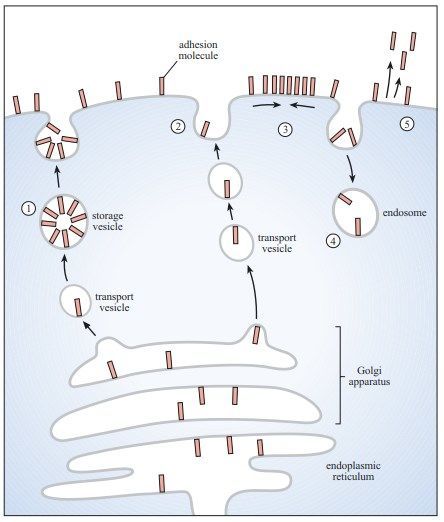
- Aadd pre-made CAMs from storage vesicle
- Bmake and add new CAMs, takes time
- Cchange grouping of CAMs
- Dremove CAMs internally
- Eshed CAMs externally
29Cells can regulate the functional activity of their adhesion molecules by changing the surface [blank_start]density[blank_end] or distribution of the molecules ([blank_start]avidity[blank_end]), and/or by modulating their [blank_start]affinity[blank_end]. e.g. the [blank_start]allosteric[blank_end] modulation of [blank_start]integrin[blank_end] affinity
- Adensity
- Bavidity
- Caffinity
- Dallosteric
- Eintegrin
30Adhesion molecules tend to cluster in high-[blank_start]avidity[blank_end] patches (which are called ‘[blank_start]focal adhesions[blank_end]’ in cell–matrix interactions).
- Aavidity
- Bfocal adhesions
31Adhesion can be rapidly modulated by changing the [blank_start]affinity[blank_end] of the individual adhesion molecules.
Alternatively, adhesion can be downregulated by [blank_start]internalizing[blank_end] or shedding adhesion molecules from the [blank_start]cell surface[blank_end].- Aaffinity
- Binternalizing
- Ccell surface
32At the leading edge of the [blank_start]pseudopod[blank_end], [blank_start]F-actin[blank_end] filaments form [blank_start]branched arrays[blank_end].
[blank_start]ARP complexes[blank_end] attach to the side of filaments and add new ones, forming branches.
[blank_start]Thymosin[blank_end] inhibits this by [blank_start]sequestering actin[blank_end]. [blank_start]Profilin[blank_end] promotes it by adding actin to the forming branches. The balance between them determines [blank_start]rate of formation[blank_end].
Actin monomers are added to the plus end, as T-form (i.e. [blank_start]Actin-ATP[blank_end]), over time it hydrolyses to D-form (i.e. [blank_start]Actin-ADP[blank_end]). [blank_start]Cofilin[blank_end] binds to [blank_start]D-form[blank_end] and helps to degrade the [blank_start]minus end[blank_end] where most of the D-form is.
Some [blank_start]plus ends[blank_end] are capped, which stops further growth. Most plus ends in [blank_start]stationary cells[blank_end] are capped.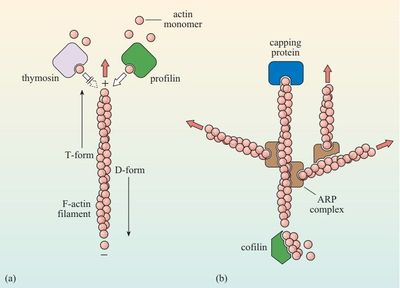
- Apseudopod
- BF-actin
- Cbranched arrays
- DARP complexes
- EThymosin
- Fsequestering actin
- GProfilin
- Hrate of formation
- IActin-ATP
- JActin-ADP
- KCofilin
- LD-form
- Mminus end
- Nplus ends
- Ostationary cells
33Adhesion molecules interact with the cytoskeleton indirectly via anchoring proteins
- ARichtig
- BFalsch
34Which of these is present in the uropod and important in the contraction of the trailing edge?
- AMyosin II
- BMyosin I
- CF-actin
35Extension of pseudopodia involves polymerization, extension and branching of [blank_start]actin[blank_end] filaments at the leading edge of the cell.
- Aactin
36Many [blank_start]adhesion molecules[blank_end], including integrins and Ig superfamily CAMs interact with [blank_start]actin filaments[blank_end] via [blank_start]anchoring proteins[blank_end]. Engagement of adhesion molecules with the [blank_start]cytoskeleton[blank_end] depends on the arrangement of the cell and whether the cell has been activated by [blank_start]extracellular signals[blank_end].
- Aadhesion molecules
- Bactin filaments
- Canchoring proteins
- Dcytoskeleton
- Eextracellular signals
37The [blank_start]ERM family[blank_end] proteins –e[blank_start]zrin[blank_end], r[blank_start]adixin[blank_end] and m[blank_start]oesin[blank_end] –act as cytoskeletal anchoring proteins for several transmembrane proteins including [blank_start]Ig superfamily CAMs[blank_end]. Following activation, these proteins switch to an [blank_start]open conformation[blank_end], which cross-links the adhesion molecule to [blank_start]actin filaments[blank_end].
- AERM family
- Bzrin
- Cadixin
- Doesin
- EIg superfamily CAMs
- Fopen conformation
- Gactin filaments
38α -Actinin, [blank_start]vinculin[blank_end] and talin are involved in cross-linking [blank_start]integrins[blank_end] to [blank_start]filaments[blank_end].
- Avinculin
- Bintegrins
- Cfilaments
39[blank_start]Myosin II[blank_end] interacts with filaments, to maintain the [blank_start]shape[blank_end] of the cell, for moving the cell [blank_start]forward[blank_end] and to move [blank_start]organelles[blank_end].
- AMyosin II
- Bshape
- Cforward
- Dorganelles
40[blank_start]Chemotactic[blank_end] molecules promote [blank_start]polarization[blank_end] of cells and [blank_start]directional[blank_end] migration. In multicellular animals, many chemotactic molecules act on [blank_start]7-helix[blank_end] transmembrane [blank_start]G protein-coupled[blank_end] receptors.
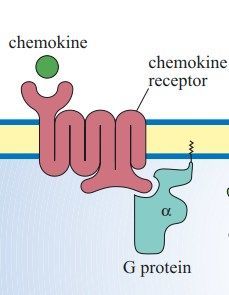
- AChemotactic
- Bpolarization
- Cdirectional
- DG protein-coupled
- E7-helix
41[blank_start]Chemokines[blank_end] are a large group of chemotactic molecules which control [blank_start]leukocyte[blank_end] migration. They have a [blank_start]glycosaminoglycan (GAG)[blank_end] binding site (GAGs may be located in the extracellular matrix or on the surface of cells),
and a [blank_start]chemokine receptor[blank_end] binding site.- AChemokines
- Bleukocyte
- Cglycosaminoglycan (GAG)
- Dchemokine receptor
42Binding of [blank_start]chemotactic[blank_end] molecules to their receptors can lead to the activation of [blank_start]PI 3-kinase[blank_end] and the [blank_start]phosphorylation[blank_end] of membrane lipids, which recruit proteins with [blank_start]pleckstrin homology[blank_end] (PH) domains to the leading edge of the cell and modulate interactions between the [blank_start]actin cytoskeleton[blank_end] and adhesion molecules.
- Achemotactic
- BPI 3-kinase
- Cphosphorylation
- Dpleckstrin homology
- Eactin cytoskeleton
43Chemokines and their receptors are not very [blank_start]specific[blank_end]. Many of the receptors will bind several types of ligand and many chemokines will bind to several different receptors. This is called [blank_start]promiscuous binding[blank_end].
- Aspecific
- Bpromiscuous binding
44Activation of GTPases belonging to the [blank_start]Rho family[blank_end] has global effects on cell morphology, the arrangement of the [blank_start]cytoskeleton[blank_end], and cell adhesion properties. Prenylation of RhoA translocates it to the plasma membrane, where it can be activated by GTP binding and modulate the F-actin network by formation of focal adhesions.
- ARho family
- Bcytoskeleton
45Molecular interactions between the [blank_start]signalling pathways[blank_end] induced by different [blank_start]chemotactic receptors[blank_end] allow cells to regulate their overall patterns of [blank_start]migration[blank_end] within the complex gradients of chemotactic (or repellent) molecules that may be found in vivo .
- Asignalling pathways
- Bchemotactic receptors
- Cmigration
46[blank_start]Slit[blank_end] proteins expressed on the cell surface are [blank_start]repellent[blank_end] proteins that act on [blank_start]Robo receptors[blank_end] and can prevent [blank_start]cell movement[blank_end] into tissues expressing the Slit proteins. Slits and Robos are widely and transiently expressed during [blank_start]development[blank_end], and are still present in the adult in many tissues.
- ASlit
- Brepellent
- CRobo receptors
- Dcell movement
- Edevelopment
47[blank_start]Matrix metalloproteases[blank_end] (MMPs) are secreted by [blank_start]migrating cells[blank_end], which allows them to move through tissues by [blank_start]cleaving molecules[blank_end] of the extracellular matrix.
- AMatrix metalloproteases
- Bmigrating cells
- Ccleaving molecules
48[blank_start]Metalloprotease disintegrins[blank_end] (ADAMs) interfere with [blank_start]intercellular adhesion[blank_end], and also can facilitate leukocyte [blank_start]motility[blank_end].
- AMetalloprotease disintegrins
- Bintercellular adhesion
- Cmotility
49MMPs and ADAMs are [blank_start]inhibited[blank_end] by tissue inhibitors of metalloproteases ([blank_start]TIMPs[blank_end]). The balance of the enzymes and inhibitors is important in controlling cell [blank_start]motility[blank_end] and tissue [blank_start]remodelling[blank_end].
- Ainhibited
- BTIMPs
- Cmotility
- Dremodelling
Informationen
- Beschreibung
- Quiz based on the summaries of Chapter 16
- Autor
- Mikki M
- Sprache
- English
- Aufrufe
- 36
- Schlagwörter
- Bewertung
- Noch keine Bewertungen Bewerte dieses Quiz