
Quiz
Bio Chapter 11 Quiz 1
Dieses Quiz enthält Fragetypen, die sich im gewohnten Player öffnen.
Fragen in diesem Quiz (34)
1Each pea-plant gamete has how many alleles for the height gene?
- A1
- B2
- C3
- D4
2A mule is the result of a cross between a donkey and a horse. A mule is a
- Aphenotype
- Bhybrid
- Cgenotype
- Dtetrad
3If a pea plant has a recessive allele for green peas, it will produce
- Agreen peas if it also has a dominant allele for yellow peas.
- Byellow peas if it does not also have a dominant allele for green peas.
- Cboth green peas and yellow peas if it also has a dominant allele for yellow peas.
- Dgreen peas if it does not also have a dominant allele for yellow peas.
4When Gregor Mendel crossed a tall plant with a short plant, the F1 plants inherited
- Afour alleles from each parent
- Bthree alleles from each parent
- Ctwo alleles from each parent
- Done allele from each parent
5When you flip a coin, what is the probability that it will come up tails?
- A1/4
- B1/8
- C1/2
- D1
6The principles of probability can be used to
- Adecide which organisms are best to use in genetic crosses.
- Bdetermine the actual outcomes of genetic crosses.
- Cpredict the traits of the offspring of genetic crosses.
- Ddetermine which species should be used in genetic crosses.
7A heterozygous tall pea plant is crossed with a short plant. The probability that an F1 plant will be tall is
- A75%
- B25%
- C100%
- D50%
8Organisms that have two identical alleles for a particular trait are said to be
- Adominent
- Bheteorzygous
- Chybrid
- Dhomozygous
9In the Punnett square shown in Figure 11–1, which of the following is true about the offspring resulting from the cross?
(T=tall and t=short)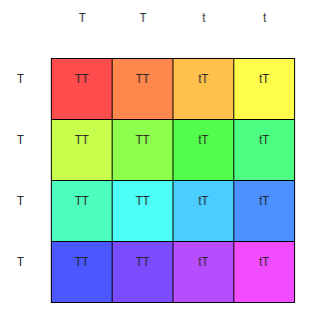
- AAll are expected to be short.
- BAll are expected to be tall.
- CAbout three fourths are expected to be tall.
- DAbout half are expected to be short.
10If a pea plant’s alleles for height are tt, what is true of its parents?
- ABoth parents were short
- BBoth parents contributed a recessive allele.
- CBoth parents were tall
- DBoth parents contributed a dominant allele.
11A tall plant (TT) is crossed with a short plant (tt). If the tall F1 pea plants are allowed to self-pollinate,
- Aall of the offsprings will be tall
- Bthe offspring can be either tall or short
- Cthe offspring will be of medium height.
- Dall of the offsprings will be short
12What principle states that during gamete formation genes for different traits separate without influencing each other’s inheritance?
- Aprinciple of probabilities
- Bprinciple of segregation
- Cprinciple of independent assortment
- Dprinciple of dominance
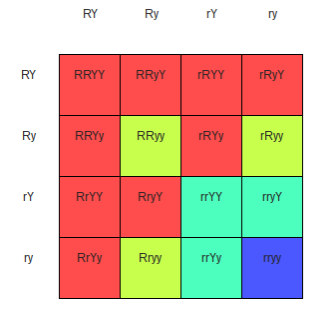
13The Punnett square in Figure 11–2 shows that the gene for pea shape and the gene for pea color
- Aare linked.
- Bare always homozygous.
- Chave the same alleles.
- Dassort independently.
14How many different allele combinations would be found in the gametes produced by a pea plant whose genotype was RrYY?
- A2
- B4
- C8
- D16
15Use Figure 11–3 to answer the following question. If a pea plant that is heterozygous for round, yellow peas (RrYy) is crossed with a pea plant that is homozygous for round peas but heterozygous for yellow peas (RRYy), how many different phenotypes are their offspring expected to show?
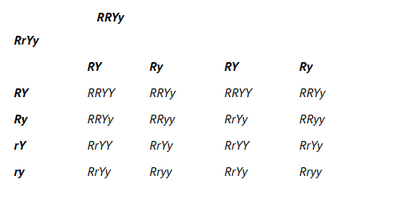
- A8
- B2
- C16
- D4
16Gregor Mendel’s principles of genetics apply to
- Aanimals only.
- Ball organisms.
- Cplants only.
- Dpea plants only.
17Why did Thomas Hunt Morgan use fruit flies in his studies?
- AFruit flies produce a large number of offspring.
- BFruit flies share certain characteristics with pea plants.
- CFruit flies have a long life span.
- DFruit flies take a long time to produce offspring.
18A trait is a specific characteristic that varies from one individual to another.
- ARichtig
- BFalsch
19True-breeding plants that produced axial flowers were crossed with true-breeding plants that produced terminal flowers. The resulting offspring all produced terminal flowers because the allele for terminal flowers is recessive.
- ARichtig
- BFalsch
20During the formation of gametes in a hybrid tall plant, the tall allele and the short allele stay together.
- ARichtig
- BFalsch
21The principles of probability can explain the numerical results of Mendel’s experiments.
- ARichtig
- BFalsch
22The probability that a gamete produced by a pea plant heterozygous for stem height (Tt) will contain the recessive allele is 100%.
- ARichtig
- BFalsch
23A trait in an unidentified plant is controlled by one gene that has two alleles. One allele is dominant over the other. According to Mendel’s principles, one fourth of the offspring made from a cross between two heterozygous plants will show the recessive trait.
- ARichtig
- BFalsch
24The plants that Gregor Mendel crossed to produce the F1 generation made up the [blank_start]____________________[blank_end] generation.
- AP
25What is the probability of flipping a coin and getting heads 5 times in a row?
- A1/2
- B1/4
- C1/8
- D1/16
- E1/32
26In the Punnett square shown in Figure 11–1, the genotypes of the offspring are [blank_start]____________________[blank_end].
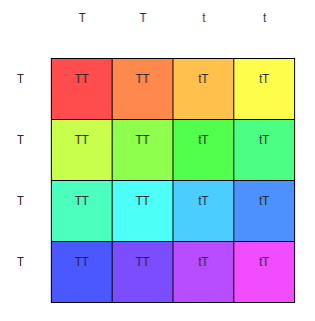
- ATT and Tt
27If pea plants that are homozygous for round, yellow seeds (RRYY) were crossed with pea plants that are heterozygous for round, yellow seeds (RrYy), the expected phenotype(s) of the offspring would be [blank_start]_________________________[blank_end].
- Around and yellow
28What is the phenotype ratio of the offspring of the plants in the Punnett square in Figure 11–2?
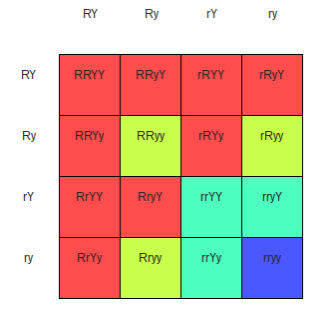
- AThe phenotype ratio is 9 round, yellow seeds : 3 round, green seeds : 3 wrinkled, yellow seeds : 1 wrinkled, green seed.
- BThe phenotype ratio is 3 round, yellow seeds : 9 round, green seeds : 3 wrinkled, yellow seeds : 1 wrinkled, green seed.
29A tall pea plant with yellow seeds is heterozygous for height and seed color (TtYy). This plant is crossed with a pea plant heterozygous for height but homozygous recessive for seed color (Ttyy). If 80 offspring are produced, how many are expected to be tall and have yellow seeds?
- A70
- B50
- C10
- D30
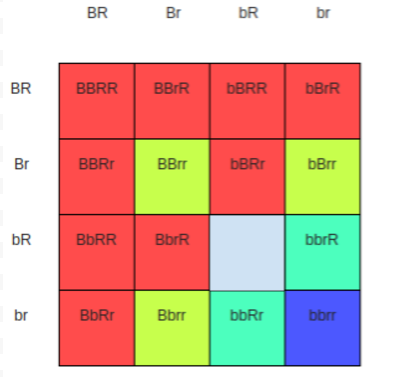
30Interpret Tables Identify the genotype of the offspring that would be represented by the blank space in Figure 11–6.[blank_start]t[blank_end]
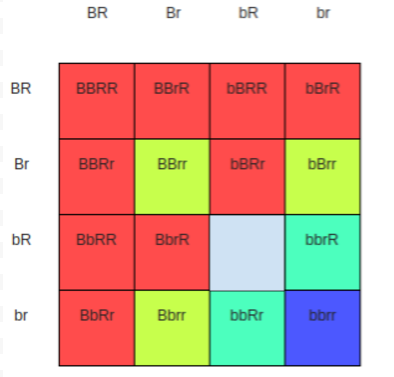
- AbbRR
31Interpret Tables Identify the phenotype of the offspring represented by the blank space in Figure 11–6.[blank_start]t[blank_end]
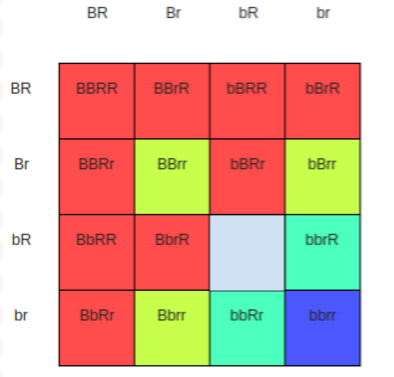
- AWhite and Rough hair
32
Analyze Data In Figure 11–6, what are the different phenotypes of the offspring?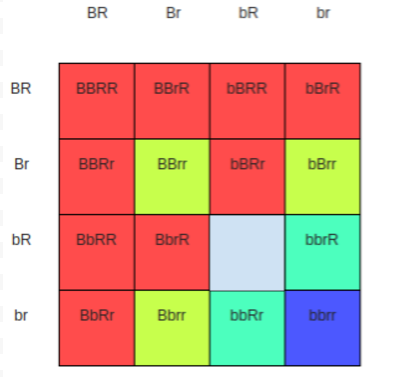
- Awhite with rough hair
- Bblack with smooth hair
- Cwhite with smooth hair
- Dbrown with smooth hair
- Eblack with rough hair
- Fbrown with rough hair
33Analyze Data In Figure 11–6, what are the genotypes of the offspring that have black, rough hair?
- AbbRR
- BBbRR
- CBBrr
- Dbbrr
- EBBRR
- FBBRr
- GBbRr
- HBbrr
34Calculate What fraction of the offspring in Figure 11–6 would be expected to have white, smooth hair?[blank_start]d[blank_end]
- A1/16
Informationen
- Beschreibung
- Biology Quiz am Bio Chapter 11 Quiz 1, erstellt von Jack Alkema am 20/12/2016.
- Autor
- Jack Alkema
- Sprache
- English
- Aufrufe
- 155
- Verlauf
- Erstellt am 20 Dez 2016 · aktualisiert am 5 Jan 2017
- Schlagwörter
- Bewertung
- 4,0 von 5 · 2 Bewertungen Bewerte dieses Quiz