
Optimization
Folien in diesem Satz (4)
-
- Your first aim with an optimization question should be to create your own equation (e.g. for the area or an unknown length)
- If you are given a shape, you should also consider the net / unfolded version of the shape to help with the above
- When differentiating, dy/dx may change to become something like dA/dy
- We differentiate in an optimization questions to find stationary points ; we find 2nd derivative to find minimums or maximums.
- Remember to use all values / equations made or found together.
-
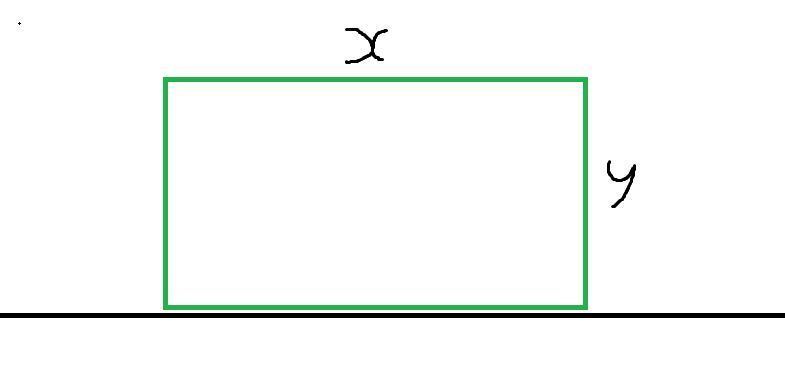
- A farmer has 20m of flexible fencing. It's connected to an established wall to from a rectangular field. Maximise the area of the field (use diagram to help).
- 20m = 2y+x , so x=20-2y. The area A=xy, so A=y(20-2y) and A=20y-2y^2.
- dA/dy of 20y-2y^2 = 20-4y , and at a stationary point dA/dy must = 0, so 20-4y=0 , 20=4y , y=5. So if y=5 then if x=20-2y , x=10.
- Therefore 5x10=50m^2, which is the area (as xy=A).
- To determine it's a maximum, we do d^2A/dy^2 = -4 which is <0, so therefore is a local maximum at y=5.
- Bildunterschrift: Ignore bottom green line
-
- Context...... P=0.67t^3-13.32t^2+70t+207. Find the minimum value of t
- dp/dr = 2.01t^2-26.64t+70=0 , solve for t=9.64 or 3.61
- d^2p/dr^2=4.02t-26.64=0 , sub in 9.64 and 3.61 to determine whether minimum or maximum; 4.02(9.64)-26.64 = -12/.1 and 4.02(3.61)-26.64=-12/.1. This tells us the minimum is t= 9.64 as -12.1<0, and d^2p/dr^2<0 at a minimum.
-
- y=-1/5x is normal to the curve y=x(rootx)-x+c. Find the value of c.
- First rewrite y=x(rootx)-x+c as y=x^(3/2)-x+c. Now differentiate to get dy/dx = 3/2x^(1/2)-1.
- We can find the gradient of the tangent to the curve by saying -1/5 x 5 = -1 , therefore =5. Now sub in y=5 to the equation, so 5=3/2x^(1/2)-1, which can be solved to get x=16. Now we have the value of x, we can sub this into y=-1/5x, so y=-1/5 x 16, y=-16/5.
- Finally we sub these back into the original equation to find c; -16/5 = 16(root16)-16+c , c=-16/5-16(root16)+16 , c=