
Groups, Formal Organizations and Bureacracy
Folien in diesem Satz (11)
-
- Groups we are apart of tend too have an influence on us
- ex. choice of outfit to wear daily, hair style
- Ones Family has a influence in adult life
- ex. choice of political party
- Phillip Zimbardo- when confronted with con, forming in the group, people jump to the "but no me" (not me syndrome) but actually do.
-
- - 9 guards, 9 prisoners; Guards had no instructions on what they their job was
- - Prisoners were awaken by guards to do "counts"; this is where the guards exercise their authority
- - pushsups were used as a form of punishment
- -prisoners began cursing at guards
- - one prisoner began suffering from acute emotional disturbance, disorganized thinking, uncontrollably crying, and rage.
- -
-
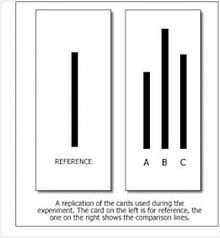
Solomon Asch's Confromity Experiment
- Bildunterschrift: Asch's experiment shows that when asked which line was the same length as the reference line, 1/3 of the students went with the wrong answer because that was what the majority said was corrent
- Even with the smallest social pressure, people will conform with the majority.
-
- Milgram studied how an authoritative figure can stimulate conformity.
- In the first experiment, 65 percent of the teachers went up to 450 volts to shock the "students" when the researcher told them to continue.
-
The Iraqi Prisoners at Abu Ghraib
- In 2004, US soldiers tortured Iraqi prisoners due to orders they felt were given both directly and indirectly.
-
- e.g. major government policies are a result of group think
- Deindividualization:
-
- Formal organizations are formed to accomplish particular tasks and are characterized by their relatively large size.
- e.g. The Federal Government--> each organization designed to accomplish certain tasks.
- - develop cultures and routine practices
- -people can form to expect patterns of behavior
- -can be used as a tool for innovation
- Normative organizations (voluntary organization) obtain personal satisfaction, but no monetary reward.
- -Gender, class, race, and ethnicity play a role
-
- - large in size, complex and impersonal. The best way to administer a complex society.
- e.g, Microsoft, Disney
- Max Weber's ideal type of Bureaucracy is characterized by:
- 1.High degree of division of labor and specialization 4. Impersonal relationships
- 2. Hierarchy of authority 5. Career Ladder
- 3. Rules and regulations 6. Efficiency
-
- The informal culture whereby the administrators and secretaries bend the rules where it appears that they show more authority than their salaries suggest.
-
- Organizational ritualism--> rigid adherence to rules can result in a slavish following of them
- Alienation--> the stresses on rules and procedure can end up psychologically separating a person from the organization and goals.
-
- George Ritzer developed the term Mcdonalization in order to refer to how the fast-food business has been adopted all over the world.
Informationen
- Beschreibung
- 1 Sociology Folienset am Groups, Formal Organizations and Bureacracy, erstellt von Kome Ekor am 30/03/2016.
- Erstellt von
- Kome Ekor
- Aufrufe
- 859
- Bewertung