
Powerpoint
Folien in diesem Satz (3)
-
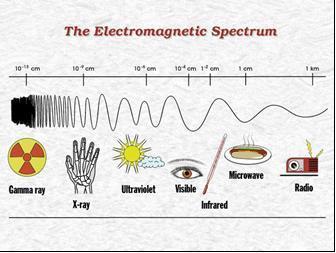
- Electromagnetic waves have an electric field and associated magnetic field at right angles. They do not need a medium to travel across therefore they can travel through a vacuum. For example space in a vacuum and light travels from the sun to use via space. All electromagnetic waves travel at the same speed traveling through a vacuum - 3x10(8) ms-1. ( The speed of light)Electromagnetic waves travel around the same speed in air however they slow down significantly in liquid and solids - around three- quarters in water and two thirds in glass.
- From radio waves to gamma waves :
- The wave length decreases
- The Frequency increases.
- Bildunterschrift: figure 1
-
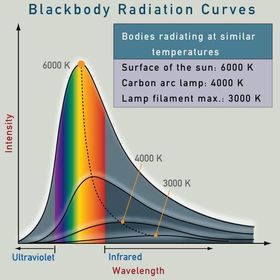
- All bodies emit Electromagnetic radiation , some objects are so hot they emit radiation in the visible part of the spectrum- on object so hot they glow red or white. even cold object emit radiation though they have shorter the wavelength in the infrared part of the spectrum. objects don't emit radiation in one wavelength . they emit a wide continuous spectrum of wavelengths and corresponding frequencies. Spectrums are often shown as a graph shown in Graph 1 . This shows the wavelength and intensity difference between the sun and an everyday filament lamp.
- notes:
- The intensity of radiation at all wavelengths goes up
- The peak wavelength is lower.
- Bildunterschrift: graph 1
-
- A perfect Black Body is a type of radiation where a object can emit and absorb all wavelengths in the electromagnetic spectrum. objects that are grey or white emit less radiation than black objects for example to worst emitters are shinny- white - black being the best emitters.
- How are thermal images made?
- Thermal imaging cameras are sensitive to radiation in the electromagnetic spectrum. warmer object often give off infrared radiation this is detected by the thermal camera as cooler areas give off less infrared radiation. this display gives of either grey scale or false colour for each temperature. This is called a Thermogram.
- Resolution
- The resolution of images is a measure of how much detail we can see.
- Spatial resolution- The smallest size that can detected by a camera. The factor that limits spatial resolution is wavelength . we cannot distinguish different objects closer together than the wavelength are viewing them in.
- Thermal resolution - This is the smallest temperature that can be detected by a camera. If two objects are the same temperature then we cannot distinguish between them.
Informationen
- Beschreibung
- A-Level Applied science (Section 2- Electromagnetic Spectrum) Folienset am Powerpoint , erstellt von kaysha123 am 24/05/2016.
- Erstellt von
- kaysha123
- Aufrufe
- 3
- Bewertung