
Lollardy

Folien in diesem Satz (10)
-
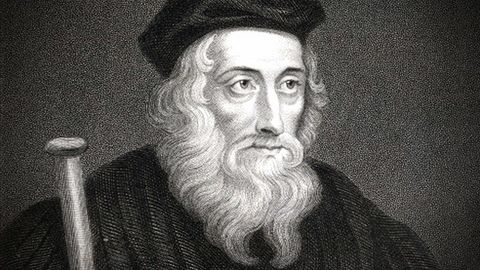
- Bildunterschrift: Did they impact the Reformation?
-
- Lollardy was founded by Wycliffe, a philosopher and theologian who criticised the Catholic Church.
- Lollardy emerged in England in the second half of the 14th Century, and was widespread up to the beginning of the 15th century.
- It was considered heresy,
- It was a small minority of mainly peasants who were critical of the church and enraged by its corruption.
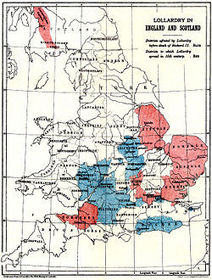
- It persisted in parts of Southern England, such as Buckinghamshire and other areas of the South East.
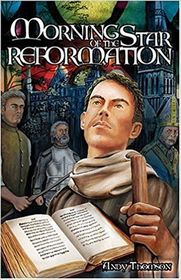
- Bildunterschrift: He is known as the ‘morning star of the reformation’
-
- Wycliffe elaborated that:
- The King was as much God's vicar as the Pope.
- This would correspond to Henry VIII's views in the future.
- The only record of beliefs is The Twelve Conclusions of Lollardy.
- In Fox's Book of Martyrs, it is evident that the Lollards survived into the 1530s
-
Where else was Lollardy found?
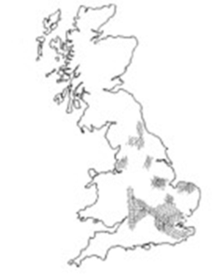
- Buckinghamshire, as previously mentioned, was one of the areas of the South East where Lollardy was found.
- 'Spread from universities and London’ - Derek Wilson
- It was passed down through families and spread by intermarriage
- It was not only the peasantry that took to it - it was among yeoman farmers, small tradesmen and craftsmen also, all of whom may have felt bitterly against the corruption and privilege of the bishopric.
-
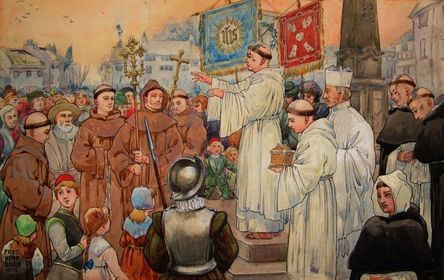
- Some examples of Lollard beliefs are:
- - Condemnation of pilgrimage and offerings to images
- - equation of the Pope as an antichrist
- - Placed stress on the understanding of the Bible and believed everyone should have access to a Bible in their own language.
- - considered Catholic Church corrupt
- - sceptical about the Eucharist and transubstantiation
- - denied idea of the special status of priesthood
-
Issues they found with the Church
- 1) Pluralism (having more than one parish) and absenteeism (not being present in a diocese)
- 2) Simony (such as when HVII raised £200 for the Archbishopric of Buckinghamshire)
- 3) Clerical misconduct, such as in the case of Richard Hunne 1514, of who it was believed was tortured to death
- 4) Wolsey was a representative of the corruption of the Church
- 5 ) Fundamental flaws with Catholic teachings, such as transubstantiation
- Wilson --> 'as some of their critics confessed, many of these heretics [Lollards] knew the Bible better than their parish clergy did'
-
- Their views were considered heresy and some were punished for this crime.
- Popularity decreased after the failed Lollard uprising of 1414, many years before the reign of Henry VII or Henry VIII
- Became geographically restricted and lost intellectual coherence
- The bulk of its followers were peasants who were of little wealth or power
- Priests retained support of most members of laity.
- Quite seditious and socialist views - would not complement the beliefs of many.
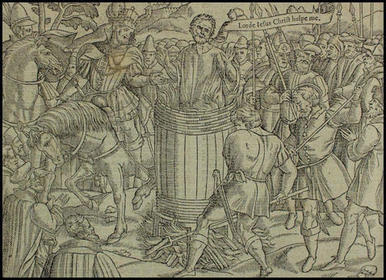
- Bildunterschrift: The burning of heretics was introduced in 1401 - Lollards placed their lives at risk
-
Lollards during Henry VIII's reign
- To what extent were they present?
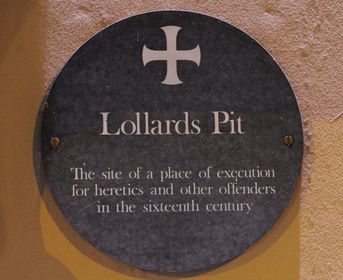
- 310 Lollards were recorded to have been burned in the Diocese of London 1510-1532
- John Hacker, a leading Lollard in London, distributed heretical books from 1520
- From 1521 he was linked with the Buckinghamshire Lollards, and his associates in London had connections with the Colchester Lollards.
- There was a network forming through England
-
- Bishop Cuthbert of London (of who replaced Wolsey) called Lutheranism the foster-child of Wycliffe heresy
- They had been linked with nobility and the crown in the past, having been protected by John of Gaunt around 1370 - 1380.
- The Lollards set the principle to other movements of criticising the church, and Protestant groups in later years such as the Baptists, Puritans and Quakers show a continuation of Lollard ideas
-
- Elton --> Lollardy had no part in Reformation
- Cross --> Even when Lollardy had its widest appeal, idealists never intended that the Church should be deprived of its surplus wealth for the good of the state.
- Dickens --> 'The ground for humanism was prepared by Lollardism'
- Cross --> In some parts of England there reappeared a surprisingly vigorous strain of Lollardy
Informationen
- Beschreibung
- AS level History Folienset am Lollardy, erstellt von Lauren Bradford am 13/03/2017.
- Erstellt von
- Lauren Bradford
- Aufrufe
- 102
- Tags
- Bewertung