
Required Practicals - AQA A Level Chemistry
Folien in diesem Satz (11)
-
AQA A-LEVEL CHEMISTRY PRACTICALS
- Bildunterschrift: Any numbers mentioned in methods are examples of quantities such as concentration, volume, e.t.c
-
- Paper 3 assesses:
- Any content
- Any practical skills
- Weighting:
- 2 hours
- 90 marks
- 30% of A-level
- The marks available consist of the following:
- 40 marks on practical techniques and data analysis (short and long answers)
- 20 marks of testing throughout the entire specification (short and long answers)
- 30 marks of multiple choice questions
-
- Making up a volumetric solution and carrying out a titration
- Measurement of an enthalpy change
- How temperature affects rate of reaction
- Carrying out test-tube reactions to identify cations and anions in solution
- Distillation of a product from a reaction
- Tests for an alcohol, aldehyde, carboxylic acid and alkene
- * Other practicals may be mentioned that are not strictly on the specification but are useful to know
-
Making up a Volumetric Solution
- Weigh a clean dry weighing boat.
- Place weighing boat on the pan of a digital balance and place the mass in the weighing boat using a spatula. Record the mass.
- Pour the contents into the weighing boat and re-weigh the weighing boat to calculate the precise mass transferred.
- Add approximately 100cm3 of deionised water to the beaker containing the solid and use a glass rod to stir the contents until the solid has dissolved.
- Using a funnel, pour the contents of the beaker into a volumetric flask and then use the wash bottle to rinse the beaker, funnel and glass rod into the volumetric flask.
- Make the volumetric flask up to the graduated mark by carefully adding deionised water from the wash bottle.
- Use a teat pipette to add the final drops to ensure that the bottom of the meniscus is on the line.
- Stopper the volumetric flask and shake the contents.
- Use the mass used and the volume to work out the conentration of the solution.
-
- Pour the solution into a clean, dry beaker and use a small volume of this solution to rinse the burette before filling it with the solution. Record the initial volume in the burette.
- Rinse a 25cm3 pipette with the other solution provided and then, using a pipetter filler, pipette exactly 25cm3 of the solution into a 250cm3 conical flask (which was previously rinsed with deionised water)
- Add 2/3 drops of phenolphthalein indicator to the solution in the conical flask and note the colour of the indicator in alkali.
- Titrate the contents of the conical flask by adding the solution to it from the burette. Add the solution slowly, swirling the flask gently to mix the solution. Add the solution dropwise near the end-point until the indicator undergoes a definite colour change; this is the end-point of the titration.
- Report the final burette reading in your table of results.
- Repeat the titration until concordant results have been reached.
-
- Enthalpy change between two solutions:
- An acid reacts at a 1:1 ratio with a base
- Using a measuring cylinder, a student measured out 50cm3 of a 0.950 moldm-3 solution of the acid

- Bildunterschrift: (Terrible) graph produced from enthalpy data. This can allow extrapolation to find the temperature at T=0.
-
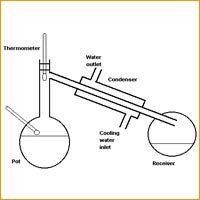
- Heat mixture to just above boiling point
- Make sure top is closed to stop mixture escaping
- Collecting vessel should be cooled so product does not evaporate
-
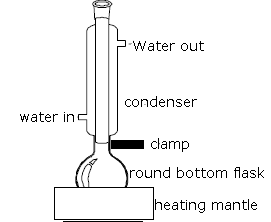
- Closed top prevents mixture escaping
- All liquids in mixture are completely oxidised as any products produced fall back into the mixture
- Liquids in mixture are heated for a prolonged amount of time to ensure complete oxidation
-
- Measuring rate of reaction:
- - By an initial rate method
- - By a continuous monitoring method
- Measuring the EMF of a electrochemical cell
- Investigating the pH change in an acid-base titration
- Preparation of:
- - A pure organic solid and test of its purity
- - A pure organic liquid
- Carry out simple test tube reactions to identify transition metal ions
- Separation of species by thin-layer chromatography
- * Other practicals may be mentioned that are not strictly on the specification but are useful to know
-
- Product dissolved in minimum hot water or other solvent so crystals form when the solution produced is cooled
- Hot solution is then filtered through hot filter into a conical flask
- Flask should be cooled in ice water to ensure high yield
- Crystals formed then filtered off using Buchner funnel and the crystals are compressed to ensure air passes through crystals not around them
- Cold water is then passed through crystals to remove soluble impurities
Informationen
- Beschreibung
- Methods for required practicals in the A Level spec, mainly useful for paper 3
- Erstellt von
- Megan Trevor
- Aufrufe
- 197
- Bewertung