
Karteikarten
Unit 2 Video Terms
Karten in diesem Stapel (49)
- 1AtomsThe fundamental units of matter that all matter is composed of.
- 2The number of different types of Atoms118
- 3ElementsThe different types of atoms, of which there are 118.
- 4Atom MakeupAtoms contain three types of particles - positively charged particles, negatively charged particles, and neutral particles.
- 5Atom Net ChargeAtoms have no net charge. The number of positively charged particles equals the number of negatively charged particles.
Positive 2 + Negative 2 = 0 - 6Atom Particle Arrangement1. A dense positively charged nucleus,
2. A cloud-like smear of negative charge that surrounds the nucleus. - 7NucleusA structure of the Atom. Densely charged. Positively charged protons and neutral neutrons are located here. Proportionally small in volume. Heavy.
- 8Nucleus SurroundA cloud-like smear of negative charge that surrounds the nucleus. Negatively charged electrons are located here. Electrons make up a very insignificant portion of the mass of the atom.
- 9Atomic NumberThe number of protons plus neutrons of an element.
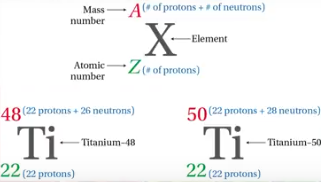
Mass Number = # of Protons + # of Neutrons
Usually written as a superscript before the chemical symbol.
Ignores electrons, as their mass is insignificantly small. - 10ProtonsPositively charged particles found in the nucleus of the atom.
- 11NeutronsNeutrally charged particles found in the nucleus of the atom.
- 12ElectronsNegatively charged particles found in the 'cloud' surrounding the nucleus of the atom.
- 13HydrogenH, contains 1 proton, usually has no neutrons, and is the smallest of the elements.
- 14LithiumLi, Atomic Number 3, contains 3 protons and electrons, contains 4 neutrons.
- 15CalciumCa, Atomic Number 20, contains 20 protons and electrons.
- 16Proton and Neutron MassProtons and Neutrons have the same mass, both are 1 atomic mass unit.
- 17Atomic Mass UnitA unit of mass used to express atomic and molecular weights, equal to one-twelfth of the mass of an atom of carbon-12. It equals to approximately 1.66 x 10^-27 kg.
- 18The Periodic TableOriginally developed by Dmitri Mendeleev in 1869, used to organize Elements.
Moving from left to right across the Periodic Table, the number of protons and electrons increases. - 19PeriodsHorizontal rows in the Periodic Table used to organize Elements.
- 20GroupsAlso known as 'families', vertical columns in the Periodic Table used to organize elements that are related to one another that behave in similar ways.
- 21Lanthanides and ActinidesThe elements disjointed from the main part of the periodic table, at the bottom. These do not fit nicely in with the other elements.
- 22Elements 92+All of the elements after 92 (Uranium, U) are artificial and do not exist naturally.
- 23SulfurS, Atomic Number 16, contains 16 protons and 16 electrons.
- 24OxygenO, Atomic Number 8, Mass Number 16, contains 8 protons, electrons, and neutrons.
- 25PotassiumK, Atomic Number 19, Mass Number 39, contains 19 protons and electrons, contains 20 neutrons.
- 26FluorineF, Atomic Number 9, contains 9 protons and electrons.
- 27Why Neutrons Matter1. Different atoms of the same element can have different numbers of neutrons.
2. All atoms of the same element have the same number of protons.
3. Atoms that have the same number of protons, but different numbers of neutrons are called Isotopes. - 28IsotopesAtoms that have the same number of protons, but different numbers of neutrons.
All isotopes of an element will usually react in the same way chemically.
Some have an unstable nucleus - these are radioactive isotopes.
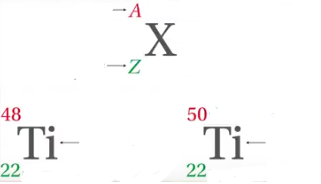
Isotopic percentages of the atoms in a sample of matter can be useful - carbon dating, locating origin. - 29Atomic Symbols
- 30Natural AbundanceA term that describes the naturally occurring ratios of isotopes.
- 31Carbon IsotopesThere are 3 Isotopes of Carbon.
Carbon-12 is the most common and stable, this accounts for 99% of all Carbon.
Carbon-13 is very rare, and is unstable, with one extra neutron, 1% of Carbon.
Carbon-14 is ultra-rare and radioactive. It is used for Carbon-Dating. - 32Carbon DatingThe determination of the age or date of organic matter from the relative proportion of the Isotopes Carbon-12 and Carbon-14 that it contains.
This ratio changes as the radioactive Carbon-14 decays and is not replaced by exchange with the atmosphere. - 33Electrons as the Most Important Particle in ChemistryElectrons are the Particles involved in chemical reactions.
- 34Electron Charge-1
- 35Electron LocationElectrons are hard to pinpoint the location of.
They occupy different areas of space around the Nucleus.
Electrons furthest from the Nucleus are most likely to be involved with chemical reactions. - 36Energy LevelAtoms have different Energy Levels that hold electrons.
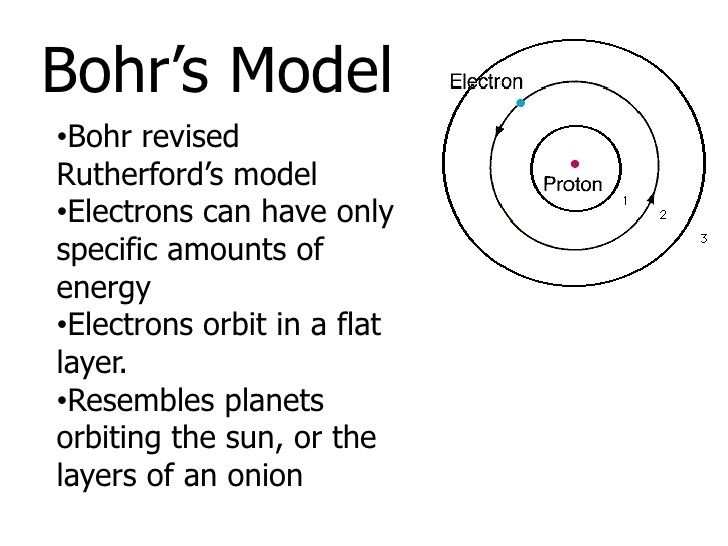
- 37Electron ArrangementThe way in which Electrons are arranged are based on the Energy Levels of atoms.
The energy of each successive level increases as we move away from the Nucleus.
The location of an Electron with respect to the Nucleus determines its role in the Atom.
The further an Electron is from the Nucleus, the more loosely it is held by the Nucleus. - 38First Energy LevelThe level closest to the Nucleus is the First Energy Level. This has the lowest energy.
- 39The Onion Model of the AtomRefers to the arrangement of Electrons into Energy Levels around the Nucleus of the Atom, which is onion shaped.
- 40Ground StateThe lowest Energy Level of a particular Electron is called the Ground State.
- 41Excited StateWhen an Electron is energized, it moves to a higher Energy Level- an Excited State.
- 42Light and Atom InteractionWhen electricity is applied to atoms in a lamp, the electrons become energized and move to a higher energy level.
When the electrons return to a lower energy level, they may give back energy in the form of light (radiant energy). - 43The Electromagnetic SpectrumHow the different types of light are represented.
Visible light is the only light that human eyes are sensitive to.
Higher energy forms are shown to the left, and have the shortest wavelengths.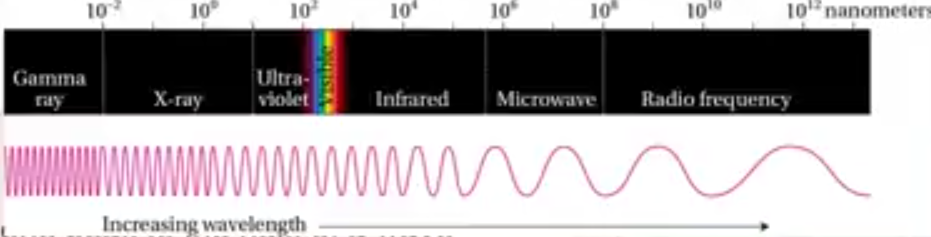
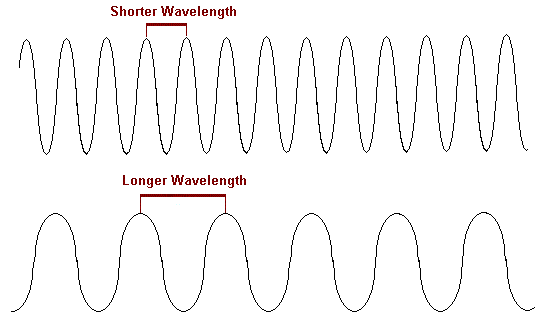
- 44WavelengthThe distance between adjacent waves. When the waves are closer together, this is a shorter wavelength. When the waves are father apart, this is a longer wavelength. Measured in Nanometers.
- 45NanometerThere are 1000000000 Nanometers in one Meter.
- 46How Light Interacts with AtomsShorter wavelengths of light are more energetic than longer wavelengths of light.
Excited Atoms of a specific Element give off specific Wavelengths of light that depend on the Energy Levels of that Atom.
These specific wavelengths of light are known as a Line Spectrum. - 47Line SpectrumThe specific Wavelengths of light given off the Excited Atoms of a specific Element, dependent on the Energy Levels of the Atom.
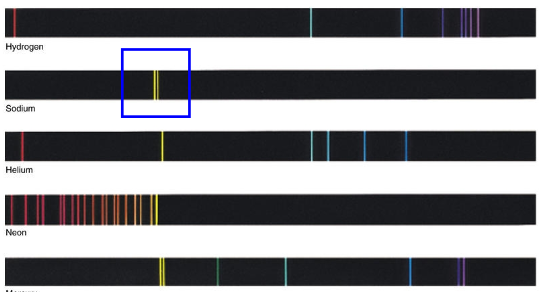
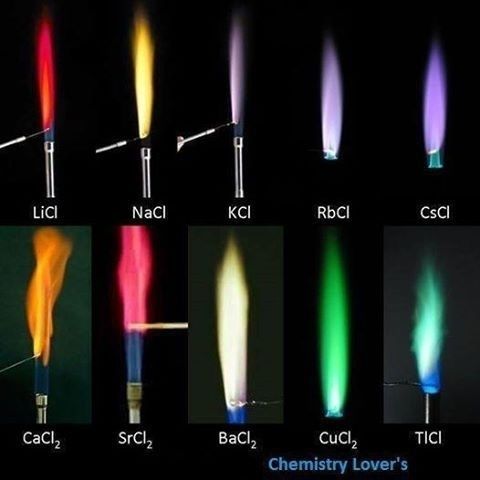
- 48Flame TestAn analytic procedure used in Chemistry to detect the presence of certain elements, particularly Metal Ions, based on each Element's characteristic emission spectrum.
- 49Light PollutionBefore the 1890's, Light Pollution was minimal due to the absence of street lamps.
It costs $2.2billion annually, produces 14 million tons of greenhouse gases, and has deleterious effects on nocturnal animals, the human body, and bird migrations.
Informationen
- Beschreibung
- A set of flashcards with terms from all three of the Unit 2 videos.
- Erstellt von
- Miriam Brundage
- Aufrufe
- 22
- Bewertung