
Karteikarten
IB Biology 7.4 Translation (HL)
Karten in diesem Stapel (10)
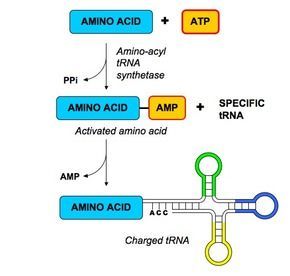
- 17.4.1 Explain that each tRNA molecule is recognised by a tRNA-activating enzyme that binds a specific amino acid to the tRNA using ATP for energyEach different tRNA molecule has a unique shape and chemical composition that is recognised by a specific tRNA-activating enzyme
The enzyme (aminoacyl-tRNA synthetase) first binds the amino acid to a molecule of ATP (to form an amino acid-AMP complex linked by a high energy bond)
The amino acid is then transferred to the 3'-end of the appropriate tRNA, attaching to a terminal CCA sequence on the acceptor stem and releasing the AMP molecule
The tRNA molecule with an amino acid attached is thus said to be 'charged' and is now capable of participating in translation
The energy in the bond linking the tRNA molecule to the amino acid will be used in translation to form a peptide bond between adjacent amino acids - 27.4.1 Draw a diagram of how a tRNA molecule is recognised by tRNA-activating enzme
- 37.4.2 Outline the structure of ribosomes, including protein and RNA composition, large and small subunits, three tRNA binding sites and mRNA binding sitesRibosomes are made of protein (for stability) and ribosomal RNA (rRNA - for catalytic activity)
They consist of two subunits:
The small subunit contains an mRNA binding site
The large subunit contains three tRNA binding sites - an aminacyl (A) site, a peptidyl (P) site and an exit (E) site
Ribosomes can be either found freely in the cytosol or bound to the rough ER (in eukaryotes)
Ribosomes differ in size in eukaryotes and prokaryotes (eukaryotes = 80S ; prokaryotes = 70S) - 47.4.3 State the four steps translation occurs in and explain these.Translation occurs in four main steps:
Initiation: Involves the assembly of an active ribosomal complex
Elongation: New amino acids are brought to the ribosome according to the codon sequence
Translocation: Amino acids are translocated to a growing polypeptide chain
Termination: At certain "stop" codons, translation is ended and the polypeptide is released - 57.4.4 Outline why and in which direction translation occurs inThe start codon (AUG) is located at the 5' end of the mRNA sequence and the ribosome moves along it in the 3' direction
Hence translation occurs in a 5' - 3' direction - 67.4.5 Draw and label a diagram showing the structure of a peptide bond between two amino acids

- 77.4.6 Explain the firt three processes of translation.Pre-Initiation:
Specific tRNA-activating enzymes catalyse the attachment of amino acids to tRNA molecules, using ATP for energy
Initiation:
The small ribosomal subunit binds to the 5' end of mRNA and moves along it until it reaches the start codon (AUG)
Next, the appropriate tRNA molecule binds to the codon via its anticodon (according to complementary base pairing)
Finally, the large ribosomal subunit aligns itself to the tRNA molecule at its P-site and forms a complex with the small ribosomal subunit
Elongation:
A second tRNA molecule pairs with the next codon in the ribosomal A-site
The amino acid in the P-site is covalently attached via a peptide bond to the amino acid in the A-site - 87.4.6 Explain the last two stages of translationTranslocation:
The ribosome moves along one codon position, the deacylated tRNA moves into the E-site and is released, while the tRNA bearing the dipeptide moves into the P-site
Another tRNA molecules attaches to the next codon in the newly emptied A-site and the process is repeated
The ribosome moves along the mRNA sequence in a 5' - 3' direction, synthesising a polypeptide chain
Multiple ribosomes can translate a single mRNA sequence simultaneously (forming polysomes)
Termination:
Elongation and translocation continue until the ribosome reaches a stop codon
These codons do not code for any amino acids and instead signal for translation to stop
The polypeptide is released and the ribosome disassembles back into subunits
The polypeptide may undergo post-translational modification prior to becoming a functional protein - 97.4.6 Draw a diagram overviewing the process of translation

- 107.4.7 State that free ribosomes synthesise proteins for use primarily within the cell, and that bound ribosomes synthesise proteins primarily for secretion or for lysosomesRibosomes floating freely in the cytosol produce proteins for use within the cell
Ribosomes attached to the rough ER are primarily involved in producing proteins to be exported from the cell or used in the lysosome
These proteins contain a signal recognition peptide on their nascent polypeptide chains which direct the associated ribosome to the rough ER
Informationen
- Beschreibung
- Biology (Topic 7 Nucleic Acid & Protein (HL)) Karteikarten am IB Biology 7.4 Translation (HL) , erstellt von robertospacey am 23/03/2015.
- Erstellt von
- robertospacey
- Aufrufe
- 71
- Tags
- Bewertung