
Karteikarten
Chapter 3: Chemical Stoichiometry
Karten in diesem Stapel (17)
- 1Avagadro's Number6.02x10^23
- 2Stoitch types in rxns and given infomol-mol
mol-mol-gram
gram-mol-mol - 3Atomic Massesgrams/mol
of a compound: take the atomic masses of each element multiplied by its coefficient and add them all together to get one molar mass for that specific molecule - 4Calc average amu (pg. 80)Dimensional analysis
= atoms (amu/atom)
amu/atom = the given average atomic mass for that specific isotope - 5Determining mass of a sample of atoms6.02E^23 amu = 1gram and use dimensional analysis
- 6mass percent and percent composition1. find the mass of each element of the particular molecule
2. Mass of element/ mass of the entire molecule
3. Multiply the ratio by 100% to get a percentage - 7Finding the Empirical Formulareview later
- 8StoichiometryThe study of quantities of materials consumed and produced in chemical reactions
- 9Finding AMU of isotopes (eg carbon)Carbon = 98.89% 12C
1.11% 13C
0.01% 14C
Multiply isotope's amu numbers (eg 12) by percentage - 10Counting by WeighingGrams of sample to moles
- 11Number of atoms in a sample with specified massagain counting by weighting
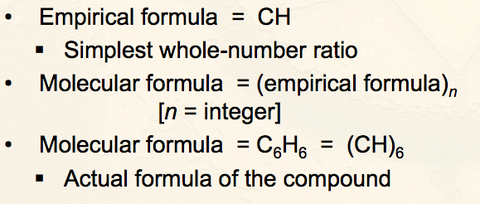
grams (moles/gram) - 12Formulas (EF and MF)
- 13Determining EF1. Start with grams of each element, %= total mass is 100 grams therefore mass of each element is its own percent
2. Convert the mass--> moles (per. table)
3. Divide each mole value by the smallest number of moles calculated.
4. Round to the nearest whole number. This is the mole ratio of the elements and the subscripts of the empirical formula
5. Use a multiplier if necessary e.g. If one solution is 1.5, then multiply each solution in the problem by 2 to get 3. e.g. If one solution is 1.25, then multiply each solution in the problem by 4 to get 5. - 14Determining MF1. mm molecular formula/ mm empirical formula = multiplier (ratio from mf to ef)
2. Multiply the subscripts of EF by this multiplier - 15Balancing Chemical Reactions1. All atoms present in the reactants must be accounted for in the products
2. Important because the balanced equation represents an overall ratio of reactants and products/ helps find how much products and reactants are formed - 16LIMITING REACTANTS1. the reactant that is consumed first and therefore limits the amounts of products that can be formed
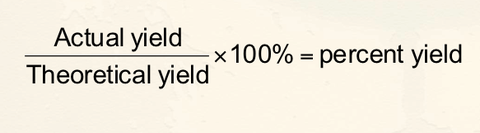
2.Determine which reactant is limiting to calculate correctly the amounts of products that will be formed. - 17PERCENT YIELD
Informationen
- Beschreibung
- Zumhadl 8th Edition Chapter 3 (77-117)
- Erstellt von
- Ayren Mcg
- Aufrufe
- 87
- Tags
- Bewertung