Karteikarten
Algebra I SOL Vocabulary & Strategies
Karten in diesem Stapel (70)
- 1Translating Expressions (A.1a): Translate from left to right unless you see a...turn-around phrase
- 2Translating Expressions (A.1a): Examples of turn-around words (phrases like...)less than,
subtracted from,
reduced by,
decreased by,
fewer than - 3Translating Expressions (A.1a): Sum of, difference of, product of all mean we should use...parentheses
- 4Translating Expressions (A.1a): Translate the following: Two times the sum of a number and four2(x + 4)
- 5Translating Expressions (A.1a): Translate the following: Five less than a number squaredx² - 5
- 6Evaluating Expressions (A.1b): In Desmos, how do you make... √1) Type "sqrt" or
2) find the symbol on the Desmos keypad - 7Evaluating Expressions (A.1b): In Desmos, how do you make... ∛1) Type "cbrt" or
2) open the Desmos keypad
-click Functions
-click Misc
-click the one that looks like a radical
-type a "3" into the root - 8Evaluating Expressions (A.1b): In Desmos, how do you make... absolute value bars (| |)Open the Desmos keypad and look for

- 9Evaluating Expressions (A.1b): In Desmos, how do you make... an exponent1) Keyboard: shift and 6 (to get ^)
2) Desmos keypad: click the button below
- 10Evaluating Expressions (A.1b): In Desmos, how do you make... a big fractionClick the divide key on the Desmos keypad or click / on your keyboard
- 11Evaluating Expressions (A.1b): What letters can you make into sliders?Any letter except x or y
- 12Evaluating Expressions (A.1b): What if you need to set the letter equal to 15 and you can't slide it that far?Click into the number and change it
- 13Radicals (A.3): What does simplest form mean?smallest number/coefficient INSIDE the radical
- 14Equations (A.4a): How do you use Desmos to solve an equation? Which letter must you use for the variable?-Type the equation into Desmos exactly as you see it
-Look for the vertical line on your graph
-click the gray dot.
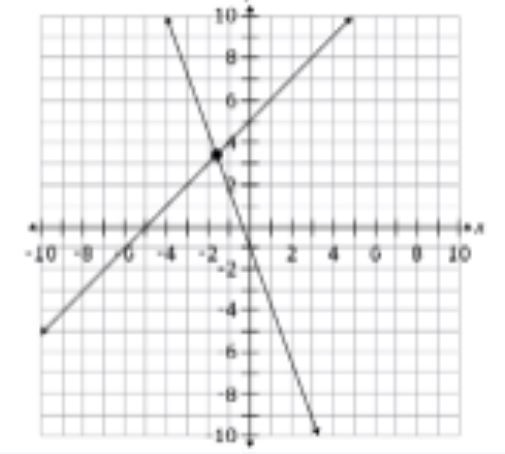
Use the variable x - 15Systems of Equations (A.4d): The solution to two or more equations is where the lines...intersect/cross/meet
(x,y) - 16Systems of Equations (A.4d): Find the solution(-2, 3)
- 17Systems of Equations (A.4d): Find the solution x + y = 7 2x + 3y = 10Type both into Desmos!
Solution: (11, - 4) - 181-Variable Inequalities (A.5a): Graph an inequality in Desmos using the variable...x
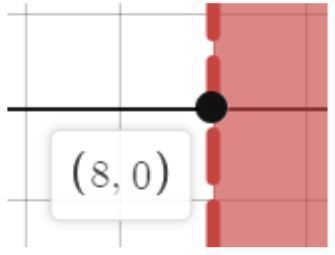
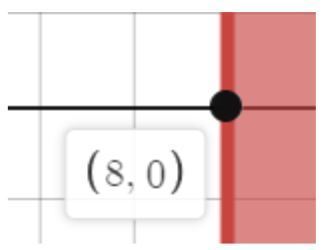
- 191-Variable Inequalities (A.5a): write the inequality for the graphx > 8
- 201-Variable Inequalities (A.5a): write the inequality for the graphx < 8
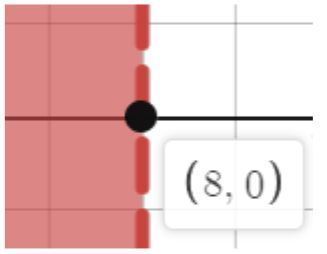
- 211-Variable Inequalities (A.5a): write the inequality for the graphx ≤ 8
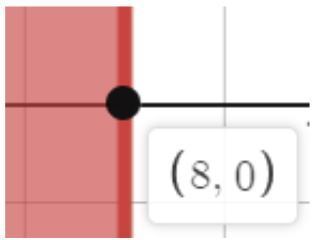
- 221-Variable Inequalities (A.5a): write the inequality for the graphx ≥ 8
- 232-Variable Inequalities (A.5bd): Is the point a solution?Yes, it's in the shaded region
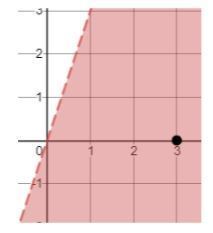
- 242-Variable Inequalities (A.5bd): Is the point a solution?No, it's on a dashed line
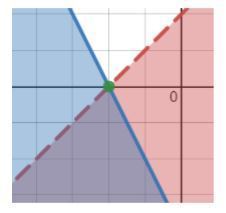
- 252-Variable Inequalities (A.5bd): Is the point a solution?Yes, it's on a solid line
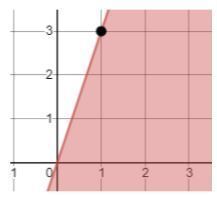
- 262-Variable Inequalities (A.5bd): Is the point a solution?Yes, it's on solid lines and it surrounds the darkest shaded region
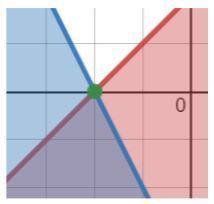
- 272-Variable Inequalities (A.5bd): Is the point a solution?No, it's on a dashed line
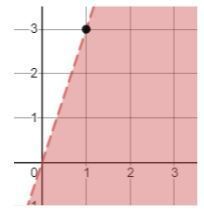
- 282-Variable Inequalities (A.5bd): Is the point a solution?No, it's not in the darkest shaded region
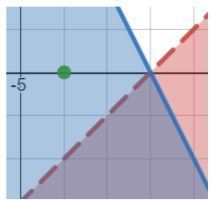
- 292-Variable Inequalities (A.5bd): Is the point a solution?No, it's not in the shaded region
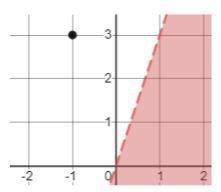
- 302-Variable Inequalities (A.5bd): Is the point a solution?No, it's not in or surrounding the darkest shaded region
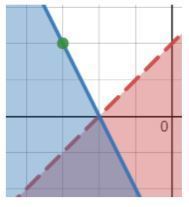
- 312-Variable Inequalities (A.5bd): Is the point a solution?Yes, it's on a solid line around the darkest shaded region
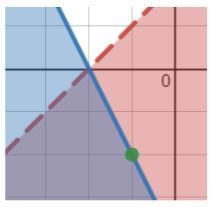
- 32Slope (A.6a): in y = mx + b, where is the slope? the y-intercept?The slope is m, the number in front of the x
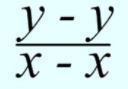
The y-intercept is b - 33Slope (A.6a): What is the slope formula?(y-y)/(x-x)
- 34Slope (A.6a): Substitute into the slope formula (3, -5) and (-4, 7)
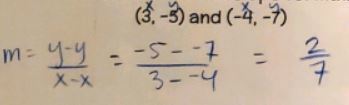
- 35Slope (A.6a): Slope is also ___________/___________Rise over run
- 36Slope (A.6a): Find the slopem = 1/3.
Count up 1 and over 3 using the points (0,0) and (3,1)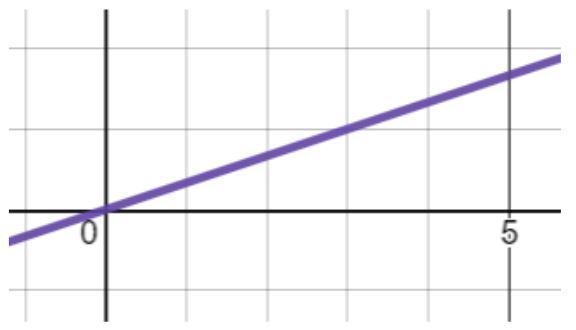
- 37Equations of Lines (A.6b): Parallel means...Two lines that never intersect. They have the same slope and different y-intercepts.
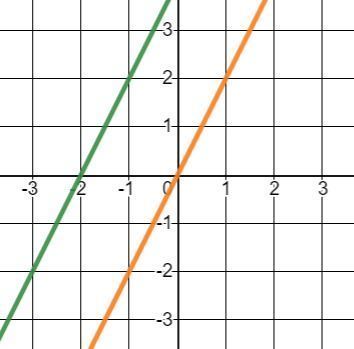
- 38Equations of Lines (A.6b): Perpendicular means...Two lines that intersect at a 90 degree angle.
Their slopes are opposite reciprocals (one positive, one negative, and flipped fractions)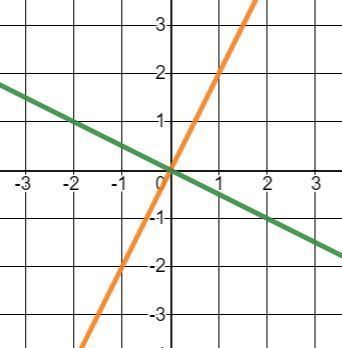
- 39Variation (A.8): In direct variation, ___________ the x and y valuesdivide
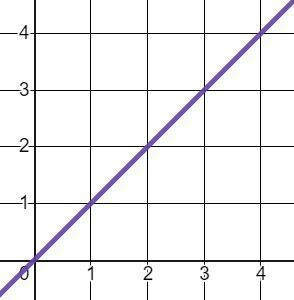
- 40Variation (A.8): Direct variation looks likea straight line with positive slope and a y-intercept of 0
- 41Variation (A.8): In inverse variation, ___________ the x and y valuesmultiply
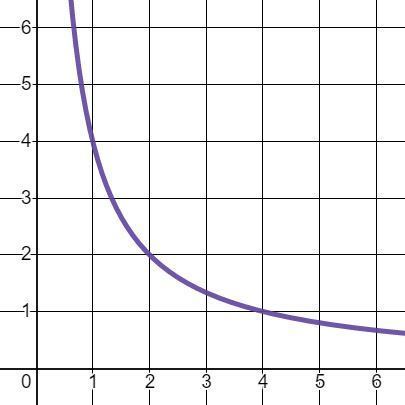
- 42Variation (A.8): Inverse variation looks likea curve that gets really close to the y- and y-axis but never touches either
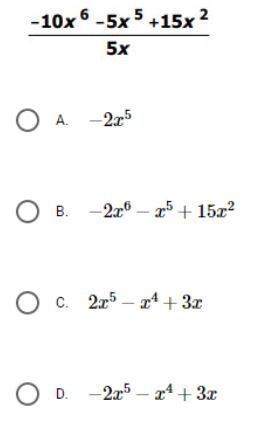
- 43Polynomials (A.2ab): When your problem and answers only have x’s, how do you you use Desmos?Type all into separate rows in Desmos. The correct answer matches the exact curve or line that the problem makes!
- 44TRY THIS PROBLEM YOURSELF IN DESMOS FIRST BEFORE YOU FLIP THE CARDD: has the same curve as the problem
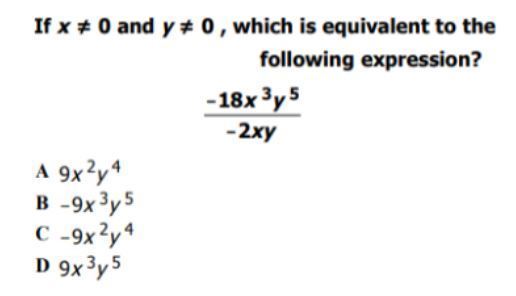
- 45Polynomials (A.2ab): When your problem and answers have both x’s and y’s, how do you you use Desmos?Type all into separate rows in Desmos AND put =5 (or some other number greater than 3) into each row so you can see the lines/curves!
- 46TRY THIS PROBLEM YOURSELF IN DESMOS FIRST BEFORE YOU FLIP THE CARDA: has the same curve as the problem
- 47Quadratic Functions (A.4b): What four words mean the same thing?Zero,
solution,
root,
x-intercept. - 48Quadratic Functions (A.4b): The words zero, solution, root, x-intercept are all looking for where our graph crosses...the x-axis
- 49—-4 and 2
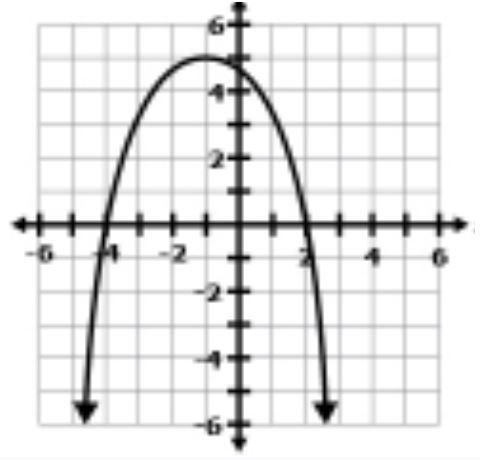
- 50Quadratic Functions (A.4b): Factors have the same _____________ as the functions.x-intercepts
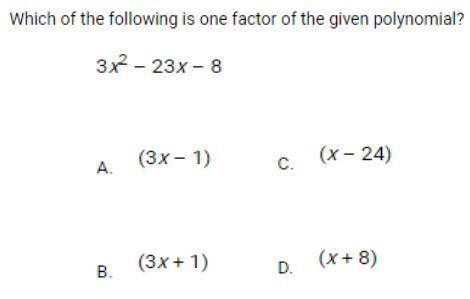
- 51TRY THIS PROBLEM YOURSELF IN DESMOS FIRST BEFORE YOU FLIP THE CARDB: has the same x-intercept of -0.333
- 52Functions (A.7a): A function never repeats...any x-values
- 53Functions (A.7a): Is it a function?No, the x-value 0 repeats

- 54Functions (A.7a): Is it a function?No, the x-value 2 repeats
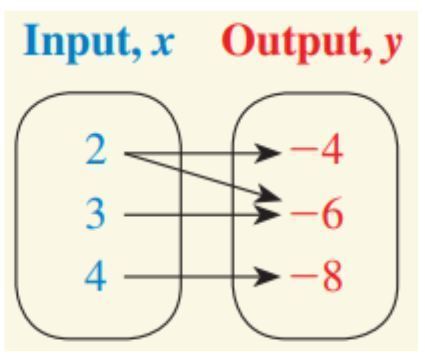
- 55Functions (A.7a): Is it a function?Yes, no x-value repeats
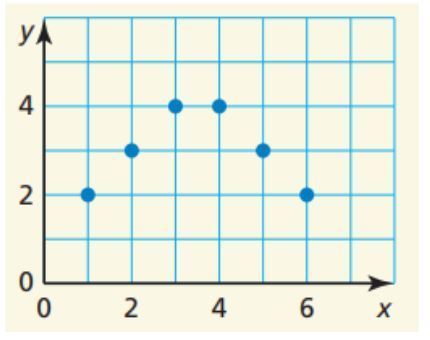
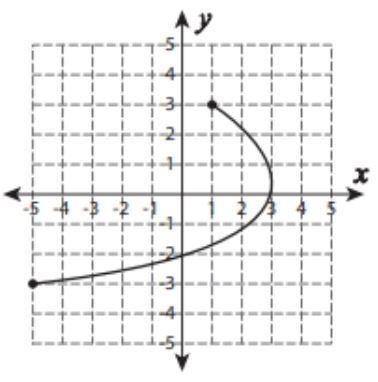
- 56Functions (A.7a): Is it a function?No, fails the vertical line test. The x-values 1 and 2 repeat
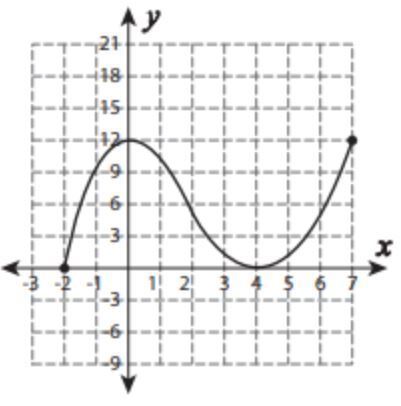
- 57Functions (A.7a): Is it a function?Yes, it passes the vertical line test. No x-value repeats
- 58Domain and Range (A.7b): Domain means...All the x-values
- 59Domain and Range (A.7b): Domain means we scan the graph from....left to right
- 60Domain and Range (A.7b): Range means...all the y-values
- 61Domain and Range (A.7b): Range means we scan the graph from...bottom to top
- 62Domain and Range (A.7b): ℝ means...all real numbers
any number you could possibly think of is included in the domain or range - 63Domain and Range (A.7b): ℝ (all real numbers) in interval notation is...(-∞, ∞)
- 64Matching Tables to Graphs/Equations (A.7f): How do you make a table in Desmos?1) Type "table" or
2) click the + in the top left corner
-click table - 65Matching Tables to Graphs/Equations (A.7f): If you can’t see the points in Desmos (from a table), what do you do?Click the magnifying glass in the blue column next to your table
- 66Matching Tables to Graphs/Equations (A.7f): When you graph the correct equation, what will it look like with the points?The correct equation will be a line or curve that goes through all the points!
Or it matches the points better than any of the other options. - 67Factoring (A.2c): 1. Type the problem into Desmos 2. Next row, type gcf(#, #, #) of the ________________________. 3. Select that number. 4. Type your other options into Desmos 5. Select all that have the same ___________________ as your polynomial.2. Coefficients (numbers in front the variables)
5. x-intercepts - 68TRY THIS PROBLEM YOURSELF IN DESMOS FIRST BEFORE YOU FLIP THE CARD Identify the factors of this polynomial: 9x² - 39x - 303: you get this from gcf( 9, 39, 30)
3x + 2: same x-int of -0.667
x-5: same x-int of 5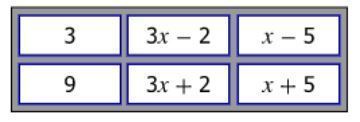
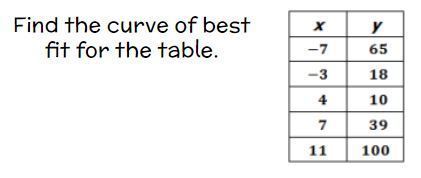
- 69TRY THIS PROBLEM YOURSELF IN DESMOS FIRST BEFORE YOU FLIP THE CARDy = -2.14x + -0.4
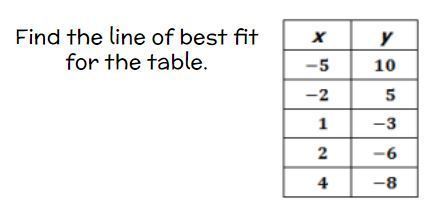
- 70TRY THIS PROBLEM YOURSELF IN DESMOS FIRST BEFORE YOU FLIP THE CARDy = 0.98x² + -1.95x + 3.2