
414752
Beschreibung

Karteikarten von jessica.massey, aktualisiert more than 1 year ago

|
Erstellt von jessica.massey
vor fast 13 Jahre
|
|
| Frage | Antworten |
| Five "Golden" approaches to ethics and moral framing | The Golden Purse The Golden Mean The Golden Law The Golden Consequence The Golden Rule |
| The Golden Rule | He who has the gold (power) rules. |
| The Golden Mean | Virtue lies between two extremes. |
| The Golden Law | What's right for one person is right for all. |
| The Golden Consequence | The greatest good for the greatest number of people. |
| The Golden Rule | Treat others the way you want to be treated. |
| The Platinum Rule | Treat others the way they want to be treated. |
| Conflict Approaches | Avoidance Accommodation Competing Compromising Collaboration |
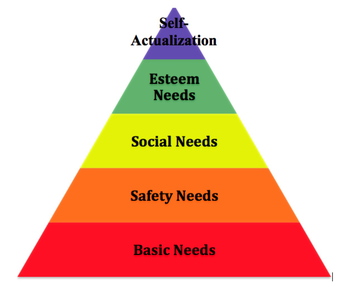
| Cultural Adaptation (Culture Shock) | Hierarchy of Needs Enculturation Acculturation Assimilation |
| Hierarchy of Needs |
Image:
Maslow (image/jpg)
|
| Enculturation | The society you are raised into. |
| Acculturation | The changing of oneself in order to belong to a new culture. |
| Assimilation | The replacement of a known culture for a new culture. |
| The "U" Curve | Honeymoon Crisis (Culture Shock) Critical Adjustment |
| Kim's Cultural Adaptation | T-graph, Adaption v. Stress measured by time (The spiraling line) |
| Acculturation Examples from "God Grew Tired of Us" | As boys they worked together to keep each other alive (the older boys took charge of younger). |
| Five Dimensions of Stereotypes | Direction Intensity Specificity Consensus Accuracy |
| Stereotype Direction | Positive or negative. |
| Stereotype Intensity | How strong is the stereotype held by the observer. |
| Stereotype Specificity | How vague or broad. |
| Stereotype Consensus | How well accepted or well known |
| Stereotype Accuracy | Is it a stereotype or sociotype |
| Stereotyping | Attributes that cover up individual differences and ascribe certain characteristics. |
| Prejudice | The very negative view of another group. |
| Ethnocentrism | Ones own group is the center of everything and all others are scaled and rated with references to it. |
| Expectation Violation Theory (EVT) | Explains a range of communication outcomes associated with violations of expectations about verbal and non verbal behavior. |
| Fundamental Attribution Error | Is it the person or the situation? |
| Five Types of Prejudice | Blatant Conceit Symbolic Tokenism |
| Pop Culture | Culture that originates from the people where commonalities are subject to hegemony and is mass produced for mass consumption. |
| Hegemony | Dominance of one over the another (ideological, political, economic, or cultural force). |
| Faith and Pop Culture Five Perspectives | Opposition Agreement Synthesized Tension Renewal |
| F/PC: Opposition | Christ against culture |
| F/PC: Agreement | Christ of culture, leads to accomidation |
| F/PC: Synthesized | Christ is above culture, lack of reform and change |
| F/PC: Tension | Christ and culture in paradox |
| F/PC: Renewal | Christ transforming culture |
| Four functions of nonverbal communication | 1)Reflecting and managing id 2)Expressing emotions and attitudes 3)Conversation management 4)Impression formation and attraction |
| ! Six Forms of Non-Verbal Communication | Kinetics and Oculesics Proxemics Haptics Paralanguage |
| Grime's Maxims to Communication | Quality Quantity Relevance Appropriate Manner |
| Communication Accommodation Theory | When people interact they adjust their speech, their vocal patterns, and their gestures to accommodate to the others |
Möchten Sie mit GoConqr kostenlos Ihre eigenen Karteikarten erstellen? Mehr erfahren.