
Karteikarten
AS Biology (AQA New Spec for 2016 Exams) FULL SPECIFICATION FLASHCARDS
Karten in diesem Stapel (132)
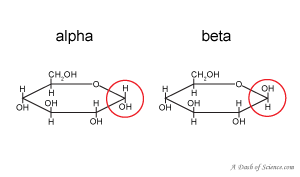
- 1Draw alpha and beta glucose
- 2What elements do carbohydrates contain?C, H, O
- 3By which process are monosaccharides joined together?Condensation
- 4What happens in a condensation reaction between two monosaccharides?-A glycosidic bond forms
-A water molecule is released - 5What is sucrose made up of?Glucose & fructose
- 6What is lactose made up of?Galactose * glucose
- 7How are polymers broken apart?Hydrolysis reactions
- 8How do hydrolysis reactions break apart polymers?A water molecule breaks the bond between the two monomers
- 9How are reducing sugars tested for?Benedict's test:
-Add blue Benedict's reagent
-Heat in boiling water bath
-Coloured precipitate indicates positive result - 10Give examples of reducing sugars.-All monosaccharides
-Maltose
-Lactose - 11How do you compare the concentration of reducing sugars in two solutions?Use Benedict's test and either weigh the amount of precipitate or use the precipitate colour (blue = low, red = high)
- 12How do you test for non-reducing sugars?Add dilute HCL to the test solution and heat it in a boiling waterbath. Then add sodium hydrogencarbonate and carry out the Benedict's test.
- 13What is the main energy storage material in plants?Starch
- 14What is starch?Starch is a mixture of two different polysaccharides: amylose and amylopectin
- 15Describe the structure of amylose and explain why it is suited to energy storage in plants.Amylose is a long, unbranched chain of alpha glucose. It has a tightly coiled shape which makes it compact and therefore excellent for storage as you can fit more glucose in a smaller space.
- 16Describe the structure of amylopectin and explain why it is suited to energy storage in plants.Amylopectin is a long, branched chain of alpha glucose. Its side branches allow easy access to the glycosidic bonds by enzymes so the glucose can be released quickly.
- 17What is the test for starch?Add iodine dissolved in potassium iodide solution to the sample. Browny-orange -> blue-black is a positive result
- 18What is the primary energy storage material in animals?Glycogen
- 19Describe glycogen's structure and explain why it is suited to energy storage in animals.A branched polysaccharide made up of alpha glucose. Very compact and allows easy access to the glycosidic bonds for quick energy release.
- 20Describe the structure of cellulose.Cellulose is made up of long, unbranched chains of beta glucose. The long, straight chains are linked together by hydrogen bonds to form fibres called microfibrils.
- 21What makes up a triglyceride?One molecule of glycerol with three fatty acid 'tails'
- 22What is the basic structure of a fatty acid?
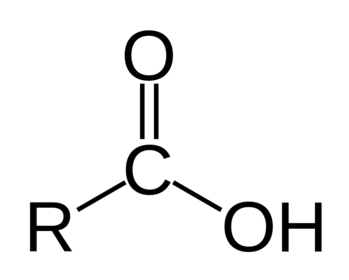
- 23How are triglycerides formed? Draw a diagram and explain.
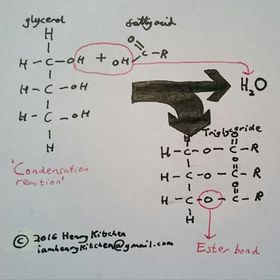
- 24What is the difference between saturated and unsaturated fatty acids?Saturated fatty acids have no double bonds between their carbon atoms, whereas unsaturated fatty acids have at least one double bond between their carbon atoms.
- 25How do you test for lipids?The emulsion test:
-Shake test sample with ethanol until it dissolves
-Pour resulting solution into water
-Lipids will show up as a milky emulsion - 26What type of lipid is found in cell membranes?Phospholipids
- 27What is the difference between a phospholipid and a triglyceride?In a phospholipid, one fatty acid molecule is replaced by a phosphate group.
- 28What important feature of a phospholipid makes it useful for cell membranes?The phosphate group is hydrophilic (attracted to water) whereas the fatty acid tails are hydrophobic (repel water).
- 29Draw the basic structure of a phospholipid.
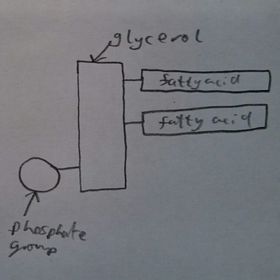
- 30What is the primary function of triglycerides? Explain.Energy storage molecules. The fatty acids' hydrocarbon tails contain lots of chemical energy which is released when they are broken down. They are also insoluble, so they do not affect the cell's water potential.
- 31What is the primary function of phospholipids? Explain.To make up the phospholipid bilayer. The heads of the phospholipid are hydrophilic and the tails are hydrophobic, causing them to form a double layer with the heads facing towards the water. The centre of the bilayer is hydrophobic and therefore does not allow water soluble substances to pass through it easily.
- 32What is the general structure of an amino acid?
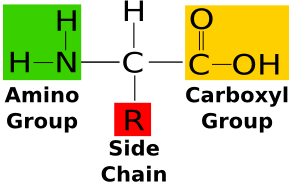
- 33How are polypeptides formed?Amino acids are linked together by condensation reactions which form peptide bonds between the amino acids and release water molecules.
- 34What type of reaction breaks down proteins?Hydrolysis
- 35What are the four structural levels of a protein?Primary: sequence of amino acids in polypeptide chain
Secondary: Hydrogen bonds can cause the polypeptide chain to coil into an alpha helix or fold into a beta pleated sheet
Tertiary: Further folding of the chain by hydrogen bonds, ionic bonds and disulfide bridges
Quaternary: In proteins with more than one polypeptide chain, this is how the chains are assembled together - 36What is the test for proteins?The Biuret test:
-Add a few drops of NaOH solution
-Add copper (II) sulfate solution
-Positive = purple
-Negative = blue - 37What is an enzyme?An enzyme is a biological catalyst.
- 38What are the two types of enzyme action?Intracellular (within cells) and extracellular (outside cells)
- 39How do enzymes catalyse reactions?Enzymes lower the reaction's activation energy.
- 40Why does an enzyme substrate complex lower the activation energy?If two substrate molecules need to be joined, the complex holds them closer together, reducing repulsion. If the enzyme is catalysing a breakdown reaction, fitting in the active site puts a strain on the bonds in the substrate.
- 41What is the lock and key enzyme model?The lock and key model is where the enzyme's active site and the substrate are exactly complementary and do not change shape.
- 42What is the induced fit enzyme model?The enzyme's active site is not exactly complementary to the substrate. When the substrate binds to the active site, the active site changes shape slightly to allow the enzyme substrate complex to form.
- 43Why are enzymes very specific?Because only one complementary substrate will fit the enzyme's active site.
- 44Why does high temperature denature proteins?The high temperature causes the hydrogen bonds, ionic bonds and disulfide bridges between the amino acids to break down, changing the tertiary structure.
- 45Why do enzymes not work as well at lower temperatures?Lower temperature means that the molecules have lower kinetic energy.
- 46Why does a non-optimum pH level result in a lower rate of reaction?H+ and OH- ions can change the ionic and hydrogen bonds in the enzyme's tertiary structure, denaturing the enzyme.
- 47Why does enzyme concentration affect the rate of reaction? Why does the rate have a peak value after which the rate does not change?Increased enzyme concentration means that the possible number of collisions between enzyme and substrate per second increases and therefore more enzyme substrate complexes form per second.
There is a peak value because the substrate concentration becomes a limiting factor. - 48What are the two types of enzyme inhibition?Competitive and non-competitive inhibition.
- 49How does competitive inhibition work?Molecules with a similar shape to the substrate molecules bind to the active sites of the enzymes but no reaction occurs. Instead, they block the active site so not substrate molecules can fit in.
- 50How does non-competitive inhibition work?Molecules bind to the enzyme away from its active site, causing the enzyme's active site to change shape so the substrate molecules can no longer bind to it.
- 51YO ELLIOTSLIME GLANDS
- 52What are the pentose sugars in DNA and RNA?DNA: deoxyribose
RNA: ribose - 53What base is not present in RNA that is present in DNA and vice versa?In RNA, thymine is replaced by uracil.
- 54What is a nucleotide made up of?A pentose sugar
A nitrogen-containing organic base
A phosphate group - 55How do polynucleotides form?Nucleotides join up via condensation reactions between the phosphate group of one nucleotide and the sugar of another. This forms phosphodiester bonds.
- 56What is the chain of sugars and phosphates in a polynucleotide called?Sugar-phosphate backbone.
- 57Describe the structure of a molecule of DNA.Two DNA polynucleotide strands are held together by hydrogen bonds between the organic bases. The two strands run antiparallel to each other and are twisted to form a DNA double helix.
- 58What base does adenine pair with in DNA?Thymine
- 59What base does guanine pair with in DNA?Cytosine
- 60By what process does DNA replicate?Semi-conservative replication
- 61How does semi-conservative replication work?-DNA helicase enzyme breaks down the H bonds between the organic bases
-Helix unwinds to form two single strands
-Each original strand acts as a template for a new strand
-Complementary base pairing means that free-floating DNA nucleotides are attracted to their complementary exposed bases on each original template strand
-Condensation reactions join each strand's nucleotides together with H bonds, catalysed by DNA polymerase
-Each new DNA molecule contains one new strand and one original strand. - 62Why is water a good buffer to temperature changes?It has a high latent heat of vaporisation and a high specific heat capacity
- 63Why are water molecules cohesive?Water molecules are polar and therefore each molecule attracts other molecules, meaning that they stick together.
- 64What does ATP stand for?Adenosine triphosphate
- 65Draw the structure of ATP
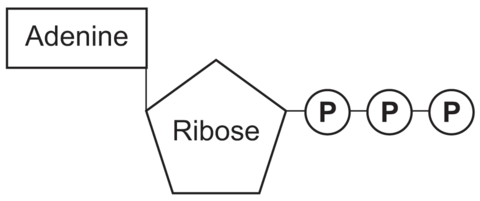
- 66How is energy released from ATP?High energy bonds between the phosphate groups are hydrolysed, releasing energy.
- 67What is the cycle of ATP use and production?-ATP is hydrolysed by cells when energy is needed, forming ADP (adenosine diphosphate) and Pi (inorganic phosphate)
-Condensation reactions between ADP and Pi for ATP during respiration/photosynthesis - 68What is a eukaryotic cell?An complex cell found in multicellular organisms (animals and plants).
- 69What is a prokaryotic cell?A single-celled organism.
- 70What are the features of a cell surface membrane?Regulates the movement of substances into and out of the cell. Has receptor molecules to allow responses to hormones.
- 71Describe the structure of a nucleus.A large organelle surrounded by a nuclear envelope (double membrane), which contains many pores. The nucleus contains chromosomes and one or more nucleoli
- 72Describe the function of the nucleus.The nucleus controls the transcription of DNA and therefore the cell's activities. The nucleolus makes ribosomes.
- 73Describe the structure of mitochondria.Organelle with a double membrane. Inner membrane is folded into structures called cristae. Inside is the matrix, which contains respiratory enzymes.
- 74Describe the function of mitochondria.The site of aerobic respiration (where ATP is produced).
- 75Describe the structure of chloroplasts.Double membrane. Contains grana, structures made up of stacked thylakoid membranes. These are linked by lamellae - thin, flat pieces of thylakoid membrane. Filled with a liquid called stroma.
- 76Describe the structure of the Golgi apparatus.Fluid filled membrane-bound sacs.
- 77Describe the function of the Golgi apparatus.Processes and packages lipids and proteins.
- 78Describe the structure of Golgi vesicles.Small fluid-filled sacs.
- 79Describe the function of Golgi vesicles.Stores lipids and proteins made by the Golgi apparatus for transport through the cell-surface membrane.
- 80Describe the structure of a ribosome.A very small organelle which floats free in the cytoplasm or is attached to the rough endoplasmic reticulum. Made up of RNA.
- 81Describe the function of a ribosome.The site of protein production.
- 82What characteristics of prokaryotic cells are not found in eukaryotic cells?-Prokaryotic cells may have a flagellum
-No nucleus, a coiled up strand of DNA simply floats free in the cytoplasm
-Plasmids (small loops of DNA) are sometimes present in the cytoplasm
-Prokaryotic cells have a cell wall
-Some bacterial cells have a slime capsule - 83Describe the structure of a virusA core of DNA or RNA surrounded by a protein capsid with attachment proteins around it.
- 84By what process do prokaryotic cells divide?Binary fission
- 85How many micrometres are in a metre?1000
- 86Define the resolution of a microscope.The smallest distance between two points which the microscope is able to discern as being two points.
- 87What are the pros and cons of transmission and scanning electron microscopes?Transmission pros:
-High resolution
-Can see internal structures
Transmission cons:
-Can only be used on thin specimens
Scanning pros:
-Can provide 3D images of the specimen's surface
-Can use thick specimens
Scanning cons:
-Low resolution compared to transmission - 88Describe the stages of cell fractionation.Homogenisation:
-Grinding cells up in blender and keeping the solution ice-cold to stop enzymes from breaking down the resulting mixture.
-Buffer solution must be added to provide a constant pH
Filtration:
-Gauze filter is used to remove large cell debris
Ultracentrifugation:
-Cell fragments poured into a test tube and spun in a centrifuge at low speed
-Heavy organelles like nuclei go to the bottom of the tube, forming a sediment called the pellet
-The rest of the solution is called the supernatant
-The supernatant is drained off and spun at a higher speed
-The mitochondria form a pellet
-The supernataint is drained off and spun again at a higher speed
-The process is repeated until all the organelles are separated out - 89What are the four stages of mitosis?Prophase, Metaphase, Anaphase and Telophase
- 90Describe prophase.-Chromosomes condense
-Centrioles move to opposite ends of cell
-Spindle fibres form
-Nuclear envelope breaks down - 91Describe metaphase.-The chromosomes line up at the equator of the cell and attach to the spindle by their centromeres
- 92Describe anaphase.-The centromeres divide, separating the pairs of sister chromatids
-Spindle fibres contract, pulling the chromatids to opposite poles of the cell - 93Describe telophase.-Chromatids uncoil and become chromosomes
-Nuclear envelope forms around each group of chromosomes
-Cytoplasm divides
-Two daughter cells are formed
-Interphase begins - 94How is the mitotic index calculated?Number of cells with visible chromosomes / total cells observed
- 95What is the function of cholesterol in the cell surface membrane?-Binds to the phospholipid tails, pulling them together and restricting their movement
-Enhances the rigidity of the cell membrane
-Maintains the shape of the cell - 96How does facilitated diffusion work?Carrier proteins:
-Large molecule attaches to carrier protein in the membrane
-Protein changes shape
-Large molecule is released inside the cell
Channel proteins:
-Channel proteins form pores in the membrane which allow charged particles to diffuse through - 97How does co-transport work?-Carrier proteins bind two molecules together
-Concentration gradient of one molecule is used to move another against its concentration gradient - 98Describe the immune response-Phagocytes recognise foreign antigens on a pathogen
-Pathogen engulfed by phagocyte
-Lysosome fuses to phagocyte
-Lysozymes break down the pathogen
-Phagocyte presents pathogen's antigens
-T cells bind to the antigens on the phagocyte
-T helper cells activate more phagocytes and cytotoxic T cells which kill foreign cells as well as activating B cells
-B cells divide to form plasma cells
-Plasma cells secrete monoclonal antibodies - 99What is the cellular immune response?T cells and other immune cells e.g. phagocytes
- 100What is the humoral immune response?B cells and monoclonal antibody production
- 101How are fish gills adapted for efficient gas exchange?-Fills are made up of thin gill filaments
-Gill filaments covered in tiny lamellae
-Lamellae have lots of capillaries
-Counter-current system maintains concentration gradient - 102How are insects adapted for gas exchange?-Pores on their abdomen called spiracles let air in and out
-Tubes called tracheae lead from the spiracles into increasingly thin-walled tracheoles
-Oxygen moves by diffusion
-Abdominal pumping allows increased oxygen flow - 103How do humans perform gas exchange?-Air enters the trachea
-Trachea splits into two bronchi
-Bronchi split into bronchioles
-Bronchioles lead to alveoli
-Ribcage, intercostal muscles and diaphragm work together to force air in and out - 104What happens during inspiration?-External intercostal muscles and diaphragm contract
-Diaphragm flattens and the ribcage moves outwards and upwards
-Pressure in the thoratic cavity decreases
-Air flows into lungs - 105How are lipids broken down?-Lipase breaks down lipids into monoglycerides and fatty acids
-Bile emulsifies the fats into small droplets which are easier to break down - 106State the two ways proteins are broken down.By endopeptidases: work within the protein
By exopeptidases: work from the ends of the protein - 107What enzyme is used to break down carbohydrates?Amylase
- 108What type of partial pressure does haemoglobin need to unload oxygen?Low
- 109Why does the left ventricle of the heart have more muscle tissue?It needs to contract powerfully to pump blood all the way around the body
- 110What do xylem transport?Xylem move water and ions upwards
- 111What do phloem transport?Phloem move organic substances (e.g. sugars) up and down
- 112What is translocation?The movement of solutes from sources to sinks
- 113How does DNA transcription work?-RNA polymerase breaks down the H bonds between the two DNA strands
-DNA uncoils
-One strand becomes a template
-Free RNA nucleotides are attracted to their complementary bases on the strand
-RNA polymerase joins the free RNA nucleotides together
-mRNA has been formed
-DNA strands recoil back into a double helix - 114Why is no splicing needed in prokaryotes?Prokaryotic DNA contains no introns
- 115How does translation work?-mRNA attaches itself to a ribosome and tRNA carries amino acids to it
-tRNA anticodon attaches itself to the mRNA's codon by complementary base pairing
-Process repeats
-Amino acids attached to the tRNA molecules are joined by peptide bonds
-Process continues until a stop codon is reached
-Polypeptide chain moves away from the ribosome and translation is complete - 116What is formed at fertilisation?A zygote
- 117What type of cell has a diploid number of chromosomes?Normal body cells.
- 118What number of chromosomes does a gamete have?Haploid
- 119How does meiosis take place?-DNA unravels and replicates
-DNA condenses
-Meiosis I: the chromosomes arrange themselves into homologous pairs
-Homologous pairs separated, halving the chromosome number
-Meiosis II: pairs of sister chromatids that make up chromosomes separate
-Four haploid gametes formed that are genetically different - 120What is crossing over and when does it occur?Crossing over is where the chromatids twist around each other and bits of the chromatids swap over, resulting in different alleles. This occurs in meiosis I.
- 121What are the two types of DNA mutation?Substitution and deletion.
- 122Describe the two types of natural selection.Directional: one extreme is more likely to survive
Stabilising: individuals in the middle of a range are more likely to survive - 123What do N and n mean in the index of diversity?N is total organisms
n is total of one species - 124Define biodiversityThe variety of living organisms in an area
- 125Define habitatThe place where an organism lives
- 126Define communityAll the populations of different species in a habitat
- 127Describe and explain the structure of an artery-Thick, muscular walls
-Large amount of elastic tissue to allow the vessel to stretch and recoil
-Inner lining (endothelium) is folded to allow stretching - 128Describe and explain the structure of a vein-Wider lumen than artery
-Little elastic and muscle tissue
-Contains valves to prevent backflow - 129What is water potential?The likelihood of water molecules to diffuse in or out of a solution
- 130What has a higher water potential: pure water or seawater?Pure water
- 131What does isotonic mean?Two solutions which have the same water potential
- 132—
Informationen
- Beschreibung
- If you see any errors, let me know! Enjoy :)
- Erstellt von
- Henry Kitchen
- Aufrufe
- 189
- Tags
- Bewertung