
Karteikarten
electrolysis
Karten in diesem Stapel (17)
- 1what is electrolysisElectrolysis is the process by which ionic substances are broken down into simpler substances using electricity. During electrolysis, metals and gases may form at the electrodes
- 2what is an ionic substanceIonic substances form when a metal reacts with a non-metal. They contain charged particles called ions. For example, sodium chloride forms when sodium reacts with chlorine. It contains positively charged sodium ions and negatively charged chloride ions. Ionic substances can be broken down by electricity
- 3what is electrolysis-using ionic substanceElectrolysis is the process by which ionic substances are decomposed (broken down) into simpler substances when an electric current is passed through them
- 4what is needed for electrolysis to workFor electrolysis to work, the ions must be free to move. Ions are free to move when an ionic substance is dissolved in water or molten (melted). For example, if electricity is passed through copper chloride solution, the copper chloride is broken down to form copper metal and chlorine gas.
- 5what happens during electrolysisHere is what happens during electrolysis:
Positively charged ions move to the negative electrode during electrolysis. They receive electrons and are reduced.
Negatively charged ions move to the positive electrode during electrolysis. They lose electrons and are oxidised. - 6what happens at the negative electrodeAt the negative electrode, positively charged ions gain electrons. This is reduction, and you say that the ions have been reduced.
- 7what does Whether you get the metal or hydrogen during electrolysis depend onMetal ions and hydrogen ions are positively charged. Whether you get the metal or hydrogen during electrolysis depends on the position of the metal in the reactivity series:
the metal will be produced if it is less reactive than hydrogen
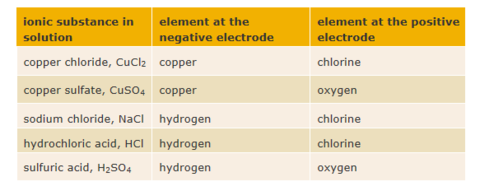
hydrogen will be produced if the metal is more reactive than hydrogen - 8what happens at the positive electrodeAt the positive electrode, negatively charged ions lose electrons. This is oxidation, and you say that the ions have been oxidised. The table summarises some of the elements you should expect to get during electrolysis.
- 9name the element at the positive and negative electrode of ionic subtances in solutions
- 10what happens during the purification of copperIn this process, the positive electrode (the anode) is made of the impure copper which is to be purified. The negative electrode (the cathode) is a bar of pure copper. The two electrodes are placed in a solution of copper(II) sulfate.
The animation shows what happens when electrolysis begins. Copper ions leave the anode and are attracted to the cathode, where they are deposited as copper atoms. The pure copper cathode increases greatly in size, while the anode dwindles away. The impurities left behind at the anode form a sludge beneath it. - 11how is hydrogen,chlorine and sodium hydroxide important in the chemical industryHydrogen
making ammonia
making margarine
Chlorine
killing bacteria in drinking water
killing bacteria in swimming pools
making bleach
making disinfectants
making hydrochloric acid
making PVC
making CFC's - limited production
Sodium hydroxide
making soap
making paper
making ceramics - 12what is brineBrine is concentrated sodium chloride solution
- 13what happens if an electric current is passed through itIf an electric current is passed through it, hydrogen gas forms at the negative electrode and chlorine gas forms at the positive electrode. A solution of sodium hydroxide forms.
- 14what is given off-sodiumYou might have expected sodium metal to be deposited at the negative electrode. But sodium is too reactive for this to happen, so hydrogen is given off instead
- 15what is a half equationA half-equation shows you what happens at one of the electrodes during electrolysis. Electrons are shown as e-. A half-equation is balanced by adding, or taking away, a number of electrons equal to the total number of charges on the ions in the equation.
- 16what happens at the negative electrode -half equationPositive ions gain electrons at the negative electrode, so are reduced.
In aluminium extraction: Al3+ + 3e- → Al
In copper purification: Cu2+ + 2e- → Cu
Electrolysis of sodium chloride solution: 2H+ + 2e- → H2 - 17what happens at the positive elecrode-half equationNegative ions or neutral atoms lose electrons at the positive electrode and are oxidised. For example, chlorine is produced during the electrolysis of sodium chloride solution:
2Cl- - 2e- → Cl2
This half-equation can be rewritten as 2Cl- → Cl2 + 2e-
In aluminium extraction: 2O2- → O2 + 4e-
In copper purification: Cu → Cu2++ 2e-
The simulation below shows what happens during the purification of copper by electrolysis.
Informationen
- Beschreibung
- GCSE Chemistry Karteikarten am electrolysis, erstellt von ella stokes am 24/02/2017.
- Erstellt von
- ella stokes
- Aufrufe
- 21
- Bewertung