
Flowchart
BAROQUE MUSIC
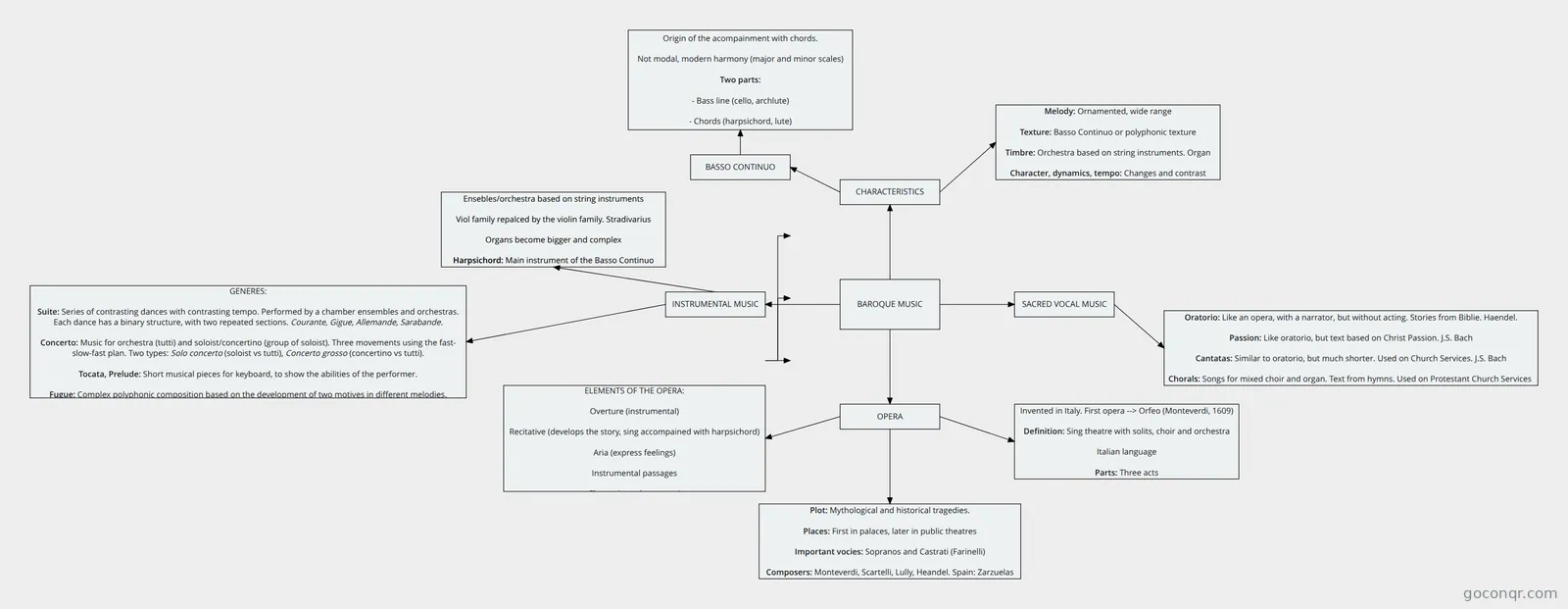
Flowchart: Baroque music
Flowchart content
BAROQUE MUSIC
CHARACTERISTICS
SACRED VOCAL MUSIC
OPERA
INSTRUMENTAL MUSIC
Melody: Ornamented, wide range
Texture: Basso Continuo or polyphonic texture
Timbre: Orchestra based on string instruments. Organ
Character, dynamics, tempo: Changes and contrast
BASSO CONTINUO
Origin of the acompainment with chords.
Not modal, modern harmony (major and minor scales)
Two parts:
- Bass line (cello, archlute)
- Chords (harpsichord, lute)
Oratorio: Like an opera, with a narrator, but without acting. Stories from Biblie. Haendel.
Passion: Like oratorio, but text based on Christ Passion. J.S. Bach
Cantatas: Similar to oratorio, but much shorter. Used on Church Services. J.S. Bach
Chorals: Songs for mixed choir and organ. Text from hymns. Used on Protestant Church Services
Invented in Italy. First opera --> Orfeo (Monteverdi, 1609)
Definition: Sing theatre with solits, choir and orchestra
Italian language
Parts: Three acts
Plot: Mythological and historical tragedies.
Places: First in palaces, later in public theatres
Important vocies: Sopranos and Castrati (Farinelli)
Composers: Monteverdi, Scartelli, Lully, Heandel. Spain: Zarzuelas
ELEMENTS OF THE OPERA:
Overture (instrumental)
Recitative (develops the story, sing accompained with harpsichord)
Aria (express feelings)
Instrumental passages
Chorus (moral passages)
GENERES:
Suite: Series of contrasting dances with contrasting tempo. Performed by a chamber ensembles and orchestras. Each dance has a binary structure, with two repeated sections. Courante, Gigue, Allemande, Sarabande.
Concerto: Music for orchestra (tutti) and soloist/concertino (group of soloist). Three movements using the fast-slow-fast plan. Two types: Solo concerto (soloist vs tutti), Concerto grosso (concertino vs tutti).
Tocata, Prelude: Short musical pieces for keyboard, to show the abilities of the performer.
Fugue: Complex polyphonic composition based on the development of two motives in different melodies.
Ensebles/orchestra based on string instruments
Viol family repalced by the violin family. Stradivarius
Organs become bigger and complex
Harpsichord: Main instrument of the Basso Continuo
Information
- Description
- Flowchart on BAROQUE MUSIC, created by Anna Ponti Fíguls on 17/05/2020.
- Created by
- Anna Ponti Fíguls
- Views
- 7
- Rating