
Flowchart
Bilingual education: frameworks and types
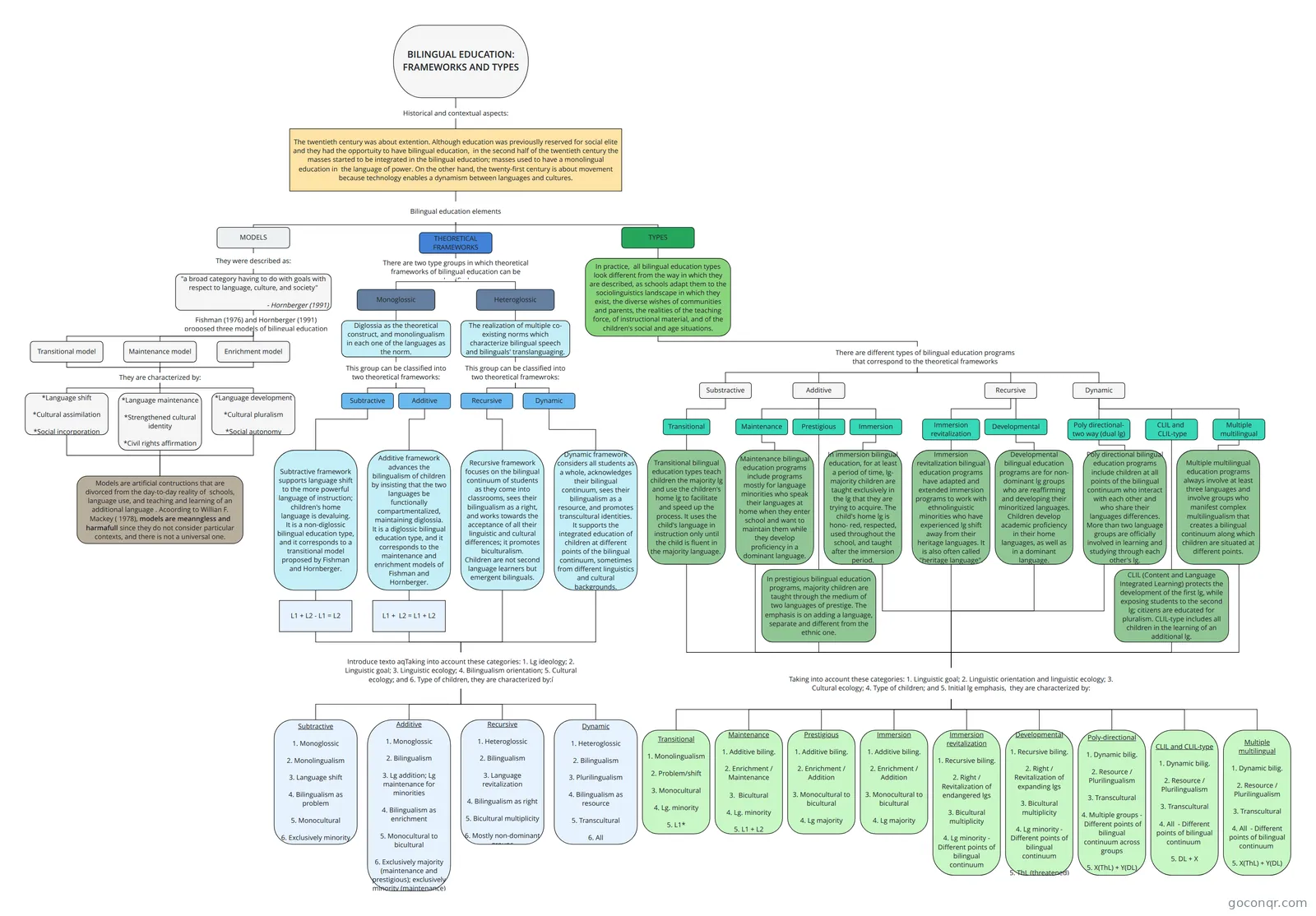
Flowchart: Bilingual education frameworks and types
Flowchart content
Historical and contextual aspects:
The twentieth century was about extention. Although education was previouslly reserved for social elite and they had the opportuity to have bilingual education, in the second half of the twentieth century the masses started to be integrated in the bilingual education; masses used to have a monolingual education in the language of power. On the other hand, the twenty-first century is about movement because technology enables a dynamism between languages and cultures.
Bilingual education elements
THEORETICAL FRAMEWORKS
MODELS
TYPES
They were described as:
"a broad category having to do with goals with respect to language, culture, and society"
- Hornberger (1991)
Maintenance model
Transitional model
Enrichment model
Models are artificial contructions that are divorced from the day-to-day reality of schools, language use, and teaching and learning of an additional language . Acoording to Willian F. Mackey ( 1978), models are meanngless and harmafull since they do not consider particular contexts, and there is not a universal one.
They are characterized by:
*Language shift
*Cultural assimilation
*Social incorporation
*Language maintenance
*Strengthened cultural identity
*Civil rights affirmation
*Language development
*Cultural pluralism
*Social autonomy
There are two type groups in which theoretical frameworks of bilingual education can be classified:
Monoglossic
Heteroglossic
Diglossia as the theoretical construct, and monolingualism in each one of the languages as the norm.
Additive
This group can be classified into two theoretical frameworks:
Subtractive
Subtractive framework supports language shift to the more powerful language of instruction; children's home language is devaluing.
It is a non-diglossic bilingual education type, and it corresponds to a transitional model proposed by Fishman and Hornberger.
Additive framework advances the bilingualism of children by insisting that the two languages be functionally compartmentalized, maintaining diglossia.
It is a diglossic bilingual education type, and it corresponds to the maintenance and enrichment models of Fishman and Hornberger.
L1 + L2 - L1 = L2
L1 + L2 = L1 + L2
The realization of multiple co-existing norms which characterize bilingual speech and bilinguals' translanguaging.
This group can be classified into two theoretical framewroks:
Recursive
Dynamic
Recursive framework focuses on the bilingual continuum of students as they come into classrooms, sees their bilingualism as a right, and works towards the acceptance of all their linguistic and cultural differences; it promotes biculturalism.
Children are not second language learners but emergent bilinguals.
Dynamic framework considers all students as a whole, acknowledges their bilingual continuum, sees their bilingualism as a resource, and promotes transcultural identities. It supports the integrated education of children at different points of the bilingual continuum, sometimes from different linguistics and cultural backgrounds.
Subtractive
1. Monoglossic
2. Monolingualism
3. Language shift
4. Bilingualism as problem
5. Monocultural
6. Exclusively minority
Additive
1. Monoglossic
2. Bilingualism
3. Lg addition; Lg maintenance for minorities
4. Bilingualism as enrichment
5. Monocultural to bicultural
6. Exclusively majority (maintenance and prestigious); exclusively minority (maintenance)
Recursive
1. Heteroglossic
2. Bilingualism
3. Language revitalization
4. Bilingualism as right
5. Bicultural multiplicity
6. Mostly non-dominant groups
Dynamic
1. Heteroglossic
2. Bilingualism
3. Plurilingualism
4. Bilingualism as resource
5. Transcultural
6. All
There are different types of bilingual education programs that correspond to the theoretical frameworks
In practice, all bilingual education types look different from the way in which they are described, as schools adapt them to the sociolinguistics landscape in which they exist, the diverse wishes of communities and parents, the realities of the teaching force, of instructional material, and of the children's social and age situations.
Substractive
Dynamic
Additive
Recursive
Transitional
Prestigious
Immersion
Maintenance
Immersion revitalization
Developmental
Poly directional-two way (dual lg)
CLIL and CLIL-type
Multiple multilingual
Transitional bilingual education types teach children the majority lg and use the children's home lg to facilitate and speed up the process. It uses the child's language in instruction only until the child is fluent in the majority language.
Maintenance bilingual education programs include programs mostly for language minorities who speak their languages at home when they enter school and want to maintain them while they develop proficiency in a dominant language.
In immersion bilingual education, for at least a period of time, lg-majority children are taught exclusively in the lg that they are trying to acquire. The child's home lg is hono- red, respected, used throughout the school, and taught after the immersion period.
In prestigious bilingual education programs, majority children are taught through the medium of two languages of prestige. The emphasis is on adding a language, separate and different from the ethnic one.
Immersion revitalization bilingual education programs have adapted and extended immersion programs to work with ethnolinguistic minorities who have experienced lg shift away from their heritage languages. It is also often called "heritage language".
Developmental bilingual education programs are for non-dominant lg groups who are reaffirming and developing their minoritized languages. Children develop academic proficiency in their home languages, as well as in a dominant language.
Poly directional bilingual education programs include children at all points of the bilingual continuum who interact with each other and who share their languages differences. More than two language groups are officially involved in learning and studying through each other's lg.
Multiple multilingual education programs always involve at least three languages and involve groups who manifest complex multilingualism that creates a bilingual continuum along which children are situated at different points.
CLIL (Content and Language Integrated Learning) protects the development of the first lg, while exposing students to the second lg; citizens are educated for pluralism. CLIL-type includes all children in the learning of an additional lg.
Transitional
1. Monolingualism
2. Problem/shift
3. Monocultural
4. Lg. minority
5. L1*
Taking into account these categories: 1. Linguistic goal; 2. Linguistic orientation and linguistic ecology; 3. Cultural ecology; 4. Type of children; and 5. Initial lg emphasis, they are characterized by:
Maintenance
1. Additive biling.
2. Enrichment / Maintenance
3. Bicultural
4. Lg. minority
5. L1 + L2
Prestigious
1. Additive biling.
2. Enrichment / Addition
3. Monocultural to bicultural
4. Lg majority
5. L1+ L2
Immersion
1. Additive biling.
2. Enrichment / Addition
3. Monocultural to bicultural
4. Lg majority
5. L2
Immersion revitalization
1. Recursive biling.
2. Right / Revitalization of endangered lgs
3. Bicultural multiplicity
4. Lg minority - Different points of bilingual continuum
5. ThL (threatened)
Developmental
1. Recursive biling.
2. Right / Revitalization of expanding lgs
3. Bicultural multiplicity
4. Lg minority - Different points of bilingual continuum
5. ThL (threatened) +DL (dominant lg)
Poly-directional
1. Dynamic bilig.
2. Resource / Plurilingualism
3. Transcultural
4. Multiple groups - Different points of bilingual continuum across groups
5. X(ThL) + Y(DL)
CLIL and CLIL-type
1. Dynamic bilig.
2. Resource / Plurilingualism
3. Transcultural
4. All - Different points of bilingual continuum
5. DL + X
Multiple multilingual
1. Dynamic bilig.
2. Resource / Plurilingualism
3. Transcultural
4. All - Different points of bilingual continuum
5. X(ThL) + Y(DL)
BILINGUAL EDUCATION: FRAMEWORKS AND TYPES
Fishman (1976) and Hornberger (1991) proposed three models of bilingual education
Introduce texto aqTaking into account these categories: 1. Lg ideology; 2. Linguistic goal; 3. Linguistic ecology; 4. Bilingualism orientation; 5. Cultural ecology; and 6. Type of children, they are characterized by:í
Information
- Description
- Flowchart on Bilingual education: frameworks and types, created by Karen Salazar Mira on 08/09/2021.
- Created by
- Karen Salazar Mira
- Views
- 10
- Rating