
Flowchart
Same language, different culture-Outline
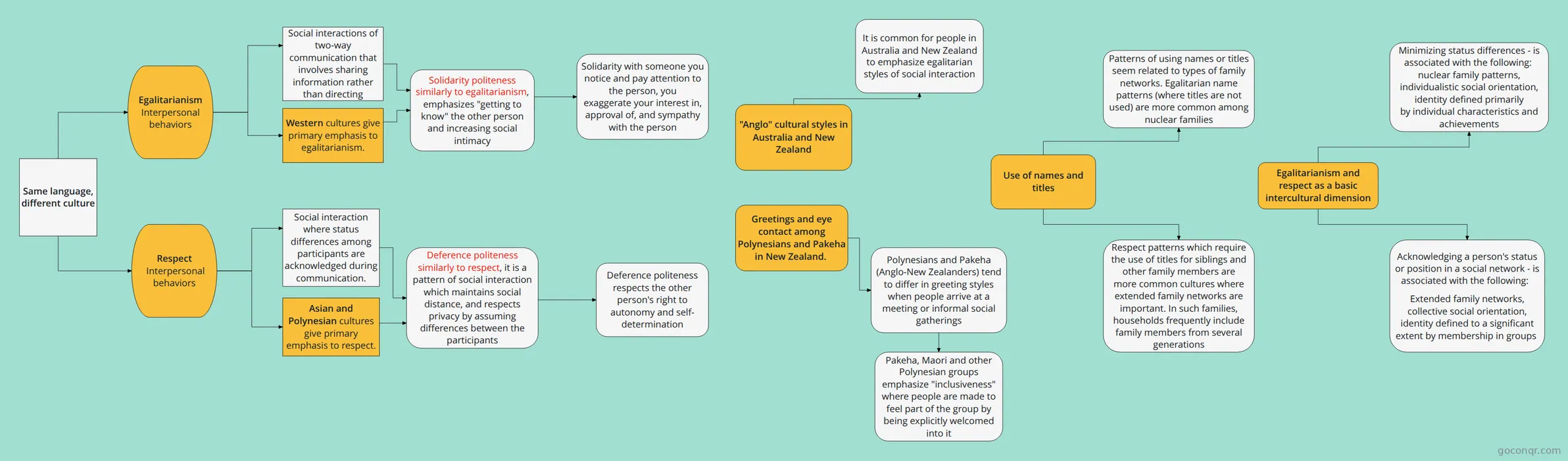
Flowchart: Same language, different culture
Flowchart content
Same language, different culture
Egalitarianism Interpersonal behaviors
Respect Interpersonal behaviors
Social interactions of two-way communication that involves sharing information rather than directing behavior.
Western cultures give primary emphasis to egalitarianism.
Social interaction where status differences among participants are acknowledged during communication.
Asian and Polynesian cultures give primary emphasis to respect.
Deference politeness similarly to respect, it is a pattern of social interaction which maintains social distance, and respects privacy by assuming differences between the participants
Deference politeness respects the other person's right to autonomy and self-determination
Pakeha, Maori and other Polynesian groups emphasize "inclusiveness" where people are made to feel part of the group by being explicitly welcomed into it
Respect patterns which require the use of titles for siblings and other family members are more common cultures where extended family networks are important. In such families, households frequently include family members from several generations
Acknowledging a person's status or position in a social network - is associated with the following:
Extended family networks, collective social orientation, identity defined to a significant extent by membership in groups
Solidarity politeness similarly to egalitarianism, emphasizes "getting to know" the other person and increasing social intimacy
Solidarity with someone you notice and pay attention to the person, you exaggerate your interest in, approval of, and sympathy with the person
Polynesians and Pakeha (Anglo-New Zealanders) tend to differ in greeting styles when people arrive at a meeting or informal social gatherings
It is common for people in Australia and New Zealand to emphasize egalitarian styles of social interaction
Patterns of using names or titles seem related to types of family networks. Egalitarian name patterns (where titles are not used) are more common among nuclear families
Minimizing status differences - is associated with the following: nuclear family patterns, individualistic social orientation, identity defined primarily by individual characteristics and achievements
"Anglo" cultural styles in Australia and New Zealand
Greetings and eye contact among Polynesians and Pakeha in New Zealand.
Use of names and titles
Egalitarianism and respect as a basic intercultural dimension
Information
- Description
- Flowchart on Same language, different culture-Outline, created by Katy Burgos on 29/10/2021.
- Created by
- Katy Burgos
- Views
- 3
- Rating