
Flowchart
Untitled
Flowchart content
Food Processing And Technology
Introduction
Food items are being processed for various reasons. Since times immemorial, grains have been dried after harvest to increase their shelf life. Initially, foods were processed primarily to improve digestibility, palatability and to ensure a continuous supply. In India pickles, murabbas and papads are examples of preserved products made from certain vegetables/ fruits/ grains. With passage of time, improved transportation, communication and increasing industrialisation, the needs of consumers have become
Chapters.
Significance
Ignificance: India has progressed from an agro-deficit to an agrosurplus country creating need for storage and processing of agricultural and horticultural produce. Indian food industry has thus emerged as a major producer of processed foods and ranks fifth in terms of size, contributing nearly 6 per cent of GDP. Besides, changes in lifestyle, increasing mobility and globalisation have increased the demands for various types of products, making the research for newer technologies necessary. It is well known that simple diets based largely on staple foods such as cereals are often deficient in certain nutrients leading to their deficiency disorders. Therefore, food fortification is done by adding the nutrient that is lacking in the food stuffs or condiments to ensure that minimum dietary requirements are met. Some examples are iodised salt, folic acid added to flour, vitamin A and D added to milk and oils/fats. In fact, FSSAI has laid down standards for fortification of staple food like salt, wheat flour, milk and oats.
Basic Concepts
Food Science: It is a distinct field involving the application of basic sciences such as chemistry and physics, culinary arts, agronomics and microbiology. Food Scientists have to use the knowledge of biology, physical sciences and engineering to study the composition of foods, changes that occur at various stages from harvest through different processes and storage, causes of their spoilage and the principles underlying food processing. Food Processing: It is the set of methods and techniques used to transform raw ingredients into finished and semi-finished products.
Food Technology: Technology is the science and application of scientific, as well as socio-economic knowledge and legal rules for production.
Food technology uses and exploits knowledge of Food Science and Food
Engineering to produce varied foods. Study of Food Technology gives in-depth knowledge of science and technology, and develops skills for selection, storage, preservation, processing, packaging, distribution of safe, nutritious, wholesome, desirable as well as affordable, convenient foods
Development of Food Processing and Technology
Research in the field of Food Technology has been conducted for decades.
1810, development of the canning process by Nicolas Appert was a decisive event. Canning had a major impact on food preservation techniques. Later
Louis Pasteur’s research, in 1864, on spoilage of wine and his description of how to avoid spoilage was an early attempt to put food technology on a scientific basis. Besides wine spoilage, Pasteur conducted research on production of alcohol, vinegar, wines, beer and souring of milk. He developed ‘pasteurisation’- the process of treating milk to destroy disease producing organisms. Pasteurisation was a significant advance in ensuring microbiological safety of food.
Food Technology was initially used to serve military needs.
Importance of Food Processing and Preservation
It has already been mentioned that food processing is a branch of manufacturing wherein raw materials are transformed into intermediate foodstuffs or edible products through the application of scientific knowledge and technology. Changes in the products often reduce preparation time for the cook. Professionals in the food processing need to be knowledgeable about general characteristics of raw food materials, principles of food preservation, processing factors which influence quality, packaging, water and waste management, good manufacturing processes and sanitation procedures.
Oods are subject to physical, chemical and biological deterioration. Food deterioration is associated with spoilage, development of off-flavors, deterioration of textures, discoloration and loss of nutritional value in varying degrees, reducing aesthetic appeal and rendering it unfit/unsafe for consumption. A number of factors can lead to food deterioration or spoilage e. Methods by which food is preserved from spoiling after harvesting or slaughtering date back to prehistoric times.
The oldest methods were sun drying, controlled fermentation, salting/pickling, candying, roasting, smoking, baking and using spices as preservatives. These tried and tested techniques are still used although, with the advent of industrial revolution, new methods have been developed.
Many food processing operations are designed to extend the shelf life of the food products. The concepts associated with food processing are reducing/eliminating microbial activity and other factors that influence food spoilage. The principle micro organisms that cause food spoilage are bacteria, fungi, yeasts and moulds. Oxidative enzymes in fresh fruits and vegetables continue to use oxygen to metabolise, reducing the shelf life of fruits and vegetables.
Controlling the availability of oxygen
Preparing for a career
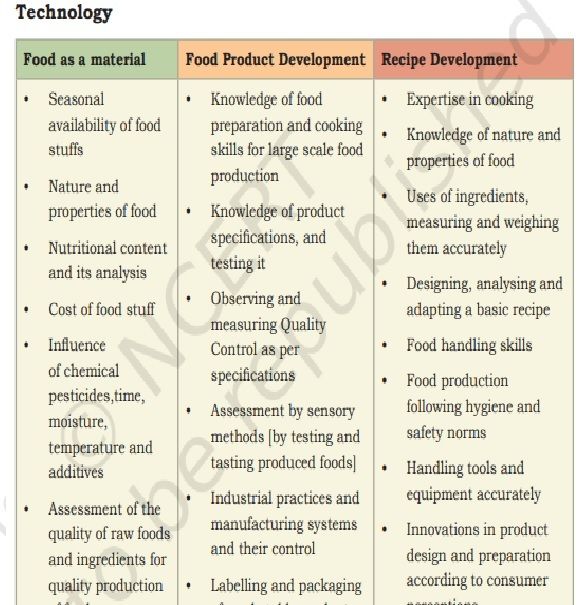
Food industry is involved in processing/manufacture, research and development , ensuring food safety and monitoring food quality, improving quality control procedures, costing to ensure profitable production, and regulatory affairs. They may specialise in a particular branch of food technology such as beverages, dairy products, meat and poultry, sea food, fats and oils, stabilisers/preservatives/colours, food grains and additives. A professional in this area requires knowledge and skills about: zz Food science, food chemistry, microbiology, food processing, safety/ quality assurance, good manufacturing practices and nutrition.
Analysis of raw and cooked/manufactured foods for composition, quality and safety.
Food ingredients, their uses in food preparations and food production on a large scale.
Product specifications and food product development.
Sensory evaluation and acceptability.
Industrial practices, systems control, distribution channels, consumer purchase patterns. Food packaging and labeling.
Ability to use information technology to support product design.
Skills in food preparation and cooking.
Ability to design, analyse, follow a design brief and adapt recipes
ith globalisation, Indian shores have opened up to foreign investments and technologies. As a result, many foreign companies and multinational companies are setting up their production, R&D, educational and outsourcing facilities in our country. Thus there is ample scope for food technologists/scientists in Indian as well as foreign organisations. Also, food processing industry provides good opportunity for export of products.
Employment exchanges will also be strengthened and upgraded.
Self Employment Avenues: Food processing in India has always been practised as household or cottage scale activity. Despite lack of basic training in food processing operations, sweets, papads, murrabas, pickles, fried snacks, roasted and puffed cereals were prepared and marketed for local consumption. Now with the growth in agriculture, horticulture and pisiculture, the production of raw material has improved. Also the
Government is giving incentives and support for enterpreneurs who want to start their own enterprise by way of providing finances, training, infrastructure and marketing facilities. Financial support is provided by many banks, with encouragement for women entrepreneurs. State
Governments also contribute by providing space to those desirous of obtaining the same. A self employment venture in food technology may be highly technology-oriented and investment–intensive, or it can be a very low key technology and low investment unit, e.g., salted peanuts, drinking water pouches, dehydrated products, pickles, among others
Information
- Description
- Flowchart on Untitled, created by DEISY JOHANA APARICIO GOMEZ on 30/07/2022.
- Created by
- DEISY JOHANA APARICIO GOMEZ
- Views
- 0
- Rating