
Module 19 of 39 · Media
Types of Bonding
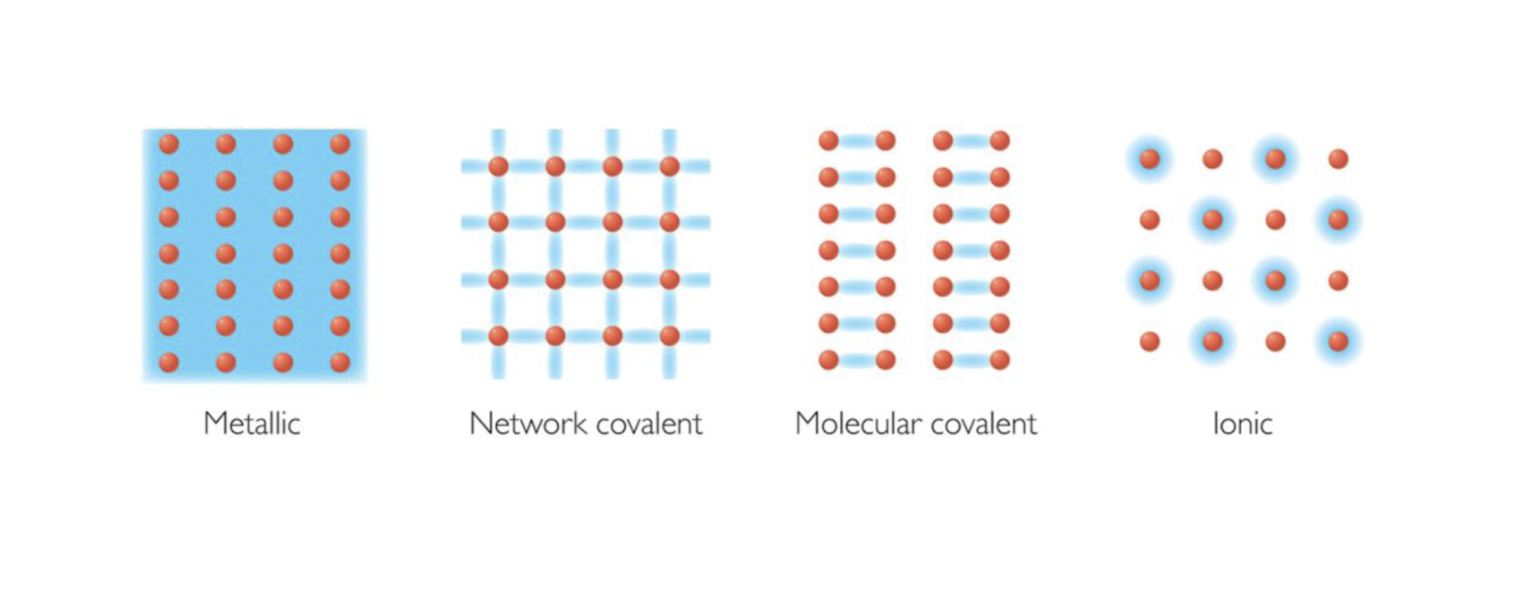
Types of Bonding
A chemical bond is an attraction between atoms that holds them together in space. Atoms bond to achieve a more stable state. Bonds are formed between neighboring atoms by sharing or transferring electrons.
Types of bonding:
- Ionic
- Electrons are transferred from one atom to another
- Made up of non-metal and metal atoms
- Soluble, Conductible when dissolved
- Usually brittle solids
- eg. salts (sodium/potassium/etc. chloride)
- Molecular Covalent
- Valence electrons are shared between pairs or groups of atoms, creating small stable units
- Made entirely of non-metal atoms
- Soluble (some), Non-Conductible
- Mostly liquids and gases
- eg. water (hydrogen oxide)
- Network Covalent
- Valence electrons are shared between the entire substance
- Made entirely of non-metal atoms
- Non-Soluble, Non-Conductible
- Extremely hard solids
- eg. sand (silicon dioxide)
- Metallic
- Valence electrons move freely about the substance
- Made entirely of metal atoms
- Non-soluble, Conductible
- Bendable, Malleable Solids
- eg. tin, gold, aluminum
The HONC Rule:
- Hydrogen makes 1 bond
- Oxygen makes 2 bonds
- Nitrogen makes 3 bonds
- Carbon makes 4 bonds
Lewis Dot Structures
- Shows pairs of electrons, both bonded pairs and lone pairs
- lone pair- a pair of electrons not involved in bonding
- Atoms tend to follow the Octet Rule, except for Hydrogen, which follows the duet rule
- The number of dots correlates with the number of valence electrons
- Double and Triple bonds
- Single bond- shares 2 electrons
- Double bond- shares 4 electrons
- Triple bond- shares 6 electrons
Electronegativity:
- Electronegativity- the tendency of an atom to attract shared electrons
- Metals- electron givers; lower electronegativity
- Non-Metals- electron takers; higher electronegativity
- Electronegativity increases from right to left across a period and up a group
- The difference between electronegativities determines how polar a molecule is