
Module 7 of 8 · Media
Screenshot 2024 05 14 At 11.59.35 Am
poisonous
gray horsebrush
Tetradymia canescens
family: Asteraceae
Native Perennial
Distribution: Western U.S.,
western Canada
Plant Communities: grasslands,
sagebrush, desert shrub, PJ,
chaparral, forests
Soil Types: medium to coarse
soils (prefers gravelly soil or
sandy loams)
Location: slopes, ridgetops, hills,
plains at 1,300 to 10,800 ft.
elevation'
• Inflorescence
• Heads 5-20
• 4 phyllaries (bracts under flower head)
• Leaves
• Alternate, simple with woolly surfaces
• Prominent midvein
• Stems gray in color
• Bark shreddy
Important
Tetradymia canescens – IdentificationFlickr “Tetradymia canescens” images courtesy of Matt Lavin.
Characteristic Growth FormFlickr “Tetradymia canescens” images courtesy of Matt Lavin.
Characteristic Growth Form■
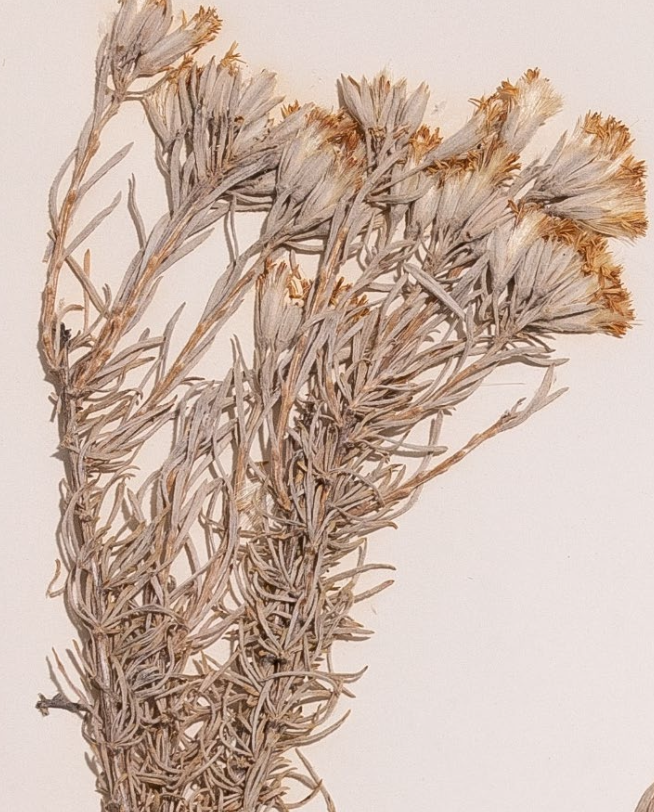
Tetradymia canescens –
herbarium sample
Sample showing typical stems:
Stems highly branched, new growth
silvery canescent tomentose.
Simple leaves, woolly-canescent, silvery.
Flowers: heads with 4 phyllaries, disk
florets bright yellow.Tetradymia canescens - Autecology
Plant Attributes
•Warm season shrub
•Relatively deep taproot
•Insect pollinated (moths, bees, flies, beetles)
•High seed production
•Low seedling survival, slow population turnover
•Regeneration by resprouting from root crown
•Occurs in all successional stagesTetradymia canescens - Autecology
Forage Quality, Palatability, and Cover
• Poor value as livestock forage species
•Toxic to sheep, with small amounts (.5% body weight)
causing liver damage, capillary breakage, and head
swelling
•Can cause abortion and poor wool quality
•Low palatability for livestock and wildlife
•Low in energy and protein content
•Can provide fair cover/habitat for large mammals and
good cover for small mammals and birdsTetradymia canescens - Autecology
Drought / Stress Tolerance
•Highly drought tolerant
Grazing Tolerance
•Increaser with high intensity grazing
Fire Tolerance
•Fire resistant shrub
•Rapid resprouting following fire