
Module 2 of 4 · Text
Growth in Flowering Plants
Growth is a characteristic of all things living. Growth means the production of new cells, usually accompanied by an increase in body size. Plants grow rather differently from animals.
https://upload.wikimedia.org/wikipedia/commons/thumb/a/a9/Plant.svg/330px-Plant.svg.png
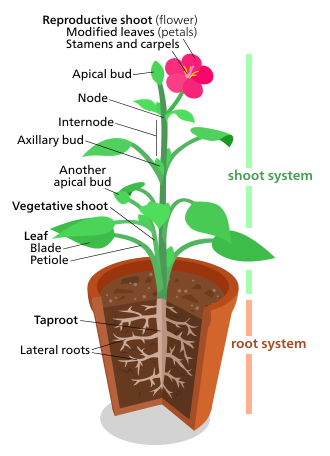
A typical plant consists of two parts - a root system that absorbs water and minerals and a shoot system that uses light energy to convert Carbon Dioxide and water into carbohydrates by photosynthesis. The roots and shoots are interdependent - The shoots depend on the roots for water and minerals, the roots depend on the shoots for energy in the form of carbohydrates.
A fully-developed shoot system consists of stem-bearing leaves. The leaves arise from points called nodes; the region between nodes is called an internode.
At the tip of the shoot, the young leaves are very small and clustered together to form a terminal bud. The stalk of a leaf is the petiole, and the angle between a petiole and the stem is the leaf axil. In each Axil, there is an axillary bud., which can grow out into a side shoot.
Petal
Produces pollen, which contains the sperm cells.
Sepal
The collective name for the anther and filament.
Nectary
Often large and coloured to attract pollinators. Collectively called the corolla.
Anther
Contains the ovules. Develops into fruit after fertilisation.
Filament
The long hollow tube connecting the stigma and ovary.
Stamen
Produces nectar to attract pollinators.
Stigma
Contains an egg cell and develops into a seed after fertilisation.
Style
Protect the bud before it opens. Collectively called the calyx.
Ovary
The sticky surface where pollen lands and germinates.
Ovule
Long stalk which holds the anther in the correct position for pollination.