
Quiz
AP WH Key Concept 1.1
This quiz has question types that open in the usual player.
Questions in this quiz (3)
11.1 A. One of the first [blank_start]major advances[blank_end] of early man was the ability to harness [blank_start]fire[blank_end]. Fire sterilized [blank_start]food[blank_end], brought people [blank_start]together in small groups[blank_end] and protected against [blank_start]predators[blank_end]. It helped people adapt to [blank_start]colder[blank_end] climates and became the focal point for the [blank_start]telling of stories[blank_end] through which [blank_start]values and knowledge[blank_end] were transmitted. Moreover, food cooked with fire eased the [blank_start]digestive process[blank_end]. Consequently, more of the body’s [blank_start]energy[blank_end] became available for the development of the [blank_start]brain[blank_end]. This may have helped Homo sapiens develop the capacity for [blank_start]language[blank_end], giving them a tremendous [blank_start]advantage[blank_end] over other mammals.
- Amajor advances
- Bfire
- Cfood
- Dtogether in small groups
- Epredators
- Fcolder
- Gtelling of stories
- Hvalues and knowledge
- Idigestive process
- Jenergy
- Kbrain
- Llanguage
- Madvantage
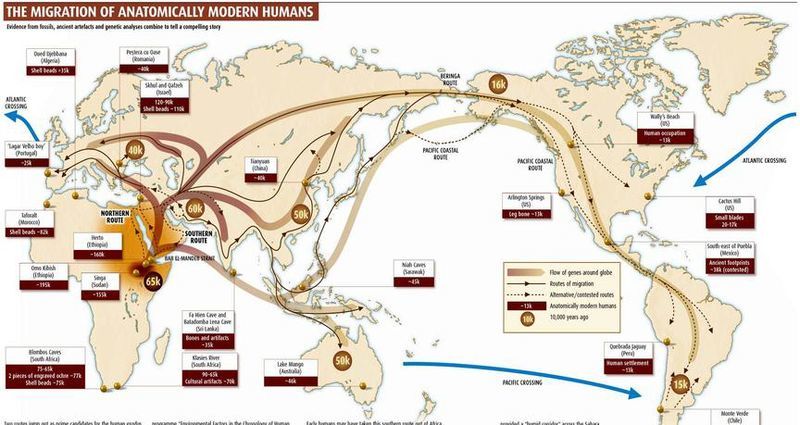
2As you can see from the map, over the course of [blank_start]thousands[blank_end] of years humans [blank_start]migrated[blank_end] from their place of origin across the face of the earth. They moved into areas with vastly different [blank_start]environments[blank_end], each with their own terms of [blank_start]survival[blank_end]. The [blank_start]peopling[blank_end] of the earth required human beings to adapt to a variety of [blank_start]climates[blank_end]. [blank_start]Tools[blank_end] made this possible. [blank_start]Bones[blank_end], [blank_start]rocks[blank_end] with sharp edges, and small pieces of [blank_start]copper[blank_end] were used to scrape hides, hunt, fish and sew. As these [blank_start]mobile bands[blank_end] came in contact with each other, they borrowed [blank_start]ideas and tools[blank_end].
- Athousands
- Bmigrated
- Cenvironments
- Dsurvival
- Epeopling
- Fclimates
- GTools
- HBones
- Irocks
- Jcopper
- Kmobile bands
- Lideas and tools
31.1 C.
[blank_start]Foraging[blank_end], or hunting and gathering, does [blank_start]not[blank_end] produce a large quantity of [blank_start]food[blank_end]. This [blank_start]limitation[blank_end] of the food supply kept foraging people in [blank_start]small groups[blank_end] of only a few people. It also meant that they were [blank_start]nomadic[blank_end], moving on to a new location once they stripped an area of its edible plants. The study of hunter/gatherers today gives us insight into their social relations. These small groups preferred not to [blank_start]marry[blank_end] in their own societies and would send [blank_start]girls[blank_end] to other foraging groups for marriage. [1] Related by [blank_start]kinship[blank_end] bonds, hunter/gatherer groups would meet to [blank_start]exchange[blank_end] tools and gifts, and to participate in [blank_start]rituals[blank_end]. It was likely there was [blank_start]movement[blank_end] of individuals among groups. There was also [blank_start]relative[blank_end] social and gender [blank_start]equality[blank_end]. Men may have taken [blank_start]leadership[blank_end] roles in some groups, but generally everyone was [blank_start]equally[blank_end] involved in the [blank_start]acquisition[blank_end] of food. It was [blank_start]impractical[blank_end] for nomadic people to [blank_start]accumulate[blank_end] more than a few things, so [blank_start]material possessions[blank_end] did were not an [blank_start]indicator[blank_end] of economic or social class. Such categories probably did not even exist for hunter-gatherers. Some modern researchers have argued that paleolithic people had more [blank_start]leisure time[blank_end], more varied and nutritious [blank_start]diets[blank_end], and were [blank_start]healthier[blank_end] than those who settled and became [blank_start]farmers[blank_end].- AForaging
- Bnot
- Cfood
- Dlimitation
- Esmall groups
- Fnomadic
- Gmarry
- Hgirls
- Ikinship
- Jexchange
- Krituals
- Lmovement
- Mrelative
- Nequality
- Oleadership
- Pequally
- Qacquisition
- Rimpractical
- Saccumulate
- Tmaterial possessions
- Uindicator
- Vleisure time
- Wdiets
- Xhealthier
- Yfarmers
Information
- Description
- AP AP World History Semster 1 Quiz on AP WH Key Concept 1.1, created by Ana Hale on 11/12/2017.
- Author
- Ana Hale
- Language
- English
- Views
- 172
- Tags
- Rating
- No ratings yet Rate this quiz