
Quiz
Neuroscience of Sleep
This quiz has question types that open in the usual player.
Questions in this quiz (59)
1Sleep is a naturally recurring state characterized by:
- reduced or absent [blank_start]consciousness[blank_end]
- relatively suspended [blank_start]sensory[blank_end] activity, and
- inactivity of nearly all [blank_start]voluntary[blank_end] muscle- Aconsciousness
- Bmemories
- Csensory
- Dneuronal
- Evoluntary
- Fskeletal
2Why do we sleep? (select all that apply):
- AVital for learning, cognition and memory (memory consolidation
- BRestoration
- CReorganization of neuronal activity
- DNeurogenesis
- EInstrumental to normal development
3All animals produce [blank_start]circadian[blank_end] rhythms, internal mechanisms that operate on an approxiamtely [blank_start]24[blank_end] hour cycle of wakefulness and sleep.
- Acircadian
- Bdream
- C24
- D12
4Circadian rhythms also regulate (select all that apply):
- AWeather
- BFrequency of eating and drinking
- CBody Composition
- DUrination
- EBody Temperatue
- FSkin Turgor
- GSecretion of hormones
- HInsulin resistance
- ISensitivity to drugs
5T or F. The purpose of the circadian rhythms is to keep our internal workings in phase with the outside world.
- ATrue
- BFalse
6A [blank_start]free[blank_end] [blank_start]running[blank_end] rhythm is a rhythm that occurs when no stimuli resets the rhythm.
- Afree
- Brunning
7A [blank_start]zeitgeber[blank_end] is a term used to describe any stimulus that resets the circadian rhythms. Examples include [blank_start]light[blank_end], which is the primary one, as well as exercise, noise, meals and temperatue.
- Azeitgeber
- Blight
8T or F. Rhythms of waking and sleep do not change as a function of age.
- ATrue
- BFalse
9See question in the image
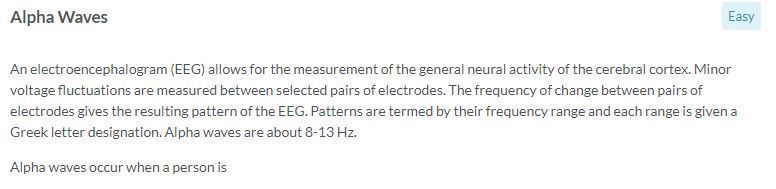
- Aalert
- Battentive
- Cresting quietly
- Dsleeping soundly
10As we drift in and out of sleep at the start of a typical night’s sleep, we enter a sleep period known as:
- AREM sleep.
- BNREM sleep
- CSlow wave sleep.
- DDelta sleep.
11Compared with stages 1 and 2 of the NREM sleep period, in stages 3 and 4:
- ASleep is lighter and it is easier to wake the sleeper
- BTheta waves are more common
- CMuscle tone, heart rate, body temperative, and blood pressure all increase
- DDelta waves are more common
12There is four stage of Non-REM sleep. This stage is also thought of as "[blank_start]deep[blank_end] sleep".
- Adeep
- Bearly
13Components of REM sleep include: (select all that apply)
- ARapid Eye Movement
- BIrregular heart rate and breathing
- Cparadoxical sleep
- Ddream state
14A mix of alpha and theta brain waves is most commonly observed during ________sleep.
- AREM
- BREM Stage 1
- CNREM Stage 2
- DNREM Stage 3
15During the night, we typically have how many cycles of NREM (1-4) and REM sleep?
- A2-3
- B5-7
- C4-5
- D8-10
16Which of the following is NOT true of REM sleep?
- ADuring the night, REM sleep lengthens in duration
- BDuring the night REM sleep occurs after an NREM sleep cycle
- CMuscle tone increases during REM sleep
- DREM follows the lightest stages of sleep
17The length of time to the 1st REM episode (REM latency) is [blank_start]90[blank_end] minutes. (put answer in numeric form).
- A90
18REM latency is usually reduced in patients with:
[blank_start]Exhaustion[blank_end]
[blank_start]Depression[blank_end]
[blank_start]Narcolepsy[blank_end]
[blank_start]Sleep apnea[blank_end]- AExhaustion
- BMigraines
- CDepression
- DAnxiety
- ENarcolepsy
- FCataplexy
- GSleep apnea
- HInsomnia
19Studies indicate that most adults need _____ hours of sleep each night
- A8-10
- B7-9
- C6-8
- D10-12
20Match the Stage to the Wave Type:
Stage 1: [blank_start]low voltage[blank_end] [blank_start]mixed frequency[blank_end]
Stage 2: [blank_start]sleep spindles[blank_end] [blank_start]K complexes[blank_end]
Stage 3: [blank_start]mostly slow waves[blank_end]
Stage 4: [blank_start]slow waves[blank_end]- Alow voltage
- Bmixed frequency
- Csleep spindles
- DK complexes
- Emostly slow waves
- Fslow waves
21Label the Stages of Sleep from the Drag & Drop Selections (note that some answers may be used twice-for Stage II, Use Stage II answer 1st, Stage 2 answer 2nd and Stage Two answer 3rd, for Stage III-use this form first):
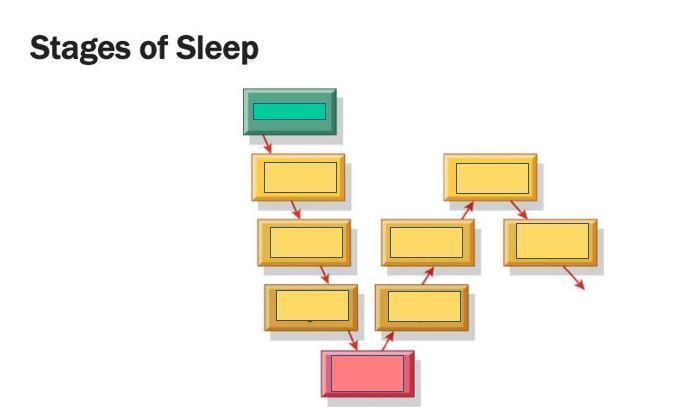
- AWakefulness
- BNREM Stage 1
- CNREM Stage II
- DNREM Stage III
- ENREM Stage IV
- FNREM Stage 3
- GNREM Stage 2
- HREM
- INREM Stage Two
22Match the characteristic to the type of sleep (NREM or REM):
EEG more similar to waking brain [blank_start]REM[blank_end]
Lack of prominent eye movement or muscle paralysis [blank_start]NREM[blank_end]
Working through past [blank_start]NREM[blank_end]
Intense brain activity [blank_start]REM[blank_end]
Vivid dreams [blank_start]REM[blank_end]
Dreams-thoughts [blank_start]NREM[blank_end]
Emotional processing [blank_start]REM[blank_end]
Learning [blank_start]NREM[blank_end]
Creativity [blank_start]REM[blank_end]
Consciousness may be totally obliterated [blank_start]NREM[blank_end]
Dreams-hallucinatory [blank_start]REM[blank_end]
The brain is active [blank_start]NREM[blank_end]
Transitional and slow wave sleep; neurological rest [blank_start]NREM[blank_end]
Potential future scenarios [blank_start]REM[blank_end]- AREM
- BNREM
- CNREM
- DREM
- ENREM
- FREM
- GREM
- HNREM
- IREM
- JNREM
- KNREM
- LREM
- MREM
- NNREM
- ONREM
- PREM
- QREM
- RNREM
- SNREM
- TREM
- UREM
- VNREM
- WNREM
- XREM
- YNREM
- ZREM
- AAREM
- ABNREM
23[blank_start]NREM[blank_end] sleep is a restorative function, with slow-rolling eye movements, decreased muscle tone, movement, HR, RR, BP, metabolism and temperature
- ANREM
24A sleep researcher is recording details of Elka's sleep patterns in a sleep laboratory. Elka's EEG recording shows that she is currently experiencing low-frequency, high-amplitude DELTA waves. Her EOG shows no sign of activity. The researcher can hear Elka talking, but cannot make out what she is saying. Elka is most likely experiencing:
- AREM Sleep
- BMuscle paralysis
- CNREM Stage 2 sleep
- DNREM Stage 4 sleep
25During which stage of sleep will you experience “hypnic jerks” – often associated with the feeling of falling.
- AStage 1
- BStage 2
- CStage 3
- DStage 4
26Match the NREM stages of sleep to their characteristic (some have two answers, and some answers are used twice):
Stage 1 [blank_start]Drowsiness[blank_end]
Stage 2 [blank_start]Light sleep[blank_end] [blank_start]Sleep spindles occur[blank_end]
Stage 3 [blank_start]Delta waves[blank_end], [blank_start]slow wave,[blank_end] [blank_start]moderate-deep sleep[blank_end]
Stage 4 Delta waves, slow wave, [blank_start]hardest to awaken from[blank_end]- ADrowsiness
- BLight sleep
- CSleep spindles occur
- DDelta waves
- Eslow wave,
- Fmoderate-deep sleep
- Ghardest to awaken from
27[blank_start]Paradoxical[blank_end] sleep is defined as an active hallucinating brain in a paralyzed body. An active brain, inactive body. This occurs during [blank_start]REM[blank_end] sleep.
- AParadoxical
- BREM
28During REM sleep you will have:
- ALow frequency, high amplitute EEG
- BHigh frequency, low aplitute EEG
29What causes the paralysis of large muscles during REM sleep?
- ADecreased GABA in pontine reticular formation inhibits lower motor neurons
- BIncreased GABA in pontine reticular formation inhibits lower motor neurons
- CDecreased Glutamate in pontine reticular formation inhibits lower motor neurons
- DIncreased Glutamate in pontine reticular formation inhibits lower motor neurons
30T or F. You will have 4-5 episodes of REM sleep per night and they increase in length
- ATrue
- BFalse
31During dreaming, which occurs in REM sleep, there is [blank_start]increased[blank_end] limbic system activity and [blank_start]decreased[blank_end] activity in the PFC>
- Aincreased
- Bdecreased
- Cdecreased
- Dincreased
32Fetal and infant sleep have a _____ proportion of REM sleep.
- Alow
- Bhigh
33REM sleep is ________ during adult life.
- ASteady
- BUnsteady
34REM sleep ______ with old age and the use of antidepressants.
- Aincreases
- Bdecreases
35Stage 4 sleep has__________waves.
- Asyncjhronized
- Bdesynchronized
36REM sleep has ____________waves.
- ASynchronized
- BDesynchronized
37Label the EEG Waves
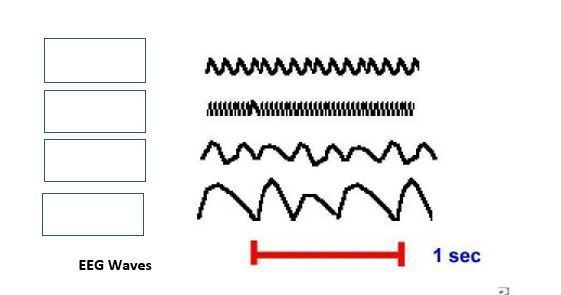
- AALPHA
- BBETA
- CTHETA
- DDELTA
38As we get older, the time to fall asleep:
- AIncreases
- BDecreases
39As we get older, our total sleep time:
- AIncreases
- BDecreases
40The areas of the brain activated in REM sleep are (see slide 38 in PPT)
1) Anterior Cingulate Cortex
2) [blank_start]Subcallosal cortex[blank_end]
3) Basal forebrain
4) Septal area
5) [blank_start]Hypothalamus[blank_end]
6) [blank_start]Amygdala[blank_end]- ASubcallosal cortex
- BHypothalamus
- CAmygdala
41T or F. 5HT, ACh, NE, DA and Histamine are active during arousal and quiet during NREM.
- ATrue
- BFalse
42T or F. During REM, ACh neurons resume activity and monoamines slow down even further.
- ATrue
- BFalse
43The Wake Promoting Neurotransmitter include (match NT to correct area of the brain):
[blank_start]ACh[blank_end] - Nuclei in the pons
[blank_start]NE[blank_end] - Locus coeruleus
[blank_start]5HT[blank_end] - Raphe nuclei
[blank_start]DA -[blank_end] Periaqueductal gray matter
[blank_start]HIstamine[blank_end] - TMN of the hypothalamus
[blank_start]Orexin[blank_end] - Posterior hypothalamus- AACh
- BNE
- C5HT
- DDA -
- EHIstamine
- FOrexin
44[blank_start]GABA[blank_end] is the sleep-promoting neurotransmitter-in the VLPO (i.e. the sleep center) it inhibits TMN or wake promoter.
- AGABA
45Too tired to turn this into a fancy matching question...so here it is for memorizing pleasure.
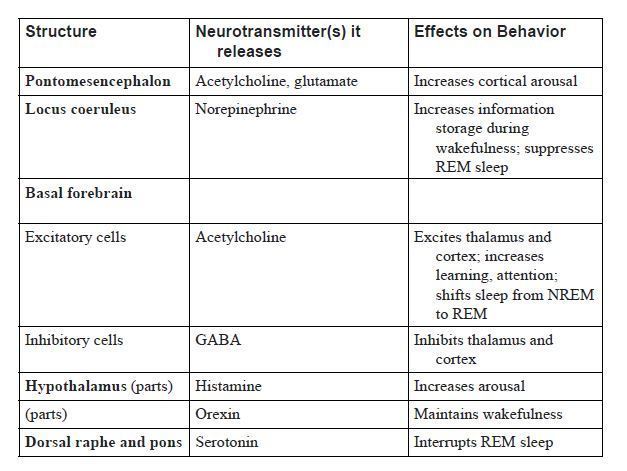
- ATrue
- BFalse
46The suprachiasmatic nucleus (SCN) signals the [blank_start]pineal[blank_end] gland that synthesizes [blank_start]melatonin[blank_end]. The release increases as the environmental light decreases.
- Apineal
- Bmelatonin
47The SCN is synchronized by signals from the retina. Retina signals are activated by inputs from the [blank_start]sun[blank_end].
- Asun
48Melatonin is an [blank_start]indolamine[blank_end] and a circadian rhythm regulated hormone.
- Aindolamine
- Bcathecolamine
49T or F. There is substantial evidence showing that melatonin turns off the activity of the SCN suggesting that this is the function that allows individuals to go to sleep.
- ATrue
- BFalse
50Put the melatonin fluctuation levels over a 24 hour period in the correct sequential order:
[blank_start]1:[blank_end] The pineal gland begins producing melatonin in the evening.
[blank_start]2[blank_end]: Melatonin levels peak in the middle of the night
3: Melatonin levels decline to low daytime amounts- A1:
- B2:
- C3:
- D2
51Which of the following statements is true of sleep deprivation?
- ASleep deprivation has no physiological effects
- BSleep deprivation affects one's abilities to perform cognitive tasks
- CSleep deprivation is a non-issue in older adults since they sleep less
- DThe effects of sleep deprivation disappear only after the individual has slept for the same amount of time they were sleep deprived.
52Narcolepsy is an irresistible attack of refreshing sleep that occurs daily over at least 3 months, and one must have at least one of the following (selecting all that apply):
- ACataplexy
- BApnea
- CHypocretin (orexin) deficiency in the CSF level
- DExcess GABA
- ENight terrors
- FNocturnal sleep polysomnography showing REM sleep latency.
53Narcolepsy -Major Symptoms (match the term to the correct definition):
[blank_start]Cataplexy[blank_end]: Sudden loss of postural tone brought on by emotion, particularly laughter
[blank_start]Excessive sleepiness[blank_end]: No relieved by adequate amounts of sleep; persistent throughout the day
[blank_start]Sleep paralysis[blank_end]: Occurs at the onset of sleep or upon awakening
[blank_start]Hypnagogic/hypnopompic[blank_end]: Dream imagery occurring at the onset or end of sleep.- ACataplexy
- BExcessive sleepiness
- CSleep paralysis
- DHypnagogic/hypnopompic
54The onset of narcolepsy is usually before _____ years of age.
- A20
- B10
- C40
- D30
55Type [blank_start]I[blank_end] Narcolepsy is caused by hypocretin (orexin) deficiency and almost always accompanied by cataplexy.
- AI
- BII
56The following are true in the neuroscience of narcolepsy (select all that apply):
- AFrequent REM sleep attacks during the day
- BSKIPS NREM
- CVLPO, the sleep switch in the brain induces sleep by putting brakes on GABA on arousal nuclei
- DDecreased orexin, wake-promoting neurons, in the hypothalamus.
57Which medication will patients with obstructive sleep apnea/hypopnea have a poor response to?
- AVenlafaxine
- BCymbalta
- CViibyrd
- DZoloft
58T or F. Patients with a sleepwalking disorder (NREM) have amenisia for the episode.
- ATrue
- BFalse
59T or F. Snoozing with booze in your system makes you miss a key part of the sleep cycle known as REM.
- ATrue
- BFalse
Information
- Description
- Quiz on Neuroscience of Sleep, created by Maggie Throckmorton on 28/03/2018.
- Author
- Maggie Throckmorton
- Language
- English
- Views
- 229
- Rating
- No ratings yet Rate this quiz