
Quiz
TMA01 Tutorial
This quiz has question types that open in the usual player.
Questions in this quiz (12)
1General design principles in constructing software are the following:
–[blank_start]Divide[blank_end] and C[blank_start]onquer[blank_end]
–Increase C[blank_start]ohesion[blank_end]
–Reduce C[blank_start]oupling[blank_end]- ADivide
- Bonquer
- Cohesion
- Doupling
2Select statements that describe best practices in terms of cohesion and coupling.
- ACohesion: Group closely the related activities within a single module
- BCoupling: Reduce degree of interdependence among different components of system
- CCoupling: Increase degree of interdependence among different components of system
- DCohesion: keep modules small and split as much as possible
3Agile Software Development Manifesto:
–[blank_start]Individuals[blank_end] and interactions over [blank_start]processes[blank_end] and
tools
–[blank_start]Working[blank_end] software over comprehensive [blank_start]documentation[blank_end]
–Customer [blank_start]collaboration[blank_end] over [blank_start]contract[blank_end] negotiation
–Responding to [blank_start]change[blank_end] over following a [blank_start]plan[blank_end].- AIndividuals
- Bprocesses
- CWorking
- Ddocumentation
- Ecollaboration
- Fcontract
- Gchange
- Hplan
4Select all statements that apply to an activity diagram.
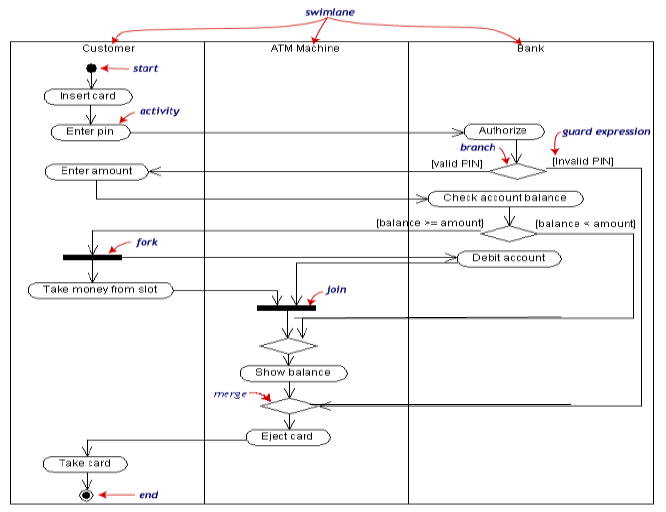
- Ait shows a process as a set of activities
- BIt shows how activities depend on one another
- CIt shows which activities can be carried out in parallel
- DIt shows the objects needed to realise the use case
- EThere can be several start states
- FThere can be several end states
5Place the boxes on the correct elements.
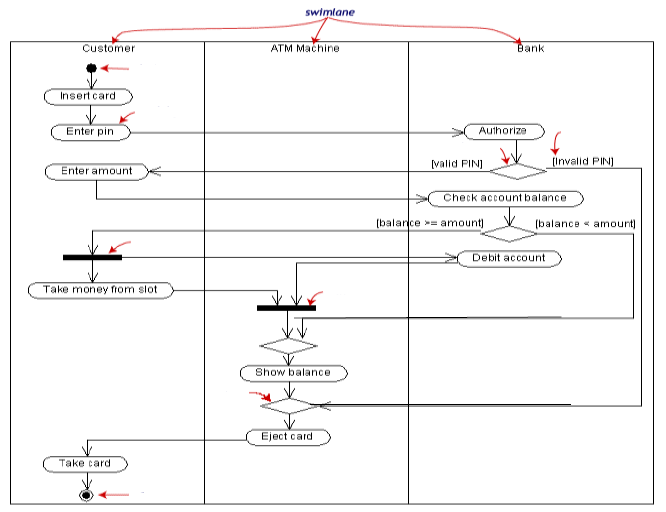
- Astart
- Bactivity
- Cfork
- Dguard expression
- Ebranch
- Fjoin
- Gmerge
- Hend
6A Join is where the paths [blank_start]meet[blank_end], a Fork is where the paths [blank_start]split[blank_end].
- Ameet
- Bsplit
7Select statements that apply to use cases and actors (select 4).
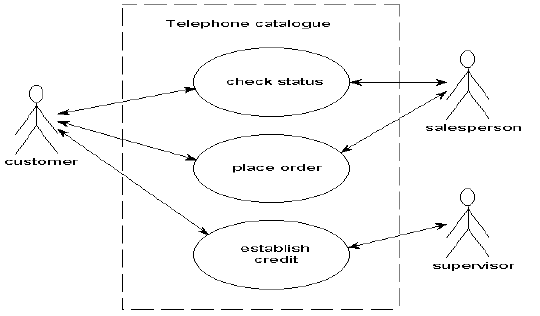
- AUse Cases define what a proposed system should do from a user’s perspective
- BUse Cases define how a proposed system's business domain should be implemented
- COne actor may play many roles
- DOne actor may play only one role
- EActors can be people or other systems
- FActors can only be people
- GA role may have many people playing in it
8Select all statements that apply to use case diagrams (Select 3).
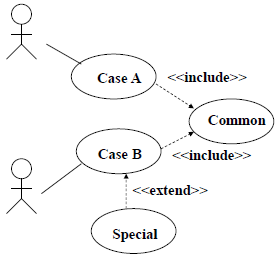
- AIn UML, special types of relationships are called stereotypes.
- BThe include relationship allows common behaviour to be pulled out into a separate use case.
- CThe include relationship injects common behaviour into use cases A and B.
- DThe extend relationship shows behaviour which is exceptional, optional or special.
9Complete the missing stereotypes.
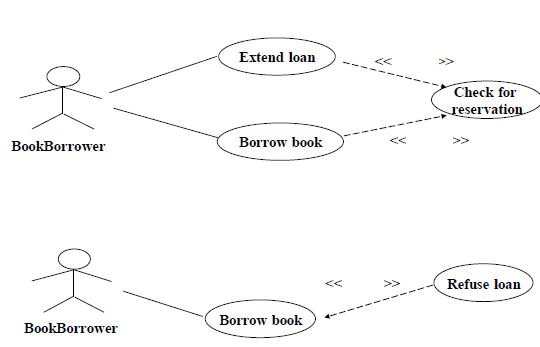
- Ainclude
- Binclude
- Cextend
10In the diagram, the arrow represents [blank_start]inheritance[blank_end] of actors.
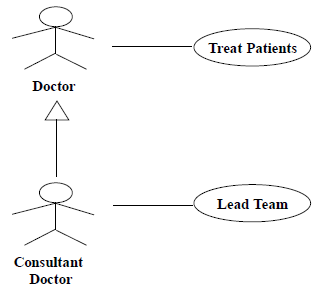
- Ainheritance
11In the diagram, the arrows illustrate the fact that the 'Phone Order' and 'Internet Order' use cases [blank_start]inherit[blank_end] from 'Place Order'.
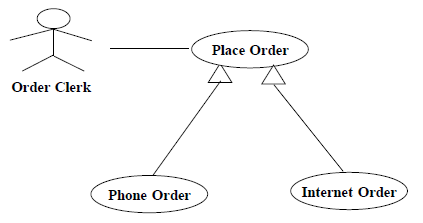
- Ainherit
12Complete the Use Case template below.
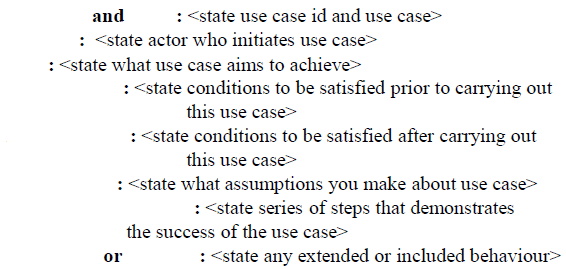
- AIdentifier
- Bname
- Cinitiator
- Dgoal
- Epre-condition
- Fpost-condition
- Gassumptions
- Hmain success scenario
- Iextensions
- Jincludes
Information
- Description
- Software Engineering Quiz on TMA01 Tutorial, created by Frans k on 30/04/2018.
- Author
- Frans k
- Language
- English
- Views
- 0
- History
- Created on 30 Apr 2018 · updated on 5 May 2018
- Tags
- Rating
- No ratings yet Rate this quiz