
Quiz
Research Methods IV - Week 10 Factorial ANOVA III
Questions in this quiz (10)
1Assuming the data meets the assumptions of parametric tests, non-parametric tests compared to their parametric counterparts ____________.
- AAre more conservative
- BHave less statistical power
- CAre less likely to accept the alternative hypothesis
- DAll of the above
2A researcher measured leadership skills in doctors, police officers and accountants. The data were skewed. What is the most appropriate test to analyse the data?
- AKruskal-wallis test
- BFriedman test
- CWilcoxon test
- DMann-whitney test
3The results of the test used to analyze the data described in question 2 showed a significant result. How should the researcher carry out post-hoc tests?
- ACompare groups using Mann-whitney test
- BCompare groups using Wilcoxon test
- CCompare groups using t-Test
- DNon of the above. Post-hoc analyses can not be carried out with non-parametric data
4An advantage of non parametric statistics is that ____________.
- AThey are easy to calculate
- BThey are very powerful
- CYou need a computer to calculate them
- DThey have many assumptions to meet
5Which of the following tests is analogous to a standard within-subjects ANOVA?
- AFriedman
- BKruskal-wallis
- CWilcoxon
- DMann-whitney
6Tied scores (when two or more scores have the same value) may present a problem in non-parametric tests. The way to deal with them in a Kruskal-Wallis test is to
- AThrow out the tied data
- BAssign any tied values the lower of the ranks they would have recieved had they not been tied
- CUse a random number table to assign ranks to the tied values
- DAssign any tied values the average of the ranks they would have recieved had they not been tied
7A data-set contains the following values: 23, 28, 37, 23, 45, 49, 37, 62. Rank the values. Which rank is associated with value 37?
- A4
- B4.5
- C3.5
- D6
8Researchers wanted to examine whether the 'sea-food' diet was effective. A group of volunteers were placed on the diet and their weight (in kilograms) was measured at the beginning of the diet, after 1 month, after 2 months, then at the end of the diet after 3 months. The data were not normally distributed. Which test would be appropriate to analyse the data?
- AFriedman
- BWilcoxon
- CKruskal-Wallis
- DMann-Whitney
9The output from the study described in question 8 is shown below.
What is the correct way to report these results?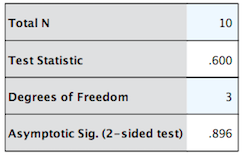
- AThe weight of the participants did not significantly change during the diet, x2 (3) = .60, p = .89
- BThe weight of the participants did significantly changed during the diet, x2 (3) = .60, p > .05
- CThe weight of the participants did not significantly change during the diet, x2 (3) = .60, p = .90
- DThe weight of the participants did significantly changed during the diet, x2 (3) = .60, p < .05
10In a Kruskal-Wallis test, the ____________ the value of H, the more likely you are to reject the null hypothesis
- AMore negative
- BSmaller
- CLarger
- DH is not relevant for the Kruskal-Wallis test
Information
- Description
- Quiz on Research Methods IV - Week 10 Factorial ANOVA III, created by Brage Haavik on 16/04/2019.
- Author
- Brage Haavik
- Language
- English
- Views
- 137
- Rating
- 5.0 out of 5 · 3 ratings Rate this quiz