
Quiz
CSSE4004 - Lecture 3
Questions in this quiz (18)
1Which of the following is true about typical RPC
- ASynchronous and transient
- BSynchronous and persistent
- CNonblocking and transient
- DSynchronous and temporary
2What is not a common protocol that middleware provides?
- ASecurity
- BTransaction
- CMessage queuing
- DConcurrency
3Which of these is not a type of synchronicity?
- APersistent asynchronous communication
- BReceipt-based transient synchronous communication
- CResponse-based transient synchronous communication
- DMulticast response synchronization
4This is not an interleaved transmission
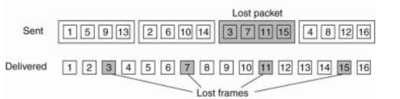
- ATrue
- BFalse
5Which of the following is false about publish-subscribe
- AOne message might be delivered to multiple recipients
- BSubscriptions may be conditional upon the content of the message
- CThe broker is responsible for deciding which subscribers should receive the message
- DThe sender specifies which recipients should receive the message
6Which of these is NOT an issue resolved by Parameter marshaling?
- AClient and server have different data representations
- BClient and server have to agree on the same encoding
- CInterpreting data and transforming it into machine dependent
representation - DGenerating stubs to interface with server side application
7What does Message-oriented communication typically allow over traditional RPC?
- AAsynchronous communication
- BPersistent communication
- CReliable communication
- DMulticast RMI
8When is stream-oriented communication appropriate?
- AWhen the the temporal relationship between different data items is essential
- BWhen large blocks of data such as video files are involved
- CWhen reliable communication is not required
- DWhen buffering is not acceptable
9Which of the following is true about Persistent synchronous communication if the recipient is not running
- AThe message is stored and the sender receives accepted acknowledgement immediatley
- BThe message is stored and the sender receives accepted acknowledgement when the recipient starts
- CThe sender is blocked until the receiver starts
- DThe message is discarded and the sender is notified when the receiver starts
10Which is true about Transient asynchronous communication if the reciever is not running
- AThe message will not be received but the sender won't be blocked
- BThe message will be queued until the receiver starts
- CThe sender will automatically retry until receiver starts
- DThe message will not be received and the sender will be blocked
11Which of the following is true about parameter specifications and stubs?
- AParameters passed by value do generally pose any problems
- BIt is only possible to pass parameters by value if they are primitive data types
- CInterfaces (procedures) are often specified in Interface Definition Languages (IDL) and compiled into stubs
- DIt is completely impossible to pass parameters by reference
12What type of communication is this?
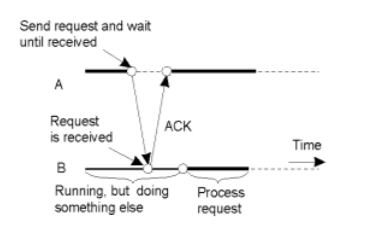
- AReceipt-based transient synchronous communication
- BTransient asynchronous communication
- CDelivery-based transient synchronous communication at
message delivery - DPersistent synchronous communication
13What are the basic operations of a message queue?
- APut, Get, Poll, Notify
- BPush, Get, Poll, Notify
- CPop, Get, Poll, Subscribe
- DPut, Get, Notify, Acknowledge
14What is the main role of a message broker?
- ATo transform messages from sender's format to receive'’s format
- BTo handle retries if a receiver fails to acknowledge the message
- CTo manage who is authorized to subscribe to which queue
- DTo balance messages between multiple storage queues
15What does this diagram represent?
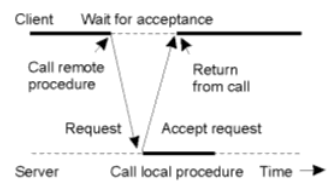
- ATraditional RPC
- BAsynchronous RPC
- CPassing a value by reference
- DA callback following an asynchronous RPC
16Which layer does the middleware layer sit between?
- AApplication and transport
- BTransport and network
- CApplication and network
- DOperating system and Network
17What kind of communication is this?
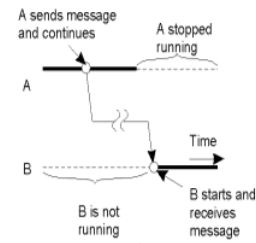
- APersistent asynchronous communication
- BPersistent synchronous communication
- CResponse-based transient synchronous communication
- DTransient asynchronous communication
18Is the caller of an RPC usually blocked while waiting for a result?
- ATrue
- BFalse
Information
- Description
- CSSE4004 - Lecture 3
- Author
- tb22
- Language
- English
- Views
- 347
- Tags
- Rating
- No ratings yet Rate this quiz