
Quiz
P2 Quiz
This quiz has question types that open in the usual player.
Questions in this quiz (17)
1Choose the sources of light.
- ALightbulb
- BSun
- CMoon
- DFire
- EWater
2Light belongs to the electromagnetic spectrum, a family of electromagnetic waves that travel at a speed of 300 000 km/s through space, which is a vacuum.
- ATrue
- BFalse
3What is a 'photon'?
- AA tiny packet of energy that behaves similar to a wave, but also as a stream of particles.
- BA picture taken of light.
4The intensity of [blank_start]electromagnetic[blank_end] radiation gets less as you move [blank_start]further[blank_end] away from the source. The intensity of the Sun's radiation decreases further away from it because it is spread over a [blank_start]larger[blank_end] area. This is why planets more distant from the Sun than the Earth are much [blank_start]cooler[blank_end] than our planet. The earth receives more of the Sun's electromagnetic radiation because the intensity of the radiation is [blank_start]greater[blank_end] closer to the Sun.
[blank_start]Intensity[blank_end] = energy transferred per second per m^2.
If you move a torch closer to a surface, its light spreads over a smaller area and becomes [blank_start]brighter[blank_end]. The total energy from the torch each second is the [blank_start]same[blank_end], but the intensity of light on the surface increases. This happens because as the distance [blank_start]doubles[blank_end], the area the energy spreads over increases four-fold, and so the intensity [blank_start]decreases[blank_end] four-fold.- Aelectromagnetic
- Bfurther
- Clarger
- Dcooler
- Egreater
- FIntensity
- Gbrighter
- Hsame
- Idoubles
- Jdecreases
5X-Rays have a higher frequency than gamma rays.
- ATrue
- BFalse
6Radiation workers increase their risk of exposure to X-rays and [blank_start]gamma[blank_end] rays. They can choose whether to accept this [blank_start]risk[blank_end]. The risk can be monitored using [blank_start]dosimeters[blank_end], allowing problems to be spotted before too much harm is done.
People who have mobile phone [blank_start]masts[blank_end] built near their homes have exposure to [blank_start]microwaves[blank_end] forced upon them. They tend to be less [blank_start]willing[blank_end] to accept any level of risk, and are more likely to [blank_start]overstate[blank_end] possible risks.- Agamma
- Brisk
- Cdosimeters
- Dmasts
- Emicrowaves
- Fwilling
- Goverstate
7We are surrounded by ionising radiation all the time. The risk to health is very low, but people tend to overstate it. Why?
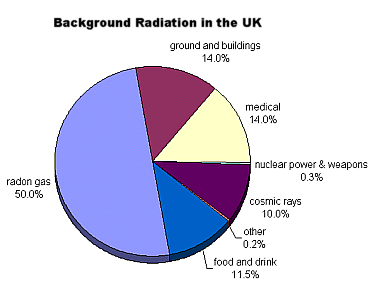
- Ait is unfamiliar to us
- Bit is invisible and hard to detect
- Ceffects can be long lasting
- Dpeople want to deter new projects eg. nuclear power stations
- Epeople are unsure of risks due to lack of education
8Why does a substance warm up when it absorbs radiation?
- Athe energy from the absorbed radiation is transferred to thermal (heat) energy
- Bthe radiation excites the particles, generating thermal energy
- CBoth!
9The risks to living cells from microwaves are very low because microwaves have a low frequency.
- ATrue
- BFalse
10What is ozone?
- AA form of oxygen containing three oxygen atoms.
- BA substance that increases the amount of UV radiation on Earth.
11Ozone is produced when oxygen [blank_start]molecules[blank_end] absorb high energy UV radiation and react together. Ozone molecules may split into an oxygen molecule and a free oxygen [blank_start]atom[blank_end] if they absorb low energy UV radiation. In both these reactions, [blank_start]infrared[blank_end] radiation is emitted. Ozone also reacts with nitrogen, hydrogen, chlorine and bromine [blank_start]compounds[blank_end].
The absorption of [blank_start]ultraviolet[blank_end] radiation in the ozone layer reduces the amount of ultraviolet radiation reaching the Earth's [blank_start]surface[blank_end]. It also causes [blank_start]chemical[blank_end] changes in this part of the atmosphere.- Amolecules
- Batom
- Cinfrared
- Dcompounds
- Eultraviolet
- Fsurface
- Gchemical
12Using the diagram, explain what the Greenhouse effect is and how it affects the Earth.
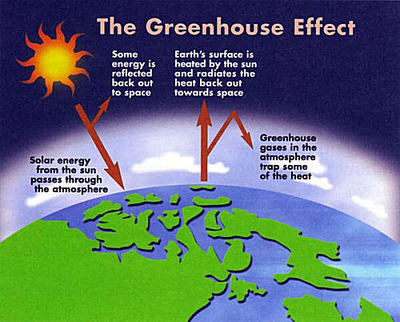
- AClick here when done
- BNot here
13Which of the following are greenhouse gases?
- AWater Vapour
- BMethane
- CCarbon Dioxide
- DSulphur Dioxide
- ENitrogen
14What is Global Warming?
- AThe increase in average temperature worldwide caused by an increase in the greenhouse effect.
- BClimate change.
- CThe extinction of antarctic species.
15A digital signal is a type of signal that can take one of a small number of fixed (discrete) values. The values change is discrete steps, and cannot take any values in-between.
- ATrue
- BFalse
16Which of these describes an analogue signal?
- AA signal that can take one of a small number of fixed (discrete) values. The values change is discrete steps, and cannot take any values in-between.
- BA signal which can vary continuously.
17There are several advantages of sending information using [blank_start]digital[blank_end] signals:
- different types of [blank_start]information[blank_end] can be sent at the same time
- digital signals can be sent more accurately than [blank_start]analogue[blank_end] signals
- digital information can be stored and [blank_start]processed[blank_end] by computers.
- digital signals can only take certain [blank_start]values[blank_end], so it is easy to tell which part of the signal is real and what is [blank_start]noise[blank_end] (unwanted information mixed in with the original signal).- Anoise
- Bvalues
- Cprocessed
- Danalogue
- Edigital
- Finformation
Information
- Description
- GCSE Physics (P2 - Radiation and Life) Quiz on P2 Quiz, created by Leah Firmstone on 31/10/2015.
- Author
- Leah Firmstone
- Language
- English
- Views
- 852
- Tags
- Rating
- 4.8 out of 5 · 4 ratings Rate this quiz