
11889679
| Question | Answer |
| AQA Chemistry (C2) CGSE Student checklist. | The periodic Table of elements Revision Checklist. 34 cards to up your knowledge. |
| DEVELOPMENT OF THE PERIODIC TABLE C2.1 I can list the significant models for ordering the elements. (lv 4) | John Dalton was decided that everything was made up of atom, ha was the first person to come up with a system. He made up loads of symbols for the atoms and arranged them in their atomic weight. 'Law of Octaves' from John Newlands. He arranged elements in atomic mass, an noticed that every 8 elements was similar. He didn't consider new elements being found or arrange elements in groups with similar chemical properties. |
| DEVELOPMENT OF THE PERIODIC TABLE C2.1 I can list the significant models for ordering the elements. (lv 4) | element was similar. He didn't consider new elements being found put elements in groups with similar chemical properties. Dmitri Mendeleev put the elements in order of relative atomic mass but left gaps for undiscovered elements. He also put them in groups that had similar chemical properties. |
| DEVELOPMENT OF THE PERIODIC TABLE C2.1 I can state how the elements are ordered in the periodic table. (Lv 4) I can describe how the elements are arranged in groups and periods in the periodic table. (Lv 6) | The elements are arranged in order of increasing atomic number. The rows are called periods and the columns are called groups. Elements with similar chemical properties are in the same group. |
| DEVELOPMENT OF THE PERIODIC TABLE C2.1 I can explain why the periodic table was a breakthrough in how to order elements. | The table tells you what elements may have similar chemical and physical properties, and also tells you how reactive something might be. The periodic table describes the atomic structure of all known elements. |
| DEVELOPMENT OF THE PERIODIC TABLE C2.1 I can explain how and why the ordering of elements has changed over time. (Lv 8) | The periodic table has filled in all of Mendeleev's gaps and has added new elements as we discovered them. Also, as we learn more about the elements we may discover mistakes made before - this is why ordering may have changed; especially if related to reactivity. |
| ELECTRONIC STRUCTURES AND THE PERIODIC TABLE C2.2 I can define a group and period in the periodic table. (Lv 4) I can describe how electronic structure is linked to the periodic table. (Lv 4) (E = Electron) (G = group) (P = period) | All elements in a G have the same number of e's in their outer shell as the G number (group 7 - 7 e's in outer shell). Elements in the same group have similar chemical properties. A P is one of the horizontal rows, all of the elements in a P have the same number of e shells (P 3 - 3 e shells). |
| ELECTRONIC STRUCTURES AND THE PERIODIC TABLE C2.2 I can state that the noble gases are un reactive. (Lv 4) I can explain why the noble gases are unreactive and the trend in their boiling points (Lv 6) | The noble gases are unreactive... ( :0 ) This is because they have a full 8 electrons in their outer shell and do not need to react to get one (a full outer shell). The boiling point in noble gases increases as it goes down the group. |
| ELECTRONIC STRUCTURES AND THE PERIODIC TABLE C2.2 I can describe how the electronic structure of metals and non-metals are different. (Lv 6) | The electronic structure in metals is with 1-2 electrons in the outer shell. The electronic structure of non-metals is different; they have a lot more electrons in their outer shell, but not quite full ones. |
| ELECTRONIC STRUCTURES AND THE PERIODIC TABLE C2.2 I can explain in terms of electronic structure how the elements are arranged in the periodic table. (Lv 6) | Elements with the same number of electron shells are arranged in the same period (row), and elements with the same number of electrons in their outer shell are in the same group. |
| ELECTRONIC STRUCTURES AND THE PERIODIC TABLE C2.2 I can explain how the electronic structure of non-metals affects their reactivity. (Lv 8) | The reactivity of non-metals decreases as you go down the group. As you go down the group, the number of filled shells increases. The force of gravity of the nucleus decreases as the shells further out as well. This means that it is easier for those atoms to loose the electrons further away; as the force holding them together is weaker. |
| ELECTRONIC STRUCTURES AND THE PERIODIC TABLE C2.2 I can use the periodic table to make predictions about electronic structure and reactions of elements. (Lv 8) | We can tell the number of electrons an element has in its outer shell by looking at the group number. We also know that electron configuration goes 2,8,8... This means we know how many electron shells are in the atom because of the period number... CONTINUED... |
| ELECTRONIC STRUCTURES AND THE PERIODIC TABLE C2.2 I can use the periodic table to make predictions about electronic structure and reactions of elements. (Lv 8) ...CONTINUED... | (e.g. period 4, group 7 - 4 shells, 7 in the outer shell - 2,8,8,7) We also know that the further down the group, the elements become less reactive. This can help us predict what might happen when tested. |
| ELECTRONIC STRUCTURES AND THE PERIODIC TABLE C2.2 I can predict the electronic structure of stable ions for the first 20 elements. (Lv 8) | Ions are electrically charged particles formed when atoms lose or gain electrons. They have the same electronic structures as noble gases. Metal atoms form positive ions, while non-metal atoms form negative ions (They gain more / less electrons and therefore have more / less electrons than protons.) |
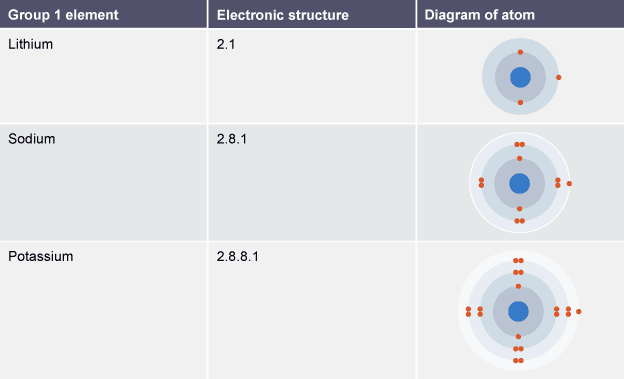
| GROUP 1 - THE ALKALI METALS C2.3 I can name the first three elements in group 1. (Lv 4) I can describe the Group 1 metals as having low densities. (Lv 4) | Lithium, Sodium, Potassium Group 1 metals have low densities... ( :0 ) |
| GROUP 1 - THE ALKALI METALS C2.3 I can write word equations from descriptions of how Group 1 metals react with water. (Lv 4) | All alkali metals react with cold water. In each reaction, hydrogen gas is given off and the metal hydroxide is produced. What would the equation be is the metal was lithium? Lithium + Water --> Hydrogen + Lithium Hydroxide. ( Li + H2O --> H + LiOH ) |
| GROUP 1 - THE ALKALI METALS C2.3 and GROUP 7 - THE HALOGENS C2.4 I can recognise trends in supplied data. (Lv 6) | A pattern of gradual change in a condition, or process, or an average or tendency of a series of data points that move in a certain direction over time; often represented by a line or curve on a graph. These lines are called lines of best fit, they show the main trend and make it easier to find anomalies. |
| GROUP 1 - THE ALKALI METALS C2.3 I can explain why the elements in group 1 react similarly and why the first three elements float on water. (Lv 6) | These elements react similarly because their atoms have the same number of electrons in their outer shell. The group 1 metals have only one electron in their outer shell. Therefore, they are ready to lose that one electron in ionic bonding. The first three elements float on water because they have very low densities. |
| GROUP 1 - THE ALKALI METALS C2.3 I can describe how you can show that hydrogen and metal hydroxides are made when group 1 elements react with water.(Lv 6) | You can show that hydrogen and metal hydroxides are made, by doing multiple chemical word equations for the group 1 elements with H2O. This lets the examiner know that you can do chemical equations and that you know what happens when Gr 1 elements react with H2O. |
| GROUP 1 - THE ALKALI METALS C2.3 I can illustrate the reactions of Group 1 metals with balanced symbol equations. (Lv 8) | Sometimes you need to adjust the number of units until you get equal numbers of each type of atom on both sides. E.G. 2Na + H2O --> H + NaOH isn't balanced... ...these are: 2Na + 2H2O --> 2H + 2NaOH, or just Na + H2O --> H + NaHO |
| GROUP 1 - THE ALKALI METALS C2.3 I can explain how group 1 metals form a ions with a +1 charge when they react with non-metals. (Lv 8) | Group 1 metals form +1 ions with non-metals because they have 1 electron in their outer shell, and this leaves when a reaction occurs. This makes the resulting element positive because originally there were the same amount of protons and electrons but now there is one more proton than electrons. |
| GROUP 1 - THE ALKALI METALS C2.3 I can justify how group 1 metals are stored and the safety precautions used when dealing with them. (Lv 8) | Strong alkali metals are corrosive and must be stored under oil to keep water and oxygen away from them. You must wear safety goggles and gloves. |
| GROUP 7 - THE HALOGENS C2.4 I can name the first 4 elements in group 7. (Lv 4) I can recognise a halogen displacement reaction. (Lv 4) | Fluorine, Chlorine, Bromine, Iodine. Halogen replacement reactions are where two halogens are mixed together. If one is already in a potassium solution another halogen might come along and take its place: Cl2 + 2KBr --> 2KCl + Br2 Bromine is pushed of of the solution. |
| GROUP 7 - THE HALOGENS C2.4 I can describe the main properties of halogens. (Lv 4) | They have relatively low melting and boiling points that increase steadily down the group. Near room temperature, the halogens span all of the physical states: Fluorine and chlorine are gases, bromine is a liquid, and iodine is a solid. |
| GROUP 7 - THE HALOGENS C2.4 I can explain why the elements in group 7 react similarly. (Lv 6) | These elements react similarly because their atoms have the same number of electrons in their outer shell. The group 7 halogens have 7 electrons in their outer shell. Therefore, they are all ready to gain that one electron in ionic bonding. |
| GROUP 7 - THE HALOGENS C2.4 I can explain how to complete a halogen displacement reaction and explain what happens in the reaction. (Lv 6) ... TO BE CONTINUED ... | Example: Chlorine (Aq) is added to a potassium bromide solution. Because chlorine is more reactive than bromine, it displaces bromine from potassium bromide. The solution turns brown. This colour is the displaced bromine. The chlorine has formed potassium chloride. |
| GROUP 7 - THE HALOGENS C2.4 I can explain how to complete a halogen displacement reaction and explain what happens in the reaction. (Lv 6) ...CONTINUED... | In that equation, the Chlorine and Bromine swapped places. A displacement reaction is a chemical reaction in which a more reactive element displaces a less reactive element from its compound. |
| GROUP 7 - THE HALOGENS C2.4 I can illustrate the reactions of Group 7 non-metals with balanced symbol equations. (Lv 8) | You may need to adjust the number of units until you get equal numbers of each type of atom on both sides. An example: Cl2 + 2KBr --> Br2 + 2KCl |
| GROUP 7 - THE HALOGENS C2.4 I can explain how group 7 non-metals form a ions with a -1 charge when they react with metals. (Lv 8) | Group 7 non-metals form -1 ions with metals because they have 7 electrons in their outer shell, and they gain 1 when a reaction occurs. This makes the resulting element negative because originally there were the same amount of protons and electrons but now there is one more electron than protons. |
| GROUP 7 - THE HALOGENS C2.4 I can explain in detail how to compare the reactivity of the group elements. (Lv 8) | The elements in Group 7 get less reactive as you go down the group. This is the opposite trend to that seen in Group 1. Fluorine is the most reactive element of all in Group 7. |
| EXPLAINING TRENDS C2.5 I can state the trend of reactivity in group 1. (Lv 4) I can state the treand of reactivity in group 7. (Lv 4) | The elements in Group 1 get more reactive as you go down the group and the elements in Group 7 get less reactive as you go down the group. |
| EXPLAINING TRENDS C2.5 I can explain how electronic structure affects trends in reactivity of group 1 and group 7 elements. (Lv 6) | Atoms gain or loose electrons more/less easily because there is more shielding. As the atomic radius increases, the more electron shielding there is from the nucleus +charge. Therefore outer shell electrons can escape more easily / it is harder to gain electrons. (The electrostatic attraction gets weaker. |
| EXPLAINING TRENDS C2.5 I can use the nuclear model to explain how the outer shell electrons experience different levels of attraction to the nucleus. (Lv 6) | |
| EXPLAINING TRENDS C2.5 I can use electronic structure to explain the trends in physical and chemical properties in group 1 and group 7 elements. (Lv 8) | The Group 1 elements have similar properties because of the electronic structure of their atoms - they all have one electron in their outer shell. Group 7 elements all have 7 electrons in their outer shell. |
| EXPLAINING TRENDS C2.5 I can apply knowledge of the reactivity of groups 1 and 7 to suggest and explain the trend in reactivity of Groups 2 and 6. (Lv 8) | Group 2 elements will react similarly to the elements of group 1. They are loosing 2 electrons instead of 1 but the reactivity still increases down the group. Group 6 elements will react similarly to the elements of group 7. They are gaining 2 electrons instead of 1 but the reactivity still decreases down the group. |
| THE TRANSITION METALS C2.6 I can list the typical properties of transition metals and their compounds (4) | They are very good conductors of heat and electricity, they're very dense, strong and shiny. They are also good catalysts. Compounds that contain transition metals are often colourful. |
| THE TRANITION ELEMENTS C2.6 I can explain why mercury is not a transition element (4) | Mercury is not a normal transition element (although it has most of the similar properties) because it is a liquid at room temperature, while most of the others are solids. |
| THE TRANSITION ELEMENTS C2.6 I can describe how the properties of Group 1 elements compare with transition metals (6) | Group 1 elements are very soft and have low densities, melting and boiling points. The transition metals are very different. They are hard, dense and strong and have high melting and boiling points. |
| THE TRANSITION ELEMENTS C2.6 I can interpret the formula and names of familiar transition metal compounds (6) | Make sure you know at least some of the main transition metal formulas, such as: Fe - iron , Ag - silver , Cu - copper. And be able to recognise other elements in a compound with them. |
| THE TRANSITION ELEMENTS C2.6 I can justify the use of a transition metal or its compound in terms of its chemical properties (8) | Alloys (compounds) of transition metals are often better for some uses as they can be stronger, better at conducting thermal or electrical energy, more unreactive (so it will last longer if outside) or more pleasing to look at e.g. shiny, if it was for a more decorative purpose. |
| THE TRANSITION ELEMENTS C2.6 I can suggest why Group 1 metals have different properties compared to transition metals (8) | Covalent bonds form more easily in transition metals and this may be why there properties are different from those of group 1. |
Want to create your own Flashcards for free with GoConqr? Learn more.