
1774299
Description

Flashcards by charlottec1999, updated more than 1 year ago

|
Created by charlottec1999
almost 12 years ago
|
|
| Question | Answer |
| Rate of reactions depends on what four things? | Temperature, Concentration, Catalysts and Surface area of the solid |
| What's the formula for rate of reaction? | Rate= product formed/time taken |
| What are the three ways that the rate of reaction can be measured? | Precipitation (measuring how fast the solution goes cloudy), Change in Mass and Volume of gas given off |
| What is collision theory? | Collision theory states that the rate of reaction simple depends on how often and and how hard the reacting particle collide with one another. |
| What is a catalyst? | A catalyst is a substance which speeds up a reaction, without being changed or used up in the reaction. |
| What are the advantages of using catalysts in industrial reactions? | They save money as they don't need to operate as long and they allow the reaction to work at lower temperatures, which is good for sustainable development. |
| What are the disadvantages of using catalysts in industrial reactions? | They can be expensive to buy (but can be reused), different reactions require different catalysts and catalysts can be 'poisoned' by impurities which means they stop working. |
| What is an exothermic reaction? | When a reaction gives off heat |
| Some exothermic reactions | Oxidation reactions, combustion or everyday uses such as hand warmers or self heating cans |
| What is an endothermic reaction? | An endothermic reaction is when heat is taken from the surroundings. |
| Some endothermic reactions | Thermal Decomposition or in ice packs |
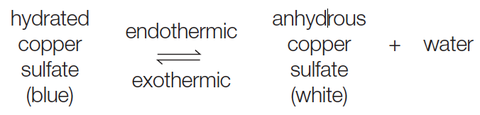
| Give an example of a reversible reaction which can be endothermic and exothermic |
Image:
chem (image/png)
|
| On the pH scale, is 1 acid or alkaline? | Acid |
| Where is bleach on the pH scale? | Around 12 |
| Where is vinegar on the pH scale? | Around 3 |
| What is the formula for a standard neutralisation reaction? |
Image:
chemm (image/jpeg)
|
| How can this be expressed in terms of ions? |
Image:
chemmm (image/png)
|
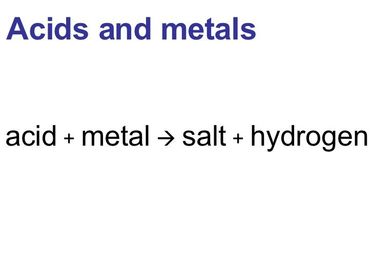
| What is the basic equation when reacting acids and metals? | |
| Hydrochloric Acid will always produce what kind of salts? | Chloride e.g. magnesium chloride |
| Sulfuric Acids will always produce what kinds of salt? | Sulfate e.g. Aluminium Sulfate |
| Nitric Acids will always make what sorts of salts? | Nitrate e.g. Zinc nitrate |
| Acid + Bases (metal oxide or metal hydroxide) = | Salt and Water |
| Bases are acids or alkalis? | Alkalis |
| Sulfuric acid + zinc oxide = ? | Zinc Sulfate and Water |
| Why might people want to neutralise Ammonia? | To make fertiliser. Ammonium nitrate is an especially good fertiliser because it has nitrogen in both sources, ammonia and nitric acid. |
| What is electrolysis? | The splitting up of a compound or solution using electricity |
| In electrolysis, what is the liquid called which conducts electricity? | The electrolyte |
| Electrolysis always involve an oxidation and reduction but which losses/gains electrons? | Oxidation is loss, Reduction is gain. (OIL RIG) |
| What is electroplating? | Electroplating is the use of electrolysis to coat the surface of one metal with another metal. |


Want to create your own Flashcards for free with GoConqr? Learn more.