
28383625
Description

Flashcards by Elexali Olayvar, updated more than 1 year ago

|
Created by Elexali Olayvar
about 5 years ago
|
|
| Question | Answer |
|
Image:
Image (binary/octet-stream)
|
Image:
Image (binary/octet-stream)
|
| When waves travel through water, why do the moving water particles continue to return to their starting position? A. Waves transfer matter, but not energy. B. Waves transfer both matter and energy. C. Waves transfer energy, but not matter. D. Waves don’t transfer matter or energy. | C. Waves transfer energy, but not matter. |
| Disturbances inside Earth’s core cause earthquakes. The starting point of the disturbance is called the epicenter. Why does the amplitude of a seismic wave usually decrease as the wave moves away from the epicenter? A. The waves lose energy in the form of heat. B. The frequency of the waves continues to increase. C. The wavelength of the waves continues to decrease. D. The waves encounter entirely different mediums. | C. The wavelength of the waves continues to decrease. |
| Why do sound waves move faster through the ground than through the air? A. Particles of matter are packed more loosely in the ground than in the air. B. Particles of matter are packed more tightly in the ground than in the air. C. Air doesn’t contain any particles of matter to transmit sound waves. D. The elevation of the ground is lower than the elevation of the air space. | B. Particles of matter are packed more tightly in the ground than in the air. |
|
Image:
Image (binary/octet-stream)
|
Image:
Image (binary/octet-stream)
|
|
Image:
Image (binary/octet-stream)
|
A. |
|
Image:
Image (binary/octet-stream)
|
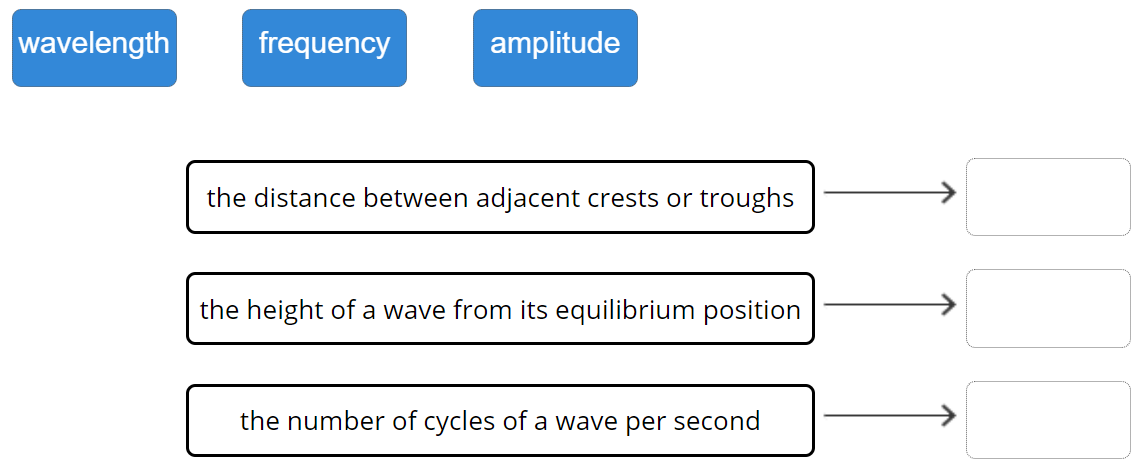
wavelength amplitude frequency |
| A mirror works on the principle of ____ , and a lens works on the principle of ______. | reflection refraction |
| Which characteristic of visible light is responsible for its color? A. amplitude B. shape C. speed D. wavelength | D. wavelength |
|
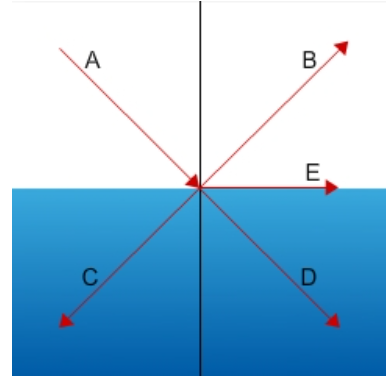
Lightray A moves from air to water. Part of ray A is reflected at the air-water boundary. Which arrow in the image is the reflected ray?
A. B
B. C
C. D
D. E
Image:
Image (binary/octet-stream)
|
A. B |
| What causes light to bend when it moves from one transparent medium to another? A. a change in amplitude B. a change in color C. a change in frequency D. a change in speed | D. a change in speed |
|
Image:
Image (binary/octet-stream)
|
Image:
Image (binary/octet-stream)
|
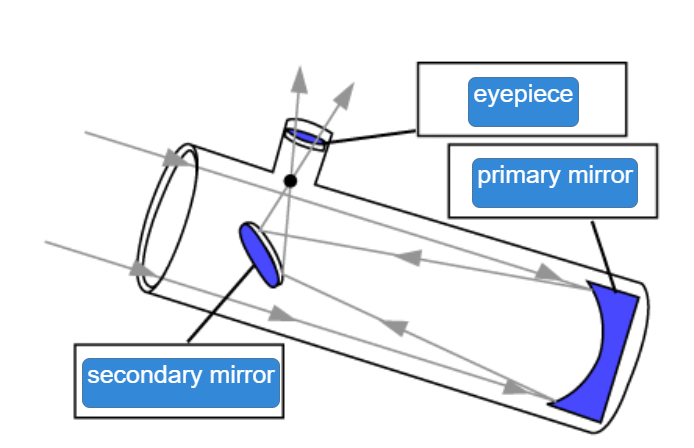
| What is the main function of a telescope? A. It brings scientists closer to distant objects. B. It magnifies light received from distant objects. C. It measures the temperature of distant objects. D. It measures the wavelengths of incoming light rays. | B. It magnifies light received from distant objects. |
|
Assume that the light from the flashlight is light from a star. Identify the spot where the light from this “star” is most concentrated.
Image:
Image (binary/octet-stream)
|
the one closest to the flashlight |
| Which feature of a wave determines its color in the visible spectrum? A. amplitude B. composition C. temperature D. wavelength | D. wavelength |
| What do scientists use to determine the temperature of a star? A. thermometer B. distance from Earth C. composition D. color | D. color |

Want to create your own Flashcards for free with GoConqr? Learn more.