
Mind map
social class differences in education- interactionalists
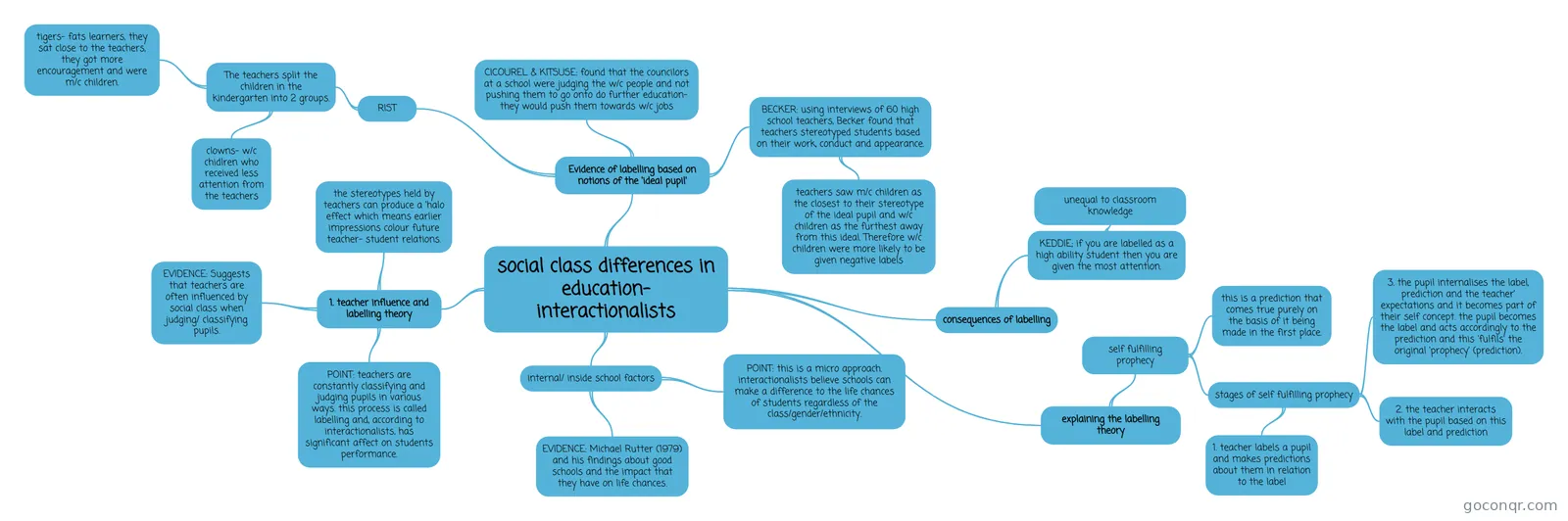
Mind map: social class differences in education interactionalists
Map content
social class differences in education- interactionalists
internal/ inside school factors
- POINT: this is a micro approach. interactionalists believe schools can make a difference to the life chances of students regardless of the class/gender/ethnicity.
- EVIDENCE: Michael Rutter (1979) and his findings about good schools and the impact that they have on life chances.
1. teacher influence and labelling theory
- POINT: teachers are constantly classifying and judging pupils in various ways. this process is called labelling and, according to interactionalists, has significant affect on students performance.
- EVIDENCE: Suggests that teachers are often influenced by social class when judging/ classifying pupils.
- the stereotypes held by teachers can produce a 'halo effect which means earlier impressions colour future teacher- student relations.
Evidence of labelling based on notions of the 'ideal pupil'
- BECKER: using interviews of 60 high school teachers, Becker found that teachers stereotyped students based on their work, conduct and appearance.
- teachers saw m/c children as the closest to their stereotype of the ideal pupil and w/c children as the furthest away from this ideal. Therefore w/c children were more likely to be given negative labels
- CICOUREL & KITSUSE: found that the councilors at a school were judging the w/c people and not pushing them to go onto do further education- they would push them towards w/c jobs
- RIST
- The teachers split the children in the kindergarten into 2 groups.
- tigers- fats learners, they sat close to the teachers, they got more encouragement and were m/c children.
- clowns- w/c chidlren who received less attention from the teachers
- The teachers split the children in the kindergarten into 2 groups.
- BECKER: using interviews of 60 high school teachers, Becker found that teachers stereotyped students based on their work, conduct and appearance.
consequences of labelling
- KEDDIE; if you are labelled as a high ability student then you are given the most attention.
- unequal to classroom knowledge
- KEDDIE; if you are labelled as a high ability student then you are given the most attention.
explaining the labelling theory
- self fulfilling prophecy
- this is a prediction that comes true purely on the basis of it being made in the first place.
- stages of self fulfilling prophecy
- 1. teacher labels a pupil and makes predictions about them in relation to the label
- 2. the teacher interacts with the pupil based on this label and prediction
- 3. the pupil internalises the label, prediction and the teacher' expectations and it becomes part of their self concept. the pupil becomes the label and acts accordingly to the prediction and this 'fulfils' the original 'prophecy' (prediction).
- self fulfilling prophecy