
482146
Description

Mind Map by Ellie.Sopp, updated more than 1 year ago

|
Created by Ellie.Sopp
about 12 years ago
|
|
Physics 2.6
- A radioactive substance contains unstable nuclei that
become stable by emitting radiation
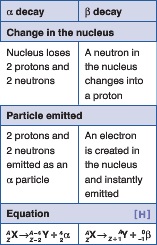
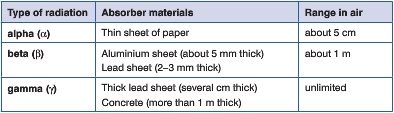
- Alpha, beta and gamma radiation
- Radioactive decay cannot be predicted
- The origins of background radiation are: air (radon), medical (x-rays),
the ground (rocks), food and drink, cosmic rays from space, nuclear
weapons, air travel and nuclear reactors
- Alpha, beta and gamma radiation
- Rutherford used measurements from alpha scattering
experiments to prove that atoms have small + charged nuclei
where most of the mass is located
- 'Plum pudding model' couldn't explain why
some alpha particles were scattered
through large angles
- The nuclear model of the atom explains
why alpha particles are scattered
- 'Plum pudding model' couldn't explain why
some alpha particles were scattered
through large angles
- Isotopes of an element are atoms with same number of
protons but different number of neutrons - same atomic
number but different mass number
- A magnetic or electric field can separate a
beam of alpha, beta and gamma
- They ionise substances they pass through,
ionisation can kill or damage cells
- They ionise substances they pass through,
ionisation can kill or damage cells
- The half life of radioactive isotopes is the
average time taken for the number of nuclei in
a sample to halve
- The activity of a radioactive source is
the number of nuclei that decay per sec
- The activity of a radioactive source is
the number of nuclei that decay per sec
- The use of a radioactive isotope depends on:
- 1) its half life
- 2) type of radiation given out
- For monitoring, isotope needs a long half life
- Tracers should be beta or gamma which last
long enough to monitor but not too long
- For radio active dating of a sample an isotope with a similar half life
needs to be used
- 1) its half life
Media attachments
Want to create your own Mind Maps for free with GoConqr? Learn more.