
495343
Description

Mind Map by sian.allison, updated more than 1 year ago

|
Created by sian.allison
almost 12 years ago
|
|
Ions and Ionic Bonding
- Ionic Bonding
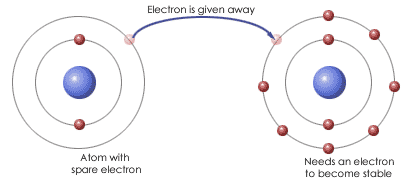
- In ionic bonding atoms lose or gain
electrons to form charged particles (called
ions) which are then strongly attracted to one
another (because of the opposite charges
- A shell with just one electron is keen to get rid..
- All the atoms over at the left hand side of the periodic table
e.g. calcium etc have just one or two electrons in their outer
shell (highest energy level). They are keen to get rid of
them because then theyll have full shells left. (They try to
have the same electronic structure as a noble gas.) That
leaves the atom as an ion instead. They leap at the first
passing ion with an opposite charge and stick to it like glue.
- All the atoms over at the left hand side of the periodic table
e.g. calcium etc have just one or two electrons in their outer
shell (highest energy level). They are keen to get rid of
them because then theyll have full shells left. (They try to
have the same electronic structure as a noble gas.) That
leaves the atom as an ion instead. They leap at the first
passing ion with an opposite charge and stick to it like glue.
- A nearly full shell is keen to get that extra electron
- On the other side of the periodic table the elements in group 6 and 7 e.g.
oxygen etc have outer shells that are nearly full. They are obviously keen
to gain that extra one or two electrons to fill up the shell up. When they do
of course they become ions they have latched onto the atom (ion) that
gave up the electron earlier.
- On the other side of the periodic table the elements in group 6 and 7 e.g.
oxygen etc have outer shells that are nearly full. They are obviously keen
to gain that extra one or two electrons to fill up the shell up. When they do
of course they become ions they have latched onto the atom (ion) that
gave up the electron earlier.
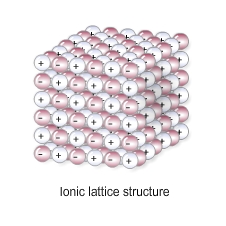
- Ionic compounds have a regular lattice
structure
- Ionic compounds always have a giant ionic lattice
- There are very strong electrostatic forces of
attraction between oppositely charged ions in all
directions
- A single crystal of sodium chloride is one giant ionic
lattice which is why salt crystals tend to be cuboid in
shape. The Na+ and Cl- are held together in a regular
lattice
- Ionic compounds always have a giant ionic lattice
- Ionic compounds all have similar properties
- High melting points
- High boiling points due to
strong attraction between
the ions
- Takes a large amount of energy to overcome this
attraction. When they melt the ions are free to move and
they will carry electric current
- Takes a large amount of energy to overcome this
attraction. When they melt the ions are free to move and
they will carry electric current
- dissolve easily. The ions separate and
are all free to move in the solution
- High melting points
- In ionic bonding atoms lose or gain
electrons to form charged particles (called
ions) which are then strongly attracted to one
another (because of the opposite charges
- Ions and Formulas
- Groups 1+2 and 6+7 are most likely to form ions
- The atoms that have been lost or
gained an electron are ions
- Ions have the electronic structure of a noble gas
- Group 1 + 2 are metals and
they lose electrons to form
positive ions
- E.g. Group 1 element (alkali metals) form ionic
compounds with non-metals
- E.g. Group 1 element (alkali metals) form ionic
compounds with non-metals
- Group 6+ 7 elements are non-metals. They
gain electrons to form negative ions
- E.g. Group 7 elements (halogens) form ionic
compounds with the alkali metals where the halide ion
has a negative charge
- E.g. Group 7 elements (halogens) form ionic
compounds with the alkali metals where the halide ion
has a negative charge
- The charge on the
positive ions is the same
as the group number of
the element
- Any of the positive ions above can
combine with any negative ions to form an
ionic compound
- The atoms that have been lost or
gained an electron are ions
- Look at charges to work out the formula of an ionic compound
- Ionic compounds are made up of a
positively charged part and a
negatively charged part
- The overall charge is 0
- must balance
- must balance
- The overall charge is 0
- Ionic compounds are made up of a
positively charged part and a
negatively charged part
- Groups 1+2 and 6+7 are most likely to form ions
- Electronic structure of ions
Media attachments
Want to create your own Mind Maps for free with GoConqr? Learn more.