
Description


|
Created by Phoebe Johnson
almost 10 years ago
|
|
Page 1
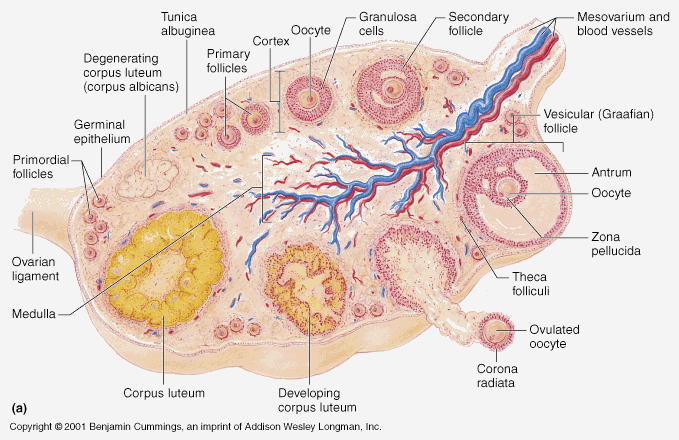
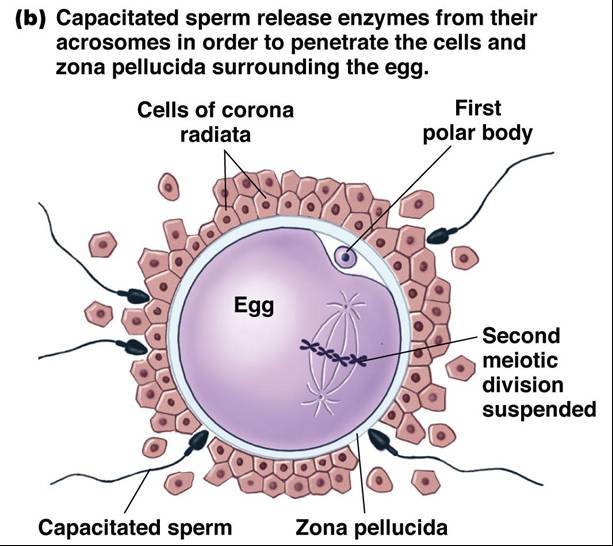
GametogenesisOogenesis1. Before birth, in the developing foetus, cells of the germinal epithelium of the ovary, which are diploid, divide by mitosis to make diploid oogonia, and more germinal epithelium cells.2. The oogonia divide many times by mitosis and enlarge, making diploid primary oocytes and more oogonia. 3. The primary oocytes begin meiosis I but stop; a girl is born with millions of primary oocytes at prophase I in her ovaries.4. Germinal epithelium cells divide to form diploid follicle cells, which surround the primary oocytes, making primary follicles. 5. From puberty onwards, hormones stimulate the primary follicles to develop further. Just before ovulation, a primary oocyte completes meiosis I, making a secondary oocyte, which contains most of the cytoplasm. The other product of meiosis I is a much smaller cell. It extrudes from the end of the secondary oocyte, and so it is called the first polar body. The secondary oocyte and polar body are both haploid. 6. The primary follicle develops into a secondary follicle, which is called a Graafian follicle when it is mature. It migrates to the surface of the ovary where it bursts and releases the secondary oocyte, in a process called ovulation. Each month several primary follicles start to develop normally, only one matures into a fully developed Graafian follicle. 7. The secondary follicle oocyte begins meiosis II but stops at metaphase II unless fertilisation takes place. 8. After fertilisation, meiosis II is completed, making an ovum containing most of the cytoplasm. The other product of meiosis II is the second polar body. 9. After ovulation the Graafian follicle becomes the corpus luteum (yellow body). If fertilisation occurs, it produces hormones, but otherwise, it regresses. A clear carbohydrate layer called the zona pellucida surrounds the cell membrane of the secondary oocyte. The chromosomes of the secondary oocyte are at metaphase II. They are at the equator, attached to the microtubules that make the spindle apparatus. The periphery of the cytoplasm contains cortical granules, which are secretory organelles that prevent the entry of more than one sperm. Corona radiate cells surround the secondary oocyte and provide nutrients. Ovaries1. Size and shape of unshelled almonds - analogous to the testes.2. Functions: a. production of ova b. secretion of hormones; oestrogen and progesterone that control sexual activity.3. Unlike the testes the production of ova is not continuous throughout life. 4. The external coat of the ovaries is made up of germinal epithelium.5. At birth around 400,000 cells have reached prophase of the 1st meiotic division - called primary oocytes.6. After puberty, each month, one of these primary oocytes completes its development into an ovum. 7. Approx. one egg is released per month from the age of 12 to 50, however, ages of sexual maturation and menopause inset vary with each individual. Approximately 456 eggs are released in a lifetime, which accounts to 0.114% of the total primary oocytes available at birth.8. Another difference between sperm production and ovum production is that the latter is cyclical, whilst the former is continuous. Ovum release is timed to coincide with a number of other events e.g. the preparation of the uterine lining to receive an ovum. This monthly reproductive cycle is called the oestrous cycle. Other animals have certain times of the year when the females are receptive to mating e.g. they may have 2 periods of time a year called "heats". The animals is said to be in oestrous. OvulationThe Graafian follicle begins to protrude from the surface on the ovary. At ovulation the secondary oocyte detaches from the follicle and is released and passes in to the oviduct. The exact mechanism of ovulation is not fully understood but LH, FSH and chemicals called prostaglandins are all thought to be involved.
Want to create your own Notes for free with GoConqr? Learn more.