
Description


|
Created by Yunuen Cisneros
over 8 years ago
|
|
Page 1
FONSECA II Location SYMPHYSIS: between the central incisors PARASYMPHYSIS: between vertical lines distal to canines BODY: from the distal symphysis of the canine to the anterior border of the masseter (distal of the 2° M) ANGLE: from the anterior border of the masseter to the posterior border of the masseter RAMUS: from posterior border of the masseter to the height of the sigmoid notch Subondylar is typically within the region of the ramus CONDYLAR Intracapsular: condylar head, which is bound by the capsule Condylar neck: from the height of the sigmoid notch to the attachment of the capsule. Dislocated: head of the condyle is dislocated from¡m the glenoid fossa Displaced: head of the condyle remains in the gleaned fossa, but the neck e condyle has been pulled out of the alignment w/ the ramus. CORONOID: superior to the height of the sigmoid notch DENTOALVEOLAR: alveolar bone and supporting root structure, doesn't involve the basal bone
Page 2
FONSECA II Patterns OPEN (COMPUND): communication w/ external environment, either trough skin /mucosa, including the periodontal ligament, any fx involving a tooth-bearing segment is an open fracture by definition CLOSED (SIMPLE): has NO communication w/ the external environment COMMINUTED: multiple segments of bone are shattered, crushed or splintered GREENSTICK: incomplete, only one cortex PATHOLOGIC: from pre-existing disease COMPLEX (COMPLICATED): simple or compound associated w/ adjacent soft tissue injury MULTIPLE: 2 or more fx within the same bone, but they do not communicate with each other ATROPHIC: spontaneous fx in a mandible that has 20 mm or less in height INDIRECT: fx at a site distant from the area of impact IMPACTED: segments have "telescoped" upon each other
Fonseca Trauma Kruger Simple: one in which the overlying integument is intact, the bone has been completely broken but is not exposed to air, it may or not be displaced. It may be comminuted Orlando's Illustrated Medical Dictionary (120): SIMPLE or CLOSED: fx that doesn't produce a wound open to the external environment COMPOUND or OPEN: an external wound communicates w/ the bone GREENSTICK: one cortex is broken, the other bent PATHOLOGIC: preexisting bone disease MULTIPLE: 2 or more lines not communicating w/ one another IMPACTED: one fragment is firmly driven into the other ATROPHIC INDIRECT COMPLICATED or COMPLEX
Page 3
FONSECA II Biomechanics FAVORABLE (STABLE): fx line and vector of the muscle pull keep the fx buttressed and appropriately reduced UNFAVORABLE (UNSTABLE): fx line and the vector of the muscle pull cause displacement
Fonseca Trauma Angle features may be classified as: Vertically favorable or unfavorable Horizontally favorable or unfavorable Muscles attached to te ramus displace the proximal segment upward and medially when fx are vertically and horizontally unfavorable These same muscles tend to impact the bone, minimizing displacement in horizontally and vertically favorable fx The farther forward the fx occurs in the body, the more the upward displacement of those muscles is counteracted by the downward pull if he mylohyoid Fx favorable: in a downward and forward direction horizontally fx Desfavorable: horizontal direction is downward and posterior
Page 4
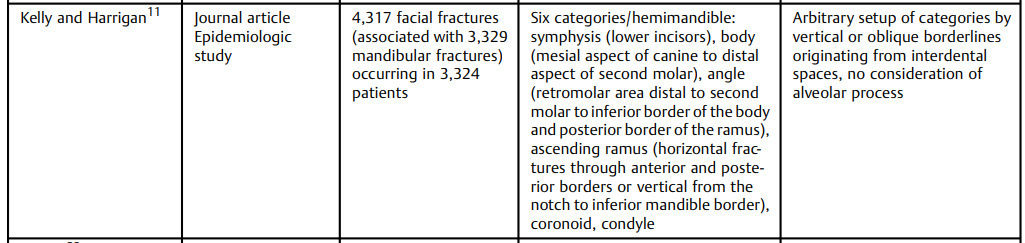
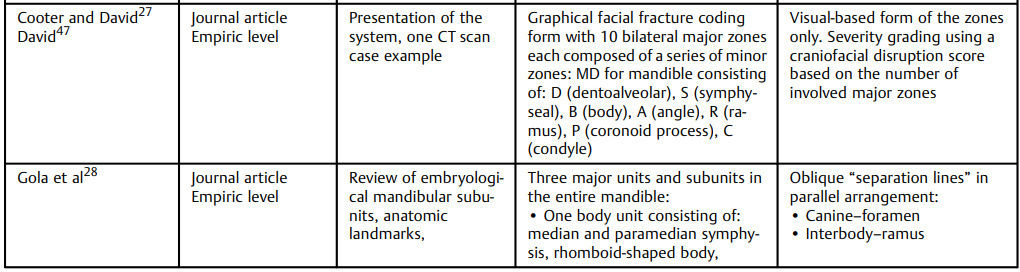
AO Level 2 tutorial ROWE & KILLEY 1955 Suggested a division of mandibular fracture sites into two main categories: 1. Alveolar fx not involving the basal bone 2. Fx involving the basal bone: subdivided into: 6 Symphysis Canine Angle Body Ramus Coronoid Condyle Major difference: the angle regionis wider due to combinatinwith the bpdy region
Fonseca Trauma 298 Simple: linear fx which aren't in communication w/ the exterior (85) Divided into 2 classes: NOT Involving basal bone: comprised of alveolar process fx Involving basal bone Single unilateral Double unilateral Bilateral Multiple

Page 5
AO Level 2 tutorial Dingman & Natvig 1964 7 1. Symphysis: intercanine area 2. Body: between the canine and the anterior boundary of the angle (anterior border of the master) 3. Alveolar process 4. Angle: triangular area bounded by the anterior margin of the masseter muscle and by a line from the retromolar trigone to the #posterior"rior attachment of the masseter to the ramus. 5. Ramus: bounded by the superior demarcation f the angle to two lines forming and apex at the sigmoid notch 6. Condyle process 7. Coronoid process
Fonseca Trauma (78) Midline: between the central incisors Parasymphyseal: within the area of the symphysis Symphysis: bounded by vertical lines distal to the canine teeth Body Angle: triangular region, by the anterior border of the master to the posterosuperior attachment of the masseter Ramus: superior aspect of the muscle to two lines fing and apex at the sigmoid notch Condylar process Coronoid process Alveolar process

Page 6
AO Level 2 tutorial KRUGER 1982
Fonseca Trauma KRUGER Single Compund Comminuted KRUGER & SCHILLI (121) Relation to the external environment Simple or closed Compound or open Types of fx Incomplete Greenstick Complete Comminuted Dentition of the jaw w/ reference to the use of splints Sufficiently edentulous jaw Edentulous or insufficiently edentulous jaw Primary and mixed dentition Localization Fx of the symphysis region between the canines fx of the canine region fx of the body between the canine and angle fx on the angle in the 3º molar region fx ramus between the angle and sigmoid notch fx coronoid process fx condylar process

Page 7
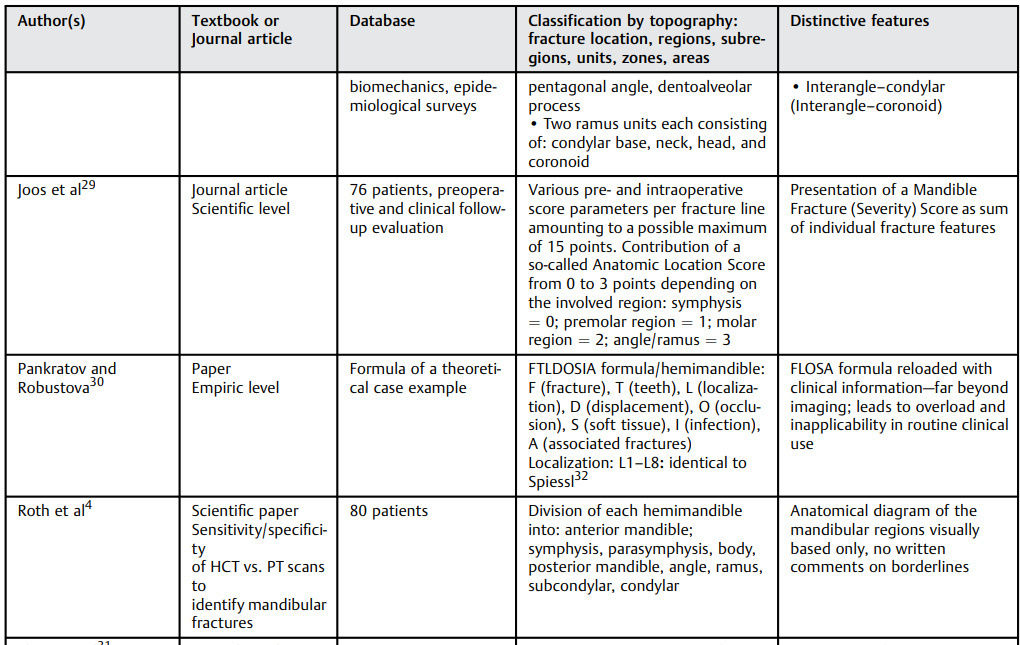
AO Level 2 tutorial SPIESSL 1989 FLOSA


Page 8
Trauma Fonseca Kazanjian and Converse (120) I: monomaxillary or intermaxillary fixation II: intermaxillary fixation, ing the condyle-ramus angle or partially edentulous body III: require prosthetic techniques, open reduction or both for stabilization
Page 9
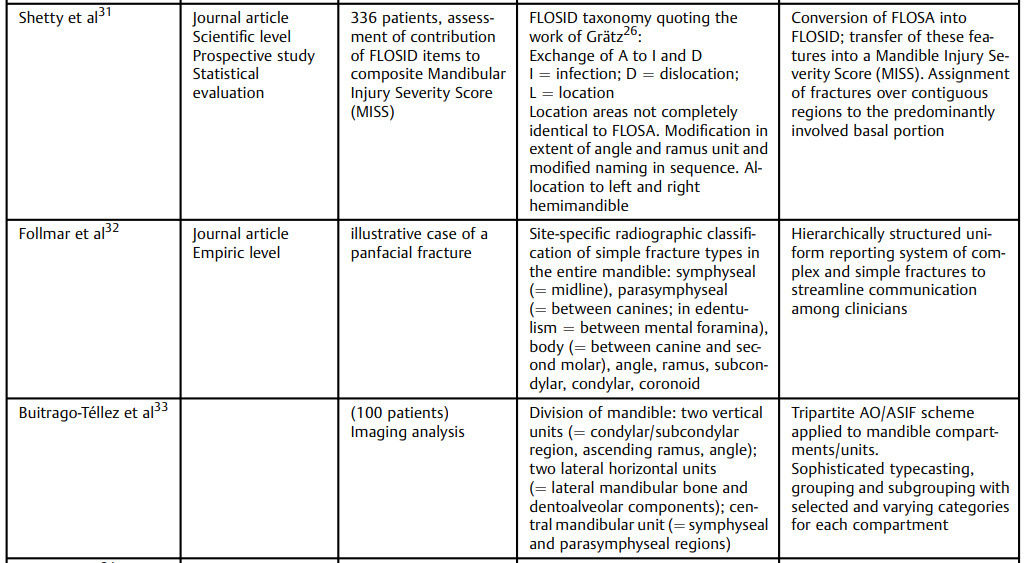
Trauma Fonseca Shetty et al (122) FLOSID Fracture type incomplete simple comminuted bone defect Location left from midline (L1) to condylar head (L8) right from midline (R1) to condylar head (R8) Nature of occlusion Normal Malocclusion Edentulous Extent of soft tissue damage closed open IO open EO open IO and EO soft tissue defect Presence of infection Yes No Rx analysis of inter fragmentary displacement mild moderate severe
Page 10



Want to create your own Notes for free with GoConqr? Learn more.