
Quiz
PHYS 200 Final Exam 5
Questions in this quiz (27)
1Mount Everest, at 29,028 feet, is the tallest mountain on the Earth. What is its height in kilometers? (Assume that 1 kilometer equals 3,281 feet.)
- A29.028 km
- B8.847 km
- C8847 km
- D18041 km
2Suppose that a person has an average heart rate of 72.0 beats/min. How many beats does he or she have in 2.0 y?
- A7.6 x 10^7 beats
- B36 beats
- C4320 beats
- D5.18 x 10^5 beats
3A soft tennis ball is dropped onto a hard floor from a height of 1.50 m and rebounds to a height of 1.10 m. Its contact with the floor lasts lasts 3.50 ms (3 .50 × 10^−3s).
How much did the ball compress during its collision with the floor, assuming the floor is absolutely rigid?- A-1.36 x 10^-3 m
- B-3.65 x 10^-6 m
- C-5.422 x 10^-3 m
- D-4.643 x 10^-3 m
4A ball is thrown straight up. It passes a 2.00-m-high window 7.50 m off the ground on its path up and takes 0.312 s to go past the window. What was the ball’s initial velocity?
- A14.5 m/s
- B7.95 m/s
- C17.6 m/s
- D28.8 m/s
5A rescue helicopter is hovering over a person whose boat has sunk. One of the rescuers throws a life preserver straight down to the victim with an initial velocity of 1.40 m/s and observes that it takes 1.8 s to reach the water.
How high above the water was the preserver released?
Note that the downdraft of the helicopter reduces the effects of air resistance on the falling life preserver, so that an acceleration equal to that of gravity is reasonable.- A18.4 m
- B1.29 m
- C2.52 m
- D31.8 m
6A projectile is launched at ground level with an initial speed of 50.0 m/s at an angle of 30.0 degrees above the horizontal. It strikes a target above the ground 3.00 seconds later. What is the y distance from where the projectile was launched to where it lands?
- A130 m
- B30.9 m
- C255 m
- D31.9 m
7The world long jump record is 8.95 m (Mike Powell, USA, 1991). Treated as a projectile, what is the maximum range obtainable by a person if he has a take-off speed of 9.5 m/s?
- A9.21 m
- B85.0 m
- C4.60 m
- D4.90 m
8A 35.0-kg dolphin decelerates from 12.0 to 7.50 m/s in 2.30 s to join another dolphin in play. What average force was exerted to slow him if he was moving horizontally?
- A68.6 N
- B9.80 N
- C343 N
- D114 N
9When starting a foot race, a 70.0-kg sprinter exerts an average force of 650 N backward on the ground for 0.800 s. What is his final speed?
- A2.97 m/s
- B7.43 m/s
- C1.13 m/s
- D11.9 m/s
10A flea jumps by exerting a force of 1.20 × 10^−5 N straight down on the ground. A breeze blowing on the flea parallel to the ground exerts a force of 0.500 × 10^−6 N on the flea. Find the direction and magnitude of the acceleration of the flea if its mass is 6.00 × 10^−7 kg.
- A10.2 m/s^2, 85.3 degrees north of east
- B20 m/s^2, 2.86 degrees north of east
- C85.3 m/s^2, 10.2 degrees north of east
- D20 m/s^2, 85.3 degrees north of east
11Three boxes (m1 = 10.0 kg, m2 = 20.0 kg, and m3 = 30.0 kg) are in contact with each other on a frictionless horizontal surface. A horizontal force F = 75.0 N is applied on m3. Calculate, the net force on each box.
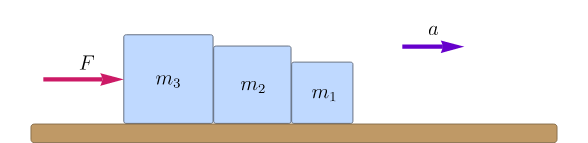
- A37.5 N, 25.0 N, 12.5 N
- B98 N, 196 N, 294 N
- C75 N, 60 N, 55 N
- D45 N, 50 N, 75 N
12Consider the 52.0-kg mountain climber. Find the force that the mountain climber must exert with her feet on the vertical rock face to remain stationary. Assume that the force is exerted parallel to her legs. Also, assume negligible force exerted by her arms.

- A512 N
- B273 N
- C510 N
- D239 N
13A contestant in a winter sporting event pushes a 45.0-kg block of ice across a frozen lake. Calculate the minimum force F he must exert to get the block moving. The coefficient of static friction is 0.1.
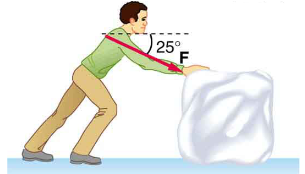
- A51 N
- B45 N
- C441 N
- D133 N
14Calculate the force a piano tuner applies to stretch a steel piano wire 8.00 mm, if the wire is originally 0.850 mm in diameter and 1.35 m long. The Young modulus for steel is 210 x 10^9 N/m^2.
- A706 N
- B2502 N
- C332 N
- D2825 N
15Riders in an amusement park ride shaped like a Viking ship hung from a large pivot are rotated back and forth like a rigid pendulum. Sometime near the middle of the ride, the ship is momentarily motionless at the top of its circular arc. The ship then swings down under the influence of gravity.
Assuming negligible friction, find the speed of the riders at the bottom of its arc, given the system's center of mass travels in an arc having a radius of 14.0 m and the riders are near the center of mass.- A11.7 m/s
- B23.4 m/s
- C16.6 m/s
- D30 m/s
16What is the linear speed of an ultra-centrifuge if a point on the ultra-centrifuge 0.100 m from its center and it is rotating at 50,000 rev/min?
- A0.52 km/s
- B30 km/s
- C5 km/s
- D5000 km/s
17A 22.0 kg child is riding a playground merry-go-round. What centripetal force does she need to stay on an amusement park merry-go-round that rotates at 3.00 rev/min if she is 8.00 m from its center?
- A17.4 N
- B483 N
- C528 N
- D1100 N
18Calculate the acceleration due to gravity on the surface of the Sun. The mass of the Sun is 1.99 x 10^30 kg. The average radius of the Sun is 6.96 x 10^8 m.
- A274 m/s^2
- B1.63 m/s^2
- C9.80 m/s^2
- D19.6 m/s^2
19Using energy considerations, calculate the average force a 60.0-kg sprinter exerts backward on the track to accelerate from 2.00 to 8.00 m/s in a distance of 25.0 m, if he encounters a headwind that exerts an average force of 30.0 N against him.
- A72 N
- B102 N
- C42 N
- D36 N
20A 500-kg dragster accelerates from rest to a final speed of 110 m/s in 400 m (about a quarter of a mile) and encounters an average frictional force of 1200 N. What is its average power output in watts if this takes 7.30 s?
- A4.81 x 10^5 W
- B3.51 x 10^6 W
- C8.40 x 10^5 W
- D3.03 x 10^6 W
21Jogging on hard surfaces with insufficiently padded shoes produces large forces in the feet and legs. Calculate the magnitude of the force needed to stop the downward motion of a jogger’s leg, if his leg has a mass of 13.0 kg, a speed of6.00 m/s, and stops in a distance of 1.50 cm. (Be certain to include the weight of the 75.0-kg jogger’s body.)
- A1.63 x 10^4 N
- B1.56 x 10^4 N
- C1.49 x 10^4 N
- D735 N
22A 0.240-kg billiard ball that is moving at 3.00 m/s strikes the bumper of a pool table and bounces straight back at 2.40m/s (80% of its original speed). The collision lasts 0.0150 s. How much kinetic energy in joules is lost during the collision?
- A0.389 J
- B1.08 J
- C0.691 J
- D0.311 J
23The Moon’s craters are remnants of meteorite collisions. Suppose a fairly large asteroid that has a mass of 5.00 × 10^12 kg (about a kilometer across) strikes the Moon at a speed of 15.0 km/s. At what speed does the Moon recoil after the perfectly inelastic collision (the mass of the Moon is 7.36 × 10^22 kg) ?
- A1.02 x 10^-6 m/s
- B7.02 x 10^-6 m/s
- C1.47 x 10^10 m/s
- D3.00 x 10^-12 m/s
24The sign’s mass is 8.00 kg. Calculate the tension in the chain assuming no friction between the legs and the sidewalk.
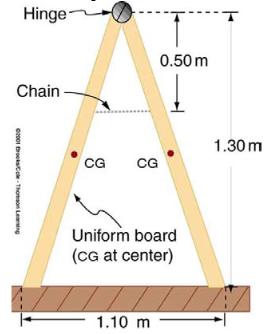
- A21.6 N
- B39.2 N
- C43.1 N
- D10.8 N
25Calculate the force on the joint.
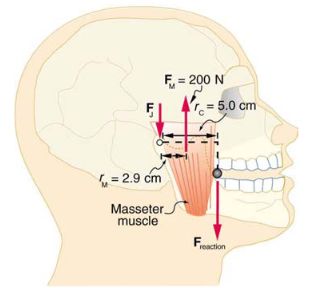
- A116 N
- B84 N
- C200 N
- D32 N
26A thin uniform rod (of mass 10kg and length of 1.2m) is attached to a friction-free pivot. Initially, the rod is balanced vertically above the pivot (position A). If the rod falls from rest, calculate the angular velocity at position C.

- A12.3 rad/s
- B7.00 rad/s
- C2.92 rad/s
- D2.72 rad/s
27Suppose a 0.250-kg ball is thrown at 15.0 m/s to a motionless person standing on ice who catches it with an outstretched arm. The total mass of the person is 70 kg.
What is his angular velocity if each arm is 5.00 kg? You may treat the ball as a point mass and treat the person's arms as uniform rods (each has a length of 0.900 m) and the rest of his body as a uniform cylinder of radius 0.180 m. Neglect the effect of the ball on his center of mass so that his center of mass remains in his geometrical center- A0.871 rad/s
- B0.0534 rad/s
- C1.74 rad/s
- D5.56 rad/s
Information
- Description
- User has deleted their subject information Quiz on PHYS 200 Final Exam 5, created by Deleted user on 20/05/2021.
- Author
- Deleted user
- Language
- English
- Views
- 30
- History
- Created on 20 May 2021 · updated on 20 May 2021
- Tags
- Rating
- No ratings yet Rate this quiz