
Quiz
Part 6 US History EOC
Questions in this quiz (38)
1In 1957, the Eisenhower Doctrine expanded the principles of the Truman Doctrine by extending Middle East military assistance in order to
- Aoffset communist influence in the region
- Bcombat anti-American terrorist threats
- Cforce the Organization of Petroleum Exporting Countries (OPEC) to end its oil embargo
- Ddefend Israel against Arab invasions
2 “. . . Let every nation know, whether it wishes us well or ill, that we shall pay any price, bear any burden, meet any hardship, support any friend, oppose any foe to assure the survival and the success of liberty. . . .”
— President John F. Kennedy, Inaugural Address, 1961
This statement by President Kennedy suggests a continued commitment to the foreign policy of- Aisolationism
- Bappeasement
- Ccontainment
- Dimperialism
3 President John F. Kennedy supported the 1961 Bay of Pigs invasion of Cuba as an effort to
- Aremove a communist dictator from power
- Bstop the flow of illegal drugs to the United States
- Csupport Fidel Castro’s efforts for reform
- Drescue hostages held by Cuban freedom fighters
4he Cuban missile crisis (1962) influenced President John F. Kennedy’s decision to
- Anegotiate the limited Nuclear Test Ban Treaty with the Soviet Union
- Breduce the nation’s commitment to the North Atlantic Treaty Organization (NATO)
- Cforbid Americans to trade with and travel to Latin America
- Dsend Peace Corps volunteers to aid developing countries
5Base your answer to the question on the cartoon to the left and on your knowledge of social studies.
What is the main idea of this 1945 cartoon?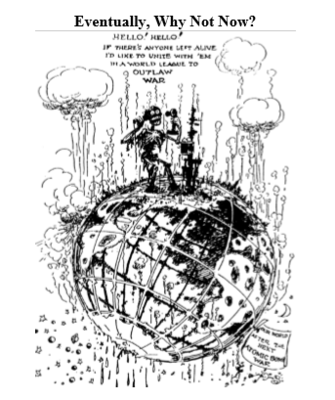
- AThe world community needs to stop the spread of nuclear weapons.
- BKorea’s development of atomic bombs has threatened world peace.
- CThe Treaty of Versailles was successful in preventing World War II.
- DGermany should be criticized for using atomic bombs.
6 “The Parties to this Treaty reaffirm their faith in the purposes and principles of the Charter of the United Nations and their desire to live in peace with all peoples and all governments. “They are determined to safeguard the freedom, common heritage and civilization of their peoples, founded on the principles of democracy, individual liberty and the rule of law. . . .”
— Preamble to the North Atlantic Treaty, 1949 This statement shows the commitment of the United States to the principle of- Acolonialism
- Bneutrality
- Cmilitarism
- Dcollective security
7 McCarthyism in the early 1950s resulted from
- Anew commitments to civil rights for African Americans
- Bopposition to the Marshall Plan
- Ccharges that Communists had infiltrated the United States government
- Dincrease public support for labor unions
8Base your answer to the question on the photograph to the left and on your knowledge of social studies.
The protestors in the photograph are expressing their hatred for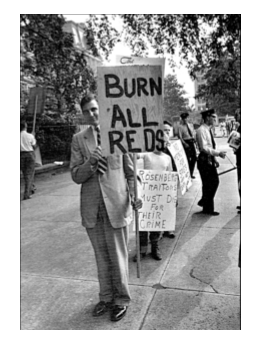
- Afascists
- Bcommunists
- Cimmigrants
- Dpolice officers
9During the early 1950s, the tactics of Senator Joseph McCarthy were criticized because he
- Aviolated important constitutional liberties
- Bdisplayed racial prejudice in his questions
- Copposed the use of loyalty oaths
- Dignored evidence of Soviet spying
10Base your answer to the question on the photograph to the left and on your knowledge of social studies.
What does this photograph indicate about the United States in the 1950s?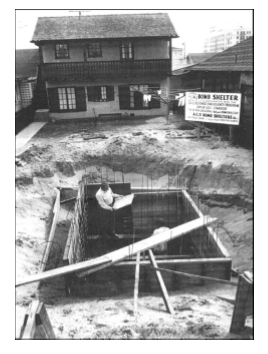
- AExtraordinary steps were taken to hide atomic weapons.
- BThe nation had become the only nuclear superpower.
- CMuch fear was created by the Cold War.
- DOnly government officials would be safe in a nuclear attack.
11President Richard Nixon supported the policy of détente as a way to
- Areduce tensions between the United States and the Soviet Union
- Bintroduce democratic elections to communist nations
- Cencourage satellite nations to break their ties with the Soviet Union
- Dundermine Soviet influence among nonaligned countries in Africa and Asia
12 “I think it will be a safer world and a better world if we have a strong, healthy United States, Europe, Soviet Union, China, Japan, each balancing the other, not playing one against the other, an even balance.”
— Richard Nixon, 1972 President Nixon put this idea into practice by- Aexpanding economic relations with communist nations
- Babandoning his policy of détente
- Cdeclaring an end to the Korean War
- Dending collective security agreements
13 The experiences of African Americans serving in the military forces during World War II influenced their postwar decision to
- Arenew support for the principle of separate but equal
- Bjoin the armed forces in record numbers
- Cincrease efforts to end racial discrimination
- Dmove back to the rural south
14 In 1948, President Harry Truman showed his support for civil rights by issuing an executive order to
- Aend the immigration quota system
- Bassure equal status for women in military service
- Cban racial segregation in the military
- Dguarantee jobs for Native American Indians
15 “We conclude that in the field of public education, the doctrine of ‘separate but equal’ has no place. Separate educational facilities are inherently unequal. . . .”
— Chief Justice Earl Warren, Brown v. Board of Education of Topeka
This quotation illustrates the Supreme Court’s power to- Auphold previous decisions
- Boverrule state laws
- Ccheck the powers of the executive branch
- Dprovide for educational funding
16In 1957, President Dwight D. Eisenhower sent federal troops to Little Rock, Arkansas, to
- Aprotect civil rights marchers
- Bhelp African Americans register to vote
- Cenforce a Supreme Court decision to desegregate public schools
- Dend race riots resulting from a bus boycott
17Which strategy did African-American students use when they refused to leave a “whites only” lunch counter in Greensboro, North Carolina, in 1960?
- Aeconomic boycott
- Bhunger strike
- Cpetition drive
- Dcivil disobedience
18The Civil Rights Act of 1964 was passed in an effort to correct
- Aracial and gender discrimination
- Blimitations on freedom of speech
- Cunfair immigration quotas
- Dsegregation in the armed forces
19 During the civil rights movement of the 1960s, activities of the Congress of Racial Equality, the National Urban League, and the National Association for the Advancement of Colored People (NAACP) illustrated that
- Aall civil rights groups use the same tactics
- Bdifferent approaches can be used to achieve a common goal
- Corganizational differences usually lead to failure
- Dviolence is the best tool for achieving social change
20Base your answer to the question on excerpts from the song lyrics below and on your knowledge of social studies.
Lyric: . . . Father, father
We don’t need to escalate
You see, war is not the answer
For only love can conquer hate
You know we’ve got to find a way
To bring some lovin’ here today. . .
— “What’s Going On,” Al Cleveland, Marvin Gaye, Renaldo Benson, 1971
Which conclusion is most clearly supported by an examination of these song lyrics?- AIn the 1960s and early 1970s, Americans shared common views on foreign policy.
- BSocial conflict existed over war and civil rights in the 1960s and early 1970s.
- CThe music of the 1960s and early 1970s supported government policies.
- DMost songwriters of the 1960s and early 1970s used their music to advocate violent revolution.
21The Feminine Mystique by Betty Friedan was an influential book in the 1960s because it
- Ahelped strengthen family values
- Bled directly to the defeat of the Equal Rights Amendment
- Cenergized a new women’s rights movement
- Dreinforced the importance of women’s traditional roles
22One similarity between the actions of Samuel Gompers and Cesar Chavez is that both leaders
- Aorganized workers for better conditions
- Brelied on the use of force to gain minority rights
- Cadvocated federal regulation of railroad rates
- Dworked to improve consumer product safety
23 Rachel Carson and Ralph Nader are similar to the muckrakers of the Progressive Era because they have
- Aadvocated a total change in the structure of government
- Battempted to expose societal problems
- Cfailed to influence public opinion
- Dsupported anti-American activities
24The Jungle by Upton Sinclair and Unsafe at Any Speed by Ralph Nader were both intended to
- Apublicize the growing violence in American society
- Bsuggest that a poor person could get rich with hard work
- Cencourage immigration reform
- Dmake the public aware of the poor quality of certain products
25 United States involvement in the Vietnam War was based in part on a desire to
- Aprevent renewed Japanese expansionism in the Pacific
- Bassure access to an adequate supply of oil from the Middle East
- Ccontain communism in Southeast Asia
- Dprotect American business interests in China
26In the 1950s, the domino theory was used by President Dwight D. Eisenhower to justify
- Asending federal troops into Little Rock, Arkansas
- BUnited States involvement in Vietnam
- Cjoining the United Nations
- Dopposing Britain and France in the Suez Canal crisis
27“I believe that our young people [18–20 years old] possess a great social conscience, are perplexed by the injustices which exist in the world and are anxious to rectify [correct] these ills.” — Senator Jennings Randolph, 1971, The New York Times
Those who favor this point of view would likely have supported- Aa constitutional amendment extending voting rights
- Ba presidential decision to raise speed limits
- Ca Supreme Court ruling to reverse desegregation
- Da law passed by Congress to increase Social Security benefits
28 The war in Vietnam led Congress to pass the War Powers Act of 1973 in order to
- Aaffirm United States support for the United Nations
- Bstrengthen the policy of détente
- Cincrease United States participation in international peacekeeping operations
- Dassert the role of Congress in the commitment of troops overseas
29Base your answer to the question on the cartoon to the left and on your knowledge of social studies.
Which event of the 1950s most likely led to the publication of this cartoon?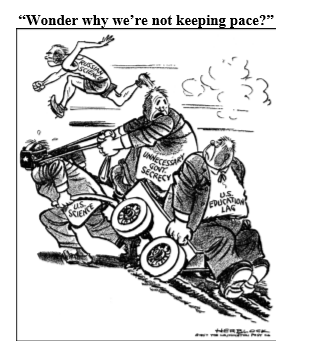
- ARussia put cosmonauts on the Moon.
- BThe Soviet Union launched the Sputnik satellite.
- CThe United States was defeated in the Vietnam War.
- DAmerican students scored low on tests in math and science.
30 The immediate impact of the 1957 launch of Sputnik I was that it
- Aforced the United States to find new sources of fuel
- Bfocused attention on the need to regulate the uses of outer space
- Cheightened the space race as a form of Cold War competition
- Dended the period of peaceful coexistence between the United States and the Soviet Union
31 “. . . We choose to go to the moon. We choose to go to the moon in this decade and do the other things, not because they are easy, but because they are hard, because that goal will serve to organize and measure the best of our energies and skills, because that challenge is one that we are willing to accept, one we are unwilling to postpone, and one which we intend to win, and the others, too. . . .”
— President John F. Kennedy, speech at Rice University, September 12, 1962
The main purpose of this speech was to win public support for- Aestablishing a missile defense system on the Moon
- Bcooperating with communist countries in exploring space
- Csurpassing the Soviet Union in the space race
- Dcontrolling the spread of nuclear weapons
32 “. . . My fellow citizens of the world: ask not what America will do for you, but what together we can do for the freedom of man. . . .”
— John F. Kennedy, Inaugural Address, 1961
To implement the idea expressed in this statement, President Kennedy supported the- Acreation of the Marshall Plan
- Bformation of the Peace Corps
- Cremoval of United States troops from Korea
- Destablishment of the South East Asia Treaty Organization
33A major goal of President Lyndon Johnson’s Great Society program was to
- Acontrol economic inflation
- Bend poverty in the United States
- Crepeal several New Deal social programs
- Dreturn responsibility for welfare programs to the states
34In 1965, Congress established Medicare to
- Aprovide health care to the elderly
- Bassist foreign nations with their health problems
- Cgrant scholarships to medical students
- Destablish universal health care
35Which statement best describes an impact of the Watergate scandal on American society?
- AThe modern environmental movement began.
- BPublic trust in government declined.
- CVoter turnout in elections increased.
- DAn economic recession ended.
36The Supreme Court decisions in New York Times Co. v. United States (1971) and United States v. Nixon (1974) reinforced the principle that the president of the United States
- Ahas unlimited use of the veto power
- Bis protected from unfair media criticism
- Cmay not be convicted of a crime
- Dis not above the law
37 The beginning of the collapse of communism in Eastern Europe is most closely associated with the
- Afall of the Berlin Wall
- Badmission of Warsaw Pact nations to the North Atlantic Treaty Organization (NATO)
- Cintervention of the North Atlantic Treaty Organization (NATO) in Yugoslavia
- Dformation of the European Union
38Base your answer to the question on the chart to the left and on your knowledge of social studies.
The changes shown on the chart most clearly reflect the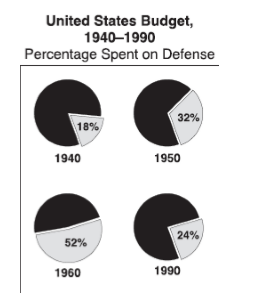
- Aeffects of the Cold War
- Binfluence of the business cycle
- Cfailure of United States military policy
- Dreverses in political party control of Congress
Information
- Description
- Part 6 US History EOC
- Author
- Deleted user
- Language
- English
- Views
- 96
- History
- Created on 6 Oct 2016 · updated on 17 Dec 2016
- Tags
- Rating
- No ratings yet Rate this quiz