
Quiz
Part 4 US History EOC
Questions in this quiz (38)
1How did the Supreme Court decision in Plessy v. Ferguson (1896) have a major impact on the lives of African Americans?
- Asegregation was legal in educational institutions
- Bvoting was a right guaranteed by the Constitution
- Cseparate but equal public facilities were legal
- Dmilitary occupation of the South was unconstitutional
2Base your answer to the question on the poem below and your knowledge of social studies
One Way Ticket
I am fed up With Jim Crow laws,
People who are cruel and afraid,
Who lynch and run, who are scared of me
And me of them. I pick up my life
And take it away on a one-way ticket
Gone Up North Gone Out West
Gone!
-Langston Hughes, 1926
Why does the author state that he has “Gone”?- Ajobs were available in northern industries
- Bthere was no racial prejudice in the West
- Cfarmland was more available in the North
- Dracial discrimination drove him away
3 Which leader founded a vocational training institution in the late 1800s to improve economic opportunities for African Americans?
- AGeorge Washington Carver
- BFrederick Douglass
- CW. E. B. Du Bois
- DBooker T. Washington
4What was one idea that both Booker T. Washington and W. E. B. Du Bois supported?
- AAfrican Americans should have increased civil rights
- Bvocational training was the best approach to education
- Cimmigration was responsible for racial segregation
- DJim Crow laws were needed to help African Americans
5 In the early 20th century, which policy for the advancement of African American was favored by W. E. B. Du Bois and the newly formed National Association for the Advancement of Colored People (NAACP)?
- Amass migration to northern cities
- Bimmediate action to end segregation and win equal rights
- Cestablishment of a new republic in Africa for freedmen
- Demphasis on economic advancement over social equality
6In which area did the views of Booker T. Washington and W. E. B. Du Bois differ most?
- Athe need to stop violence against African Americans
- Bthe speed with which full equality of the races should be achieved
- Cthe need to integrate the armed forces
- Dthe idea of including white Americans in their political organizations
7A significant contribution to the industrialization of the United States was Henry Ford’s development of
- Athe assembly line
- Belectric-powered vehicles
- Cthe first holding company
- Da new process for making steel
8Henry Ford produced a more affordable car primarily because his company
- Apaid workers lower wages than its competitors paid
- Bused foreign-made parts
- Cdeveloped a less expensive method of production
- Doffered a variety of options to buyers
9 Improved mass-production techniques affected the American economy of the 1920s by
- Areducing prices of consumer goods
- Blowering the quality of most products
- Ccausing higher unemployment
- Ddecreasing the quantity of manufactured products
10At the beginning of World War I, President Woodrow Wilson followed a traditional United States foreign policy by
- Arefusing to permit trade with either side in the conflict
- Bsending troops to Great Britain
- Cdeclaring American neutrality
- Drequesting an immediate declaration of war against the aggressors
11In the years before the United States entered World War I, President Woodrow Wilson violated his position of strict neutrality by
- Asecretly sending troops to fight for the democratic nations
- Bopenly encouraging Mexico to send troops to support the Allies
- Csupporting economic policies that favored the Allied nations
- Dusing United States warships to attack German submarines
12During his reelection campaign in 1916, President Woodrow Wilson used the slogan, “He kept us out of war.” In April of 1917, Wilson asked Congress to declare war on Germany. What helped bring about this change?
- ABolshevik forces increased their strength in Germany and Italy
- BBritain was invaded by nations of the Central Powers.
- CRussia signed a treaty of alliance with the Central Powers.
- DGermany resumed unrestricted submarine warfare.
13 A major reason the United States entered World War I was to
- Again additional colonial possessions
- Breact to the bombing of Pearl Harbor
- Csafeguard freedom of the seas for United States ships
- Dhonor prewar commitments to its military allies
14 President Woodrow Wilson’s Fourteen Points were proposed during World War I primarily to
- Adefine postwar objectives for the United States
- Boutline military strategies for the United States
- Cconvince other democratic nations to join the United Nations
- Dstrengthen the United States policy of isolationism
15One goal for a lasting peace that President Woodrow Wilson included in his Fourteen Points was
- Aestablishing a League of Nations
- Bmaintaining a permanent military force in Europe
- Creturning the United States to a policy of isolationism
- Dblaming Germany for causing World War I
16Following World War I, the United States Senate refused to ratify the Treaty of Versailles primarily because the treaty
- Afailed to include most of President Wilson’s Fourteen Points
- Bdid not punish Germany for starting the war
- Ccontained provisions that might lead the United States into foreign conflicts
- Dmade no provision for reduction of military weapons
17The change in the nation’s attitude toward membership in the League of Nations and membership in the United Nations shows the contrast between
- Aneutrality and containment
- Bappeasement and internationalism
- Cisolationism and involvement
- Dinterventionism and détente
18During World War I, many American women helped gain support for the suffrage movement by
- Aprotesting against the war
- Bjoining the military service
- Clobbying for child-care facilities
- Dworking in wartime industries
19 The “clear and present danger” doctrine stated by the Supreme Court in the case of Schenck v. United States (1919) had an important impact on the Bill of Rights because it
- Alimited the powers of the president
- Bplaced limits on freedom of speech
- Cclarified standards for a fair trial
- Dexpanded the rights of persons accused of crimes
20Base your answer to the question on the graph to the left and on your knowledge of social studies.
Data from this graph support the conclusion that World War I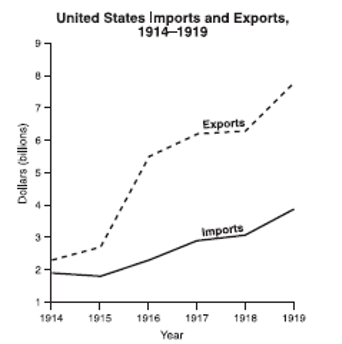
- Acaused the United States trade deficit to increase
- Bcost the United States many billions of dollars
- Cwas a significant benefit to the American economy
- Dcreated an unfavorable balance of trade
21The Palmer raids following World War I were caused by fear of
- Anew military weapons
- Bforeign invasion of the United States
- Ccommunist influence in the United States
- Deconomic depression
22The treaty signed at the Washington Conference (1921-1922) was an effort to
- Alimit the spread of military dictatorships
- Bmaintain peace through international agreements
- Cform new military alliances after World War I
- Dbring democratic government to Eastern Europe
23The trial of Sacco and Vanzetti in the 1920s was accompanied by
- Anativists fears of foreign influence in the United States
- Bconcern that the United States would sink into a depression
- Cpublic reactions against organized crime
- Da grassroots movement to gain equal rights for minorities
24 Which factor contributed most to the growth of nativist’s attitudes in the United States in the years immediately following World War I?
- Athe establishment of national Prohibition
- Ba decline of organized religions
- Cthe increase in the number of settlement houses
- Dthe large numbers of immigrants from southern and eastern Europe
25 What was a principle reason for rapid economic growth in the United States during the 1920s?
- Aprosperity of American agriculture
- Bincrease of American imports
- Cdevelopment of many new consumer goods
- Dincreased spending on defense
26Improved mass-production techniques affected the American economy of the 1920s by
- Areducing prices of consumer goods
- Blowering the quality of most products
- Ccausing higher unemployment
- Ddecreasing the quantity manufactured products
27 Which situation helped cause the stock market crash of 1929?
- Aexcessive speculation and buying on margin
- Bunwillingness of people to invest in new industries
- Cincreased government spending
- Dtoo much government regulation of business
28Which economic trend of the 1920s helped cause the Great Depression?
- Arising cost of mass-produced goods
- Bincreasing income tax rates
- Cfalling tariff rates
- Dwidening income gap between the rich and the poor
29Base your answer to the question on the map to the left and on your knowledge of social studies.
What was the most likely cause of the election results shown on the map?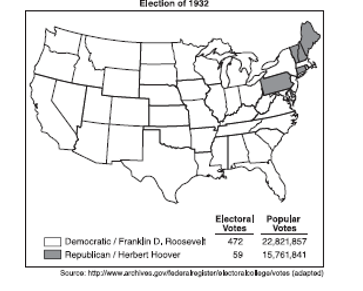
- AMost voters blamed President Herbert Hoover for the Great Depression.
- BIt is difficult to defeat an incumbent president.
- CFranklin D. Roosevelt had more business experience than Herbert Hoover.
- DRepublican Party popularity had been declining for several elections.
30 Which group of Americans generally failed to experience the economic prosperity of the 1920s?
- Afarmers
- Bretailers
- Cconsumers
- Dmanufacturers
31Which statement most accurately describes conditions of American farmers during the economic boom of the mid-1920s?
- AShortages of fertile land and farm equipment lowered farm income.
- BOverproduction helped keep farmers from participating in the prosperity of the times.
- CSubsidies and other government programs dramatically increased farmers’ incomes.
- DHigher prices for farm products resulted in a higher standard of living for farmers.
32What were two basic causes of the Dust Bowl during the early 1930s?
- Astrip mining and toxic waste dumping
- Bover-farming and severe drought
- Cclear-cutting of forests and construction of railroads
- Doverproduction and urban sprawl
33Which conditions are most characteristic of an economic depression?
- Ahigh unemployment and overproduction
- Blarge business investments and low taxes
- Ctoo much money in circulation and high stock prices
- Dhigh employment and increased real estate investments
34 During the Great Depression, expressions such as Hoovervilles and Hoover blankets showed that President Hoover
- Awas seen as a role model
- Bused the military to aid the unemployed
- Cwas blamed for the suffering of the poor
- Dsupported relief and public housing for the needy
35In the 1920’s, both Langston Hughes and Duke Ellington made major contributions to
- Aeconomic growth
- Beducational reform
- Cthe creative arts
- Dpolitical leadership
36The Harlem Renaissance was important to American society because it
- Ahighlighted the cultural achievements of African Americans
- Bisolated African Americans from mainstream society
- Cprovided new political opportunities for African Americans
- Dbrought an end to racial segregation in the North
37Which generalization can best be drawn from the experiment with national Prohibition (1919– 1933)?
- ASocial attitudes can make laws difficult to enforce.
- BAmericans resent higher taxes.
- CMorality can be legislated successfully.
- DPeople will sacrifice willingly for the common good.
38What was a major result of Prohibition in the United States during the 1920s?
- Arestriction of immigration
- Bgrowth of communism
- Cdestruction of family values
- Dincrease in organized crime
Information
- Description
- Part 4 US History EOC
- Author
- Deleted user
- Language
- English
- Views
- 32
- History
- Created on 6 Oct 2016 · updated on 7 Oct 2016
- Tags
- Rating
- No ratings yet Rate this quiz