
Quiz
B1 Quiz
This quiz has question types that open in the usual player.
Questions in this quiz (13)
1Label the image with the correct terms.
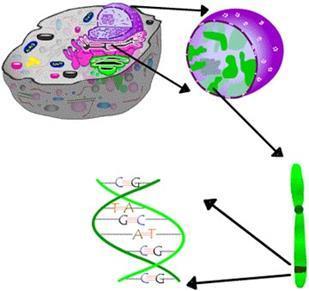
- ACell
- BNucleus
- CChromosome
- DDNA
- EGene
2Choose the correct order below, from smallest to largest.
- ABase - Gene - DNA - Chromosome - Nucleus - Cell
- BGene - Base - DNA - Chromosome - Nucleus - Cell
- CCell - Nucleus - Chromosome - DNA - Gene - Base
3Genes instruct the cells to make proteins needed for your body to work. The strands of DNA are made up of four chemicals that we call bases, along with phosphate and sugar molecules. It is the order of these four different bases along each piece of the DNA strand that determines the protein code.
- ATrue
- BFalse
4Choose the characteristic which is an example of a genetic trait.
- Ablue eyes
- Bdyed hair
- Ctatoos
5In some cases, several [blank_start]genes[blank_end] work together to determine a feature. A good example of this is [blank_start]eye[blank_end] colour. Human eye colour does not follow a simple [blank_start]pattern[blank_end] of inheritance, because it is [blank_start]determined[blank_end] by a [blank_start]number[blank_end] of different genes. As a result, there is a wide [blank_start]range[blank_end] of eyes colours in humans. This is an example of [blank_start]continuous[blank_end] variation, where there is a wide range of possible [blank_start]outcomes[blank_end].
- Agenes
- Beye
- Cpattern
- Ddetermined
- Enumber
- Frange
- Gcontinuous
- Houtcomes
6The genetic make up of an individual organism is called the phenotype.
- ATrue
- BFalse
7Tick the correct facts about chromosomes.
- AEach chromosome contains hundreds of genes.
- BChromosomes occur in triplets.
- CHuman body cells have 46 chromosome pairs.
- DThe sex cells have only one chromosome from each pair.
- EOffspring get one of each pair of chromosomes from their mother and one from their father, meaning they have two alleles for each gene.
8It is possible that both alleles of a gene are the same, in which case the individual is said to be [blank_start]homozygous[blank_end] for that trait. If the alleles for a gene in an individual are different, the individual is said to be [blank_start]heterozygous[blank_end] for the trait.
- Ahomozygous
- Bheterozygous
9Explain, using ideas about chromosomes and alleles, why siblings often look similar to each other, but not identical.
- AClick here.
- BNot here.
10Draw a punnett square for a cross between a hairy-toed male (Hh) and a female with hairless toes (hh). What proportion of the offspring would have hairy toes?
- A0.25
- B0.50
- C0.75
- D1.00
11Clones are individuals with [blank_start]identical[blank_end] genes. Bacteria, plants and even some [blank_start]animals[blank_end] can reproduce [blank_start]asexually[blank_end] to form clones. In asexual reproduction, only one [blank_start]parent[blank_end] is involved, so the offspring has identical [blank_start]DNA[blank_end] to the parent. As clones have identical DNA, any differences between clones and their parents are likely to be due to the [blank_start]environment[blank_end] which they are in, rather than to their [blank_start]genes[blank_end].
- Aidentical
- Banimals
- Casexually
- Dparent
- EDNA
- Fenvironment
- Ggenes
12The diagram below shows the steps of artificial animal cloning. Choose the correct labels for each stage of the process.
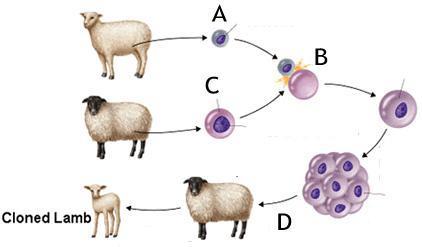
- AA donor cell is taken from a sheep.
- BDonor Nucleus
- CThe two cells are fused.
- DEgg cell from adult sheep
- ENucleus of the egg cell is removed
- FThe fused cell begins dividing normally
- GEmbryo
- HEmbryo is placed in the womb of female
- IEmbryo develops normally into a clone
13Adult stem cells can develop into any type of cell.
- ATrue
- BFalse
Information
- Description
- A quiz made for B1 21st Century science GCSE revision, not including genetic testing.
- Author
- Deleted user
- Language
- English
- Views
- 19
- History
- Created on 9 Mar 2017 · updated on 9 Mar 2017
- Tags
- Rating
- No ratings yet Rate this quiz