
Quiz
Atomic Structure Quiz 2 - Edexcel
This quiz has question types that open in the usual player.
Questions in this quiz (19)
1Isotopes are atoms of the same element that contain different numbers of electrons.
- ATrue
- BFalse
2The mass number is always a whole number.
- ATrue
- BFalse
3How a mass spectrometer works:
Produces positive ions that are deflected by a [blank_start]magnetic[blank_end] field according to their mass-to-charge ratio (known as their [blank_start]m/z[blank_end] ratio)
Calculates the relative [blank_start]abundance[blank_end] of each ion
Displays abundance as [blank_start]percentage[blank_end]- Amagnetic
- Bm/z
- Cabundance
- Dpercentage
4Chlorine is an example of a [blank_start]diatomic[blank_end] molecule.
- Adiatomic
5Molecular ion peak: The peak with the [blank_start]highest[blank_end] m/z ratio, the [blank_start]M[blank_end] peak. This peak is helpful in figuring out the relative molecular mass of a compound using a mass [blank_start]spectrum[blank_end]
- Ahighest
- BM
- Cspectrum
6Orbital: A region within an atom that can hold up to [blank_start]two[blank_end] electrons with [blank_start]opposite[blank_end] spins
- Atwo
- Bopposite
7[blank_start]J.J. Thomson[blank_end] discovered the electron.
[blank_start]Ernest Rutherford[blank_end] discovered proton.
[blank_start]James Chadwick[blank_end] discovered the nucleus- AJ.J. Thomson
- BErnest Rutherford
- CJames Chadwick
8[blank_start]Atomic number(Z):[blank_end] The number of protons in an element
[blank_start]Mass number:[blank_end] Number of protons and neutrons in an atom
[blank_start]Isotopes:[blank_end] Atoms of the same element with different numbers of neutrons- AAtomic number(Z):
- BMass number:
- CIsotopes:
9Drag and drop the labels onto the following diagram:
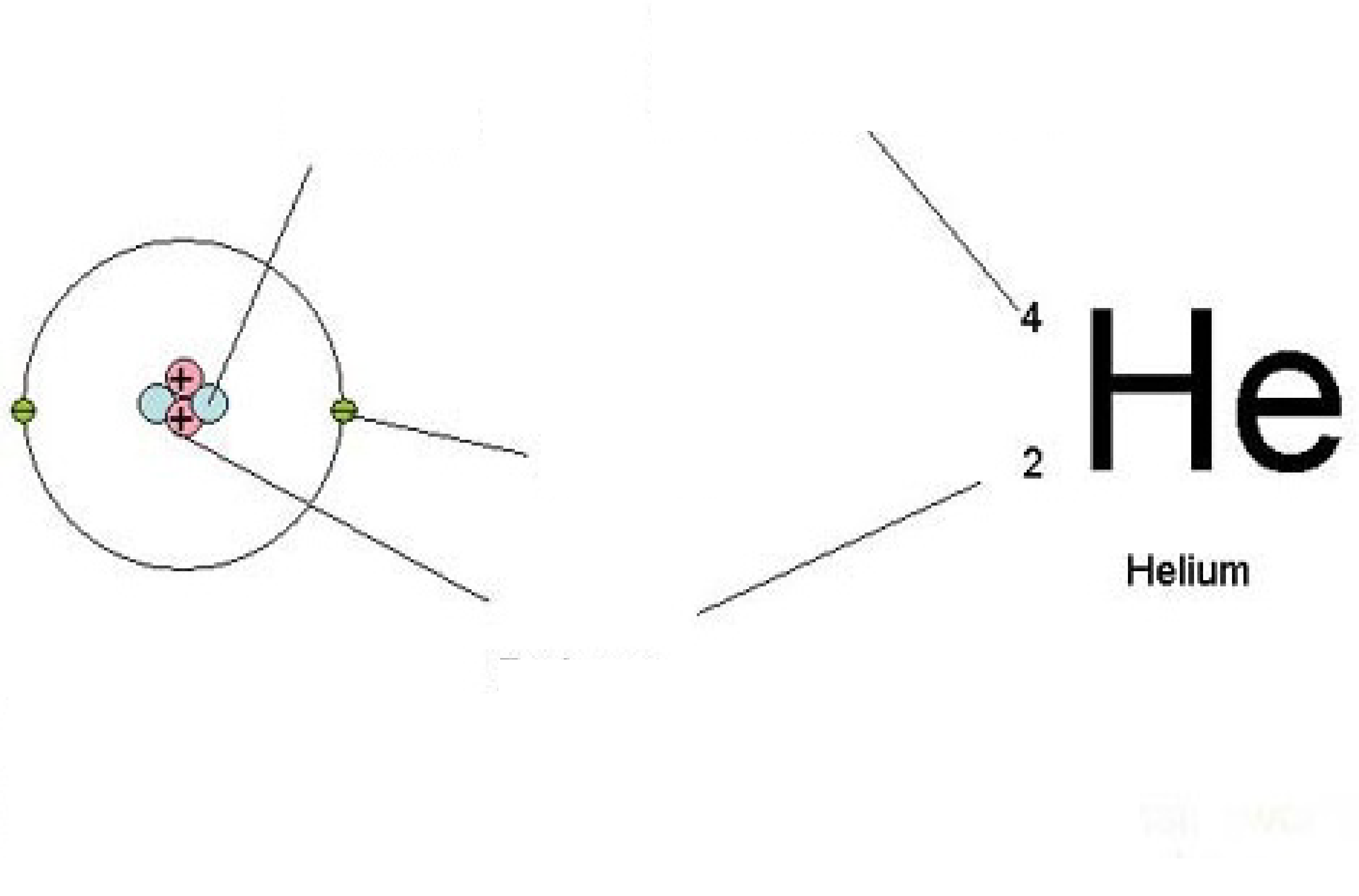
- AProton
- BMass number
- CNeutron
- DElectron
10When atoms in the gaseous state are given energy - either heat or electrical - the electrons move to higher [blank_start]energy levels[blank_end].
These higher energy levels are unstable, so the electrons soon fall back to their original energy levels. When they fall back, they emit energy in the form of [blank_start]electromagnetic radiation[blank_end].
This radiation can be analysed using a [blank_start]spectroscope[blank_end], which produces a line emission spectrum.
The line emission spectrum shows that only specific frequencies of electromagnetic radiation are released by the atoms.
The line spectrum of each element is [blank_start]unique[blank_end].
This is compelling evidence for the face that the energy of electrons in atoms can only have certain, fixed values and not a continuous range - we say that the energy levels are [blank_start]quantised[blank_end].- Aenergy levels
- Belectromagnetic radiation
- Cspectroscope
- Dunique
- Equantised
11For all electron subshells, [blank_start]s[blank_end]>[blank_start]p[blank_end]>[blank_start]d[blank_end]>[blank_start]f[blank_end], in terms of energies.
- As
- Bp
- Cd
- Df
- Es
- Fp
- Gd
- Hf
- Is
- Jp
- Kd
- Lf
- Ms
- Np
- Od
- Pf
12The diagram shows a number of ways of representing
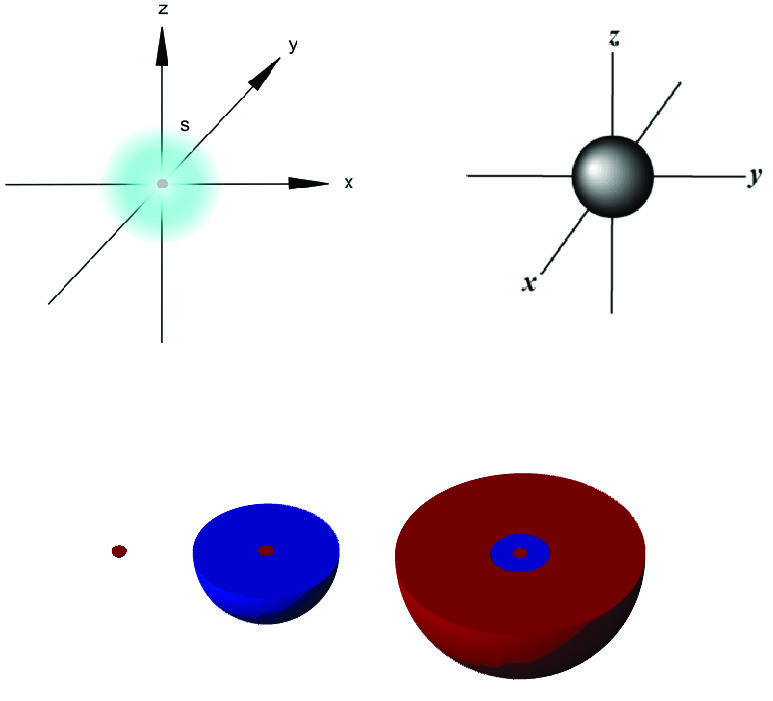
- AAn s oribital
- BA p orbital
- CA d orbital
- DAn f orbital
13The size and shape of the orbitals is such that there is a [blank_start]90[blank_end]% probability of finding the electron within their boundaries
- A90
14P orbitals are elongated and shaped like [blank_start]dumbbells[blank_end].
They have non-uniform charge [blank_start]density[blank_end].
There are 3 p orbitals in each p subshell - these are sometimes labelled as \(p_x\), \(p_y\) and \(p_z\) according to the axes along which they are oriented.
The p orbitals within a subshell differ only in their orientation - they are at mutual [blank_start]right angles[blank_end].- Adumbbells
- Bdensity
- Cright angles
15This is a way of representing
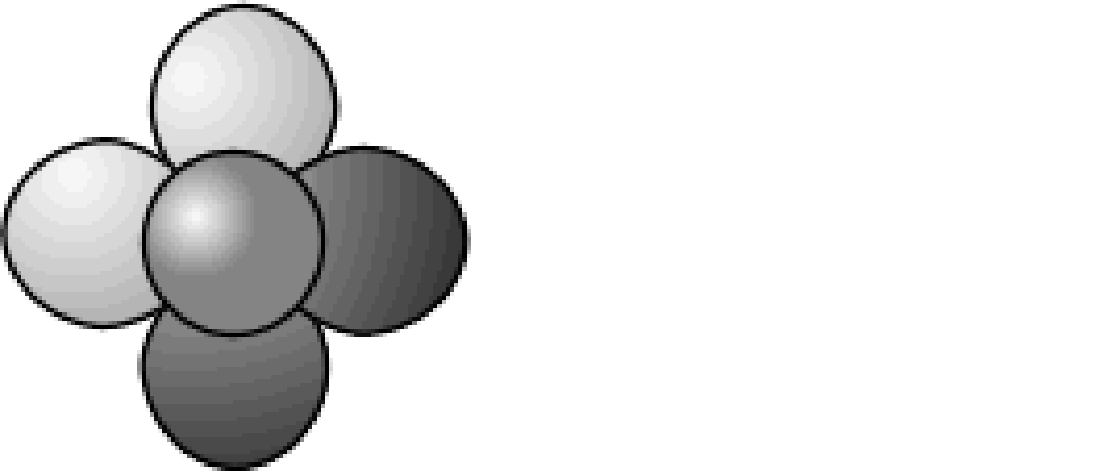
- Ap orbitals
- Bs orbitals
- Cd orbitals
- Df orbitals
16The first quantum shell can have [blank_start]2[blank_end] electrons.
The second quantum shell can have [blank_start]8[blank_end] electrons .
The third quantum shell can have [blank_start]18[blank_end] electrons.
The fourth quantum shell can have [blank_start]32[blank_end] electrons.- A2
- B8
- C18
- D32
17"Completely removing" an electron involves moving it an [blank_start]infinite[blank_end] distance away from the atom that it no longer experiences any attractive force from the nucleus - this involves an [blank_start]increase[blank_end] in energy.
If the energy of the electron is already high, then this increase will not be large.
If the electron is in a low energy quantum shell, then a [blank_start]large increase[blank_end] in energy is required to move the electron away from the nucleus
This increase in energy is the [blank_start]ionisation energy[blank_end],- Ainfinite
- Bincrease
- Clarge increase
- Dionisation energy
18In general, ionisation energies [blank_start]decrease[blank_end] moving down a group.
Moving down the group, the nuclear charge [blank_start]increases[blank_end] as more protons are added to the nucleus. This increases the attractive force of the nucleus felt by each electron, decreasing its energy.
However, each electron is added to a new quantum shell. Each quantum shell is higher in energy and electrons in higher shells also experience more [blank_start]repulsion[blank_end] from electrons in lower shells. These two factors lead to an increase in the energy of the electron.
However, the effect from the new quantum shell is [blank_start]greater[blank_end] than the increase in nuclear charge, so overall there is an increase in electron energy and a decrease in ionisation energies moving down the group- Adecrease
- Bincreases
- Crepulsion
- Dgreater
19[blank_start]Covalent radius[blank_end]: Half the distance between the nuclei when two atoms of that element are covalently bonded together in a homonuclear diatomic molecule
[blank_start]Van der Waals radius[blank_end]: Half of the distance between the closest approach of two non-bonded atoms of a given element- ACovalent radius
- BVan der Waals radius
Information
- Description
- User has deleted their subject information Quiz on Atomic Structure Quiz 2 - Edexcel, created by Deleted user on 14/08/2017.
- Author
- Deleted user
- Language
- English
- Views
- 15
- History
- Created on 14 Aug 2017 · updated on 14 Aug 2017
- Tags