
Quiz
Chapter 07
Create a free account to finish this quiz
Save your progress and see your final score.
Already have an account? Sign in
Questions in this quiz (61)
1Based on the solar atmosphere and outer layers of the sun, select all of the correct statements from the following list.
- AThe solar wind is ionized gas streaming away from the sun.
- BHelioseismology is the study of "sunquakes."
- CThe temperature of the corona is millions of degrees.
- DThe photosphere is the outermost layer of the sun.
- ESpicules and filaments are found in the solar corona.
- FGranulation is caused by convection.
- GThe chromosphere is the visible surface of the sun.
2Based on nuclear fusion in the sun, select all of the correct statements from the following list.
- ANeutrinos oscillate among three different types.
- BDuring the proton-proton chain, helium is made into hydrogen.
- CGamma rays produced by fusion make it to the solar surface much faster than neutrinos.
- DFor nuclei to combine, temperatures must be very high.
- EThe number of neutrinos observed to be coming from the sun is the amount we expect.
- FDue to the required temperatures, fusion occurs only in the core of the sun.
3What evidence do we have that the granulation seen on the sun's surface is caused by convection?
- AThe bright centers of granules are cooler than their dark boundaries and Doppler measurements indicate that the centers are rising and edges are sinking.
- BThe bright centers of granules are cooler than their dark boundaries.
- CThe bright centers of granules are hotter than their dark boundaries.
- DDoppler measurements indicate that the centers are rising and edges are sinking.
- EThe bright centers of granules are hotter than their dark boundaries and Doppler measurements indicate that the centers are rising and edges are sinking.
4Which layer of the sun's atmosphere contains the cooler low-density gas responsible for absorption lines in the sun's spectrum?
- Aphotosphere
- Bchromosphere
- Ccorona
- Dsolar wind
- EAll of these choices are correct.
5Which of the following is true about granules and supergranules?
- AGranules and supergranules each fade in about 10 to 20 minutes and they are both due to convection cells in layers below.
- BThey are both about the same size and they are both due to convection cells in layers below.
- CGranules and supergranules each fade in about 10 to 20 minutes.
- DThey are both about the same size.
- EThey are both due to convection cells in layers below.
6This diagram explains the structure of solar granules. Why is the center of a granule brighter than its edges?
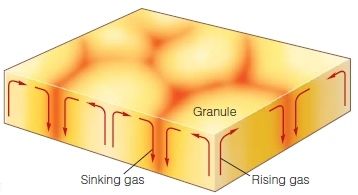
- AThe surface elevation is higher at the center.
- BThe temperature is lower at the center.
- CThe surface elevation is lower at the center.
- DThe surface elevation is higher at the center and the surface elevation is lower at the center.
- EThe temperature is higher at the center.
7What is revealed by observing the sun at a very narrow range of wavelengths within the 656-nm hydrogen alpha line?
- Athe structure of the photosphere
- BWe can see the electrons make the transition from energy level 3 to level 2.
- Cthe structure of the corona
- DNothing is seen; all light is absorbed at this wavelength.
- Ethe structure of the chromosphere
8The sun's atmospheric layers are all less dense than its interior. Based on this figure, which layer of the sun is responsible for the absorption lines in the solar spectrum?
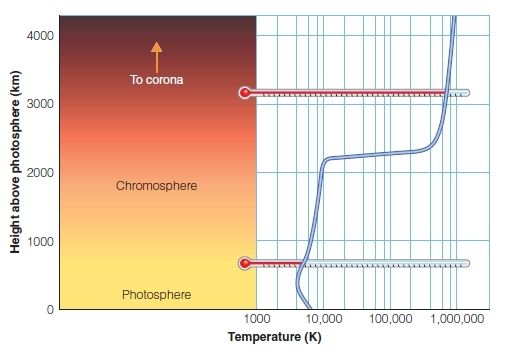
- Aphotosphere
- Bcorona and chromosphere
- Ccorona
- DAll the layers are responsible.
- Echromosphere
9What are the general trends in temperature and density from the photosphere to the chromosphere to the corona?
- AThe temperature decreases and density increases.
- BThe temperature decreases and density decreases.
- CThe temperature increases and density decreases.
- DThe temperature and density remain constant.
- EThe temperature increases and density increases.
10What physical property of the sun is responsible for "limb darkening"?
- AThe chromosphere is hotter than the photosphere and the lower photosphere is hotter than the upper photosphere.
- BThe lower photosphere is cooler than the upper photosphere.
- CThe lower photosphere is hotter than the upper photosphere.
- DThe chromosphere is cooler than the photosphere.
- EThe chromosphere is hotter than the photosphere.
11The spectrum of the corona has bright spectral lines of highly ionized elements. What does this reveal?
- AThe corona is very irregular in shape.
- BThe corona is a very hot, low-density gas.
- CThe corona is a very hot, high-density gas.
- DThe corona is a very hot, low-density gas and the corona extends out to 20 solar radii.
- EThe corona extends out to 20 solar radii.
12What heats the chromosphere and corona to high temperatures?
- Avisible light emitted by layers below
- Bfluctuating magnetic fields from below that transport energy outward
- Csun-grazing comets giving up their energy of motion as they vaporize in these two layers
- Dshort-wavelength electromagnetic radiation emitted by layers below
- Elong-wavelength electromagnetic radiation emitted by layers below
13How are astronomers able to explore the layers of the sun below the photosphere?
- AThey do this by observing solar X-rays and gamma rays with space telescopes. These shorter wavelengths are emitted from hotter regions below the photosphere.
- BShort-wavelength radar pulses penetrate the photosphere and rebound from deeper layers within the sun.
- CThey do this by measuring and modeling the modes of vibration of the sun's surface.
- DLong-wavelength radar pulses penetrate the photosphere and rebound from deeper layers within the sun.
- EHighly reflective space probes have plunged below the photosphere and sampled the sun's interior.
14What is responsible for the sun's surface and atmospheric activity?
- Amany comets impacting the sun
- Bgravitational contraction of the sun
- Cthe sun sweeping up interstellar space debris
- Dgravitational interactions between the sun and the planets
- Ethe sun's magnetic field
15Each of these frames shows the migration (due mostly to solar rotation) of sunspots across the face of the sun with the earliest sketch at the top. If the north pole of the sun is at the top of each frame, in which direction does the sun rotate?
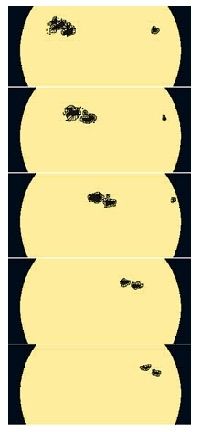
- Acounterclockwise when viewed from above the sun's north pole
- Bclockwise when viewed from above the sun's north pole
- CIt depends on which part of the solar cycle the sun is in.
- DThe sun does not rotate. The effect is due to the rotation of Earth.
- ENone of these choices are correct.
16What is the source of the sun's changing magnetic field?
- Athe differential rotation of the sun and the sun's large iron core
- Bconvection beneath the photosphere
- Cthe differential rotation of the sun
- Dthe sun's large iron core
- Ethe differential rotation of the sun and convection beneath the photosphere
17What evidence do we have that sunspots are magnetic?
- AThe spectral lines of sunspots are split by the Zeeman Effect and observations at far ultraviolet show material arched above the sun's surface from one sunspot to another.
- BThe spectral lines of sunspots are split by the Zeeman Effect.
- CObservations show that the north pole and south pole sunspots attract one another and move closer together over time.
- DObservations at far ultraviolet show material arched above the sun's surface from one sunspot to another.
- EThe spectral lines of sunspots are split by the Zeeman Effect and observations show that the north pole and south pole sunspots attract one another and move closer together over time.
18What does a Maunder butterfly diagram show?
- AThe sun's magnetic field is simple at the beginning of a sunspot cycle and grows progressively more complex due to differential rotation.
- BDuring the 11-year sunspot cycle, the spots begin at high latitude and then form progressively closer to the equator.
- CPlanetary nebulae do not all have spherical symmetry.
- DWhen a butterfly flaps its wings in Brazil, it affects the climate worldwide.
- EBetween the years 1645 and 1715, the low activity on the sun correlates with the Little Ice Age.
19How constant is the solar constant? That is, by how much has the solar constant of 1,360 joules per square meter per second been observed to vary over days or weeks?
- Aabout 20%
- Babout 10%
- Cabout 5%
- Dabout 1%
- Eabout 0.1%
20How does the sun maintain its energy output?
- Afusion of hydrogen nuclei
- Bcoal burning in pure oxygen
- Cgravitational contraction
- Dfission of uranium-235
- Ethe impact of small meteoroids
21Why does nuclear fusion require high temperatures?
- AAll of these choices are correct.
- BProtons have positive charge, and like charges repel one another.
- CTwo protons must get close enough together to overcome the Coulomb barrier.
- DTwo protons must get close enough for the strong force to bind them together.
- EProtons have positive charge, and like charges repel one another and two protons must get close enough together to overcome the Coulomb barrier.
22Based on this figure, which atomic element has the greatest binding energy per nuclear particle?
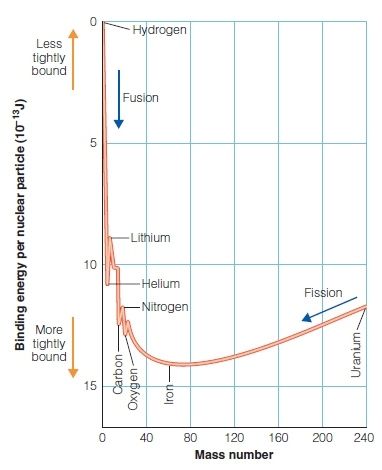
- Ahydrogen
- Buranium
- Ccarbon
- Dhelium
- Eiron
23What happens to the neutrinos that are produced in the proton-proton chain?
- Athey combine with antineutrinos and form a pair of gamma rays
- Bthey head out of the sun at nearly the speed of light
- Cthey collide immediately with other particles, thus adding to the gas pressure that supports the sun against gravitational contraction
- Dthey spiral out along magnetic field lines to become cosmic rays
- Ethey are blocked by the Coulomb barrier and remain inside the sun
24What solved the solar neutrino problem?
- AThe standard model of energy production within the sun was modified.
- BIt was discovered that electron neutrinos do not penetrate rock as easily as expected.
- CThe discovery that neutrinos oscillate between three different types.
- DThe finding that chlorine does not interact with electron neutrinos as predicted.
- ESome of the radioactive argon gas was found leaking out of the neutrino detector undetected.
25Which layer is considered the visible surface of the sun?
- ANone of these choices are correct.
- Bthe chromosphere
- Cthe photosphere
- Dthe corona
26Why can't you see deeper into the photosphere?
- AThe deep photosphere does not emit visible wavelengths.
- BThe photosphere is blocked by the chromosphere.
- CThe upper photosphere blocks the light from the deep photosphere.
- DNo light is being emitted in the deep photosphere.
27What type of energy transport is occurring just below the photosphere?
- AWe do not know, since we cannot see below the photosphere.
- Bradiation
- Cconduction
- Dconvection
28What is the evidence in the photosphere of the type of energy transport occurring beneath it?
- Afilaments
- Bspicules
- Cgranulation
- Dsunspots
29A certain type of energy transport (radiation, convection, or conduction) occurs just below the photosphere. What evidence is there for this energy transport?
- AThese features are at a much lower temperature than the rest of the photosphere.
- BThe sun gives off radiation.
- CThese features are cooler at their edges and hotter at their centers.
- DThere is no evidence of the types of energy transport occurring in the sun.
30How are granules and supergranules similar?
- AThey last for about the same amount of time.
- BThey are similar in size.
- CBoth are caused by convection, they are similar in size, and they last for about the same amount of time.
- DBoth are caused by convection.
31How are granules and supergranules different?
- AGranules are caused by convection; supergranules by conduction.
- BSupergranules do not last as long.
- CAll of these choices are differences.
- DSupergranules are larger.
32How do astronomers detect structure in the chromosphere?
- Aby observing Balmer emission lines
- Bby observing certain absorption lines
- Cby observing at ultraviolet and X-ray wavelengths
- Dby observing the chromosphere during solar eclipses
33What is an image of the Sun's chromosphere obtained by astronomers called?
- Aa filtergram
- Ba Blamergram
- Ca chromogram
- Da Kirchoffagram
34Which is an example of a structure in the chromosphere?
- Aspicules and filaments
- Bspicules
- Cfilaments
- DNone of these choices are correct.
35What evidence can you give that the solar corona is at a very high temperature?
- AIt is far from the photosphere.
- Bfrom coronagraphs
- CIt emits ultraviolet radiation.
- DIt emits X-rays.
36How do astronomers think the solar chromosphere and corona gets heated to their high temperatures?
- AEnergy escaping from sunspot regions heats them.
- BMagnetic fields carry heat outward from lower layers.
- CNatural heat flow from the photosphere heats the chromosphere, then natural heat flow from the chromosphere heats the corona.
- DProminences and flares erupt from the photosphere out to the chromosphere and corona.
37How are astronomers able to explore the layers of the solar interior?
- AThey can't; they just guess what happens in the interior based on what is happening in the outer layers.
- Bfrom Doppler shifts on the solar surface
- Cwith coronagraphs and filtergrams
- Dby sending space probes into the solar interior
38Why does fusion require a high temperature?
- Abecause it occurs in the sun
- Bbecause it produces so much energy
- Cto overcome the repulsive force between the protons
- Dto overcome attractive forces between protons and electrons
39Where in the sun does nuclear fusion occur?
- Athe photosphere
- Beverywhere in the sun
- Cthe core
- Dthe corona
40Why does fusion occur in the layer(s) that it does?
- AOnly the core is hot enough.
- BOnly the corona is hot enough.
- CAny layer of the sun is hot enough.
- DOnly the photosphere is cool enough.
41How do astronomers detect neutrinos?
- AThey use very thick blocks of lead.
- BThey observe nuclear reactions triggered by neutrino collisions in large underground pools of chemicals.
- CThey are observed as one of the types of particles in the solar wind.
42Why are neutrinos so hard to detect?
- AThey oscillate between three different "flavors."
- BThey have very low mass.
- CAll of these choices are reasons.
- DThey move very fast.
43What is neutrino oscillation?
- Aneutrinos changing between three different types
- Ban idea made up by astrophysicists desperate to verify their theories about nuclear fusion in the sun
- Cneutrinos changing between three different types and neutrinos vibrating at a certain resonant frequency
- Dneutrinos vibrating at a certain resonant frequency
44Sunspots are which of the following?
- AAll of these choices are correct.
- Bpoles of solar magnetic fields
- Ccooler areas in the photosphere
- Ddarker areas in the photosphere
45What evidence is there that sunspots are magnetic?
- AActually, there is not evidence of this.
- BTheir spectra show the Zeeman effect.
- CThey are darker than their surroundings.
- DTheir temperatures are cooler than their surroundings.
46An attempt to explain the sunspot cycle is which of the following?
- Athe Zeeman effect
- Bthe Maunder butterfly model
- Cthe dynamo effect
- Dthe Babcock model
47The sunspot cycle could be explained by which of the following?
- Asplitting of spectral lines by the sun's magnetic field
- Btwisting and turning of the sun's magnetic field with the sun's rotation
- Cthe fact that it repeats itself every 11 years
- Dmagnetic fields in the photosphere caused by convection
48What is a solar prominence?
- AIt is solar material from the chromosphere following the arches of the sun's magnetic field.
- BIt is an ejection of solar material from the corona.
- CIt is an eruption of solar material from the photosphere.
- DIt is the same thing as a flare.
49What does the spectrum of a solar prominence reveal?
- AZeeman splitting
- Bthat it is much hotter than its surroundings
- Cthat it is much cooler than its surroundings
- Dthat it is a similar temperature to its surroundings
50What does the shape of a solar prominence suggest?
- AZeeman splitting
- Bthat it is material that will leave the sun
- Cthat it is headed toward the corona
- Dthat it is following the solar magnetic field
51What is a solar flare?
- Aan ejection of solar material from the corona
- Bsolar material from the chromosphere following the arches of the sun's magnetic field
- Can eruption of solar material from the photosphere
- Dthe same thing as a filament
52At what wavelengths is a solar flare observed?
- Aultraviolet
- BAll of these choices are correct.
- CX-ray
- Dvisible
53How can solar flares affect Earth?
- AThe sun is much too far away for flares to affect Earth.
- BThey can cause communication blackouts.
- CThey can cause auroras and communication blackouts.
- DThey can cause auroras.
54The image on the top is of a solar ________
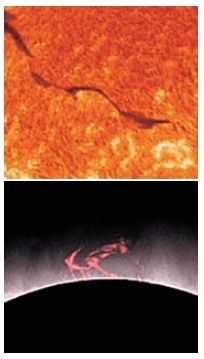
- Aspicule.
- Bflare.
- Cprominence.
- Dfilament.
55The image on the bottom is of a solar ________
- Aspicule
- Bprominence
- Cflare
- Dfilament
56The above image was recorded by which of the following?
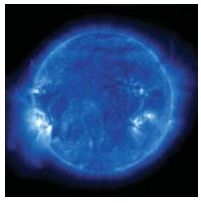
- Aa filtergram
- Ba magnetic dynamo
- Ca coronagraph
- Dthe SOHO spacecraft
57The above image is of which of the following?
- Asolar prominences
- Bactive regions
- CAll of these choices are correct.
- Dthe chromosphere
58Which of the lists below has the layers of the sun in order from the outermost to the innermost, from left to right?
- Acorona, chromosphere, photosphere, core
- Bchromosphere, photosphere, core, corona
- Ccore, corona, chromosphere, photosphere
- Dphotosphere, core, corona, chromosphere
59Which of the following layers of the solar atmosphere has the highest temperature?
- Achromosphere
- Bphotosphere
- Ccorona
60Which of the lists below has the layers of the solar interior in order from the outermost to the innermost, from left to right?
- Aradiative zone, core, convective zone
- Bconvective zone, radiative zone, core
- Ccore, convective zone, radiative zone
61Which of the following sections of the sun has the highest temperature?
- Acore
- Bradiative zone
- Cconvective zone
Information
- Description
- Quiz on Chapter 07, created by Lisa Ye on 26/02/2018.
- Author
- Lisa Ye
- Language
- English
- Views
- 0
- Rating
- No ratings yet Rate this quiz