
Quiz
Neurophysiology 4-5b
This quiz has question types that open in the usual player.
Questions in this quiz (38)
1What are the 3 connective tissue meninge layers?
- ADura Mater
- BSubarachnoid space
- Carachnoid
- DPia mater
- ESkull
- FWhite mater
- GGrey Mater
2Where is the Subarachnoid space located
- ABetween the Dura mater and the skull
- BBetween the Arachnoid and dura mater
- CBetween the arachnoid and pia mater
- DBetween the pia mater and the dura mater
- EIn the head only between the arachnoid and pia mater
- FIn the spine only between the Dura mater and the skull
3In the blood supply for the CNS, the oxygen requirements of the synapses and cell bodies are [blank_start]greater[blank_end] than those for axons because the CNS has a [blank_start]high[blank_end] metabolic rate.
- Agreater
- Blesser
- Chigh
- Dlow
4What area of the CNS has a greater requirement for blood and oxygen than other areas?
- Aspine
- Bbrain
- Cwhite matter
- Dbrainstem
- Eforebrain
5Which ventricle surrounds the interthalamic adhesions?
- Alateral ventricle
- Bmedial ventricle
- Csecond ventricle
- Dthird ventricle
- Efourth ventricle
6The fourth ventricle connects with?
- Ainterthalamic adhesions
- Blateral ventricles
- Cthe central canal of the spinal cord
- Ddorsal sagittal sinus
7Which is not a function of Cerebrospinal fluid.
- AProtect the brain and spinal cord against impact
- Bremove waste and potentially harmful cellular metabolites
- Cdelivers peptide hormones and growth factors
- Dmaintain a consistent microenvironment for the neurons and glia
- Eseal the CNS from the outside environment creating a selective barrier
8Micronutrients are supplied to the neurons and neuroglia cells via?
- ACapillaries of the choroid plexus
- Binterstitial capillaries
- Cblood-brain barrier
- DNeurons and neuroglia cells are capable of generating their own micronutrients they just need assistance with obtaining macronutrients
9What supplies neurons and neuroglia cells with oxygen and macronutrients such as glucose?
- ACapillaries in the choroid plexus
- BEpendymal cells
- Cinterstitial capillaries
- DNeurons and neuroglia cells are capable of generating their own macronutrients they just need assistance with obtaining micronutrients
10What glial cells line the choroid plexus located in all 4 ventricles?
- ASchwann cells
- BOligodendrocytes
- CAstrocytes
- Dependymal cells
11What is the correct flow of CSF?
- ALateral ventericles-> cerebral aqueduct-> thrid ventricle-> fourth ventricle->arachnoid villus-> dorsal sagittal sinus-> veins
- BLateral ventericles-> thrid ventricle->cerebral aqueduct-> fourth ventricle->subarachnoid space-> arachnoid villus-> dorsal sagittal sinus-> veins
- CFourth ventericles-> thrid ventricle->cerebral aqueduct-> lateral ventricle->subarachnoid space-> arachnoid villus-> dorsal sagittal sinus-> veins
- DSubarachnoid space-> Lateral ventericles-> thrid ventricle->cerebral aqueduct-> fourth ventricle-> arachnoid villus-> dorsal sagittal sinus-> veins
- ESubarachnoid space-> Lateral ventericles-> thrid ventricle-> fourth ventricle->cerebral aqueduct-> arachnoid villus-> dorsal sagittal sinus-> veins
12Absorption of the CSF is pressure dependent and unidirectional.
- ATrue
- BFalse
13What is the function of astrocytes in the Blood-brain barrier
- AAstrocytes do not play a role in the Blood-Brain barrier they are necessary for the Blood CSF barrier
- Bthey form perivascular end feet around the entire outer surface of the capillary endothelium and maintain the tight junctions of the endothelial cells
- CThey secrete paracrine that promote the formation of pores
- Dastrocytes form a secondary layer of cells around the capillary endothelium and have no other function
14the Blood-brain barrier is highly permeable to... (5)
- AWater
- BCarbon Dioxide
- Calcohol
- Danesthetics
- Eplasma proteins
- Flarge organic molecules
- Gelectrolytes
- Hoxygen
15Which of the following statements are incorrect.
- AGlucose can pass the blood-brain barrier using passive/ facilitated diffusion of a GLUT 1 transporter.
- BSmall neutral amino acids are synthesized in the CNS
- CTryptophan is a precursor for a neurotransmitter
- DGABA (gamma-aminobutyric acid) is a common inhibitory neurotransmitter
- EParacellular aqueous pathways help transport water-soluble agents
- Fplasma proteins used a form of endocytosis to cross the BBB called adsorptive transcytosis
- Glarge neutral amino acids use active diffusion to cross the blood-brain barrier. many of which are precursors for neurotransmitters
16What is the difference between diffusion potentials and membrane potentials?
- Adiffusion potentials only occur in electrically excitable cells
- Bdiffusion potentials do not cause measurable changes and membrane potentials only happen in electrically excitable cells
- Cdiffusion potentials cause small immeasurable changes and membrane potentials are the electrical difference between the interior and exterior of the cell
- Ddiffusion potentials occur in all cells where membrane potentials are only in electrically excitable cells
17What two cells are capable of easily changing their membrane potential?
- Avirtually all cells
- Bmuscle and cardiac cells
- Cmuscle and neurons
- Dneurons and epithelial cells
- Erespiratory cells and neurons
18ionic differences are the consequence of? (2)
- Apassive transport only
- Bdifferential permeability
- Cvoltage-gated potassium pump
- Dmembrane pumps
- Esolute concentration
- Fvoltage-gated sodium pump
19[blank_start]Potassium and proteins[blank_end] are in abundance inside a cell where [blank_start]Sodium[blank_end] is more concentrated outside the cell.
- APotassium and proteins
- BSodium
- Cchloride
- Dlipids
- EPotassium
- FSodium
- Gproteins
- Hchloride
- Ilipids
- Jpotassium
20What entices Potassium to passively reenter the cell when determining the resting potential of a nerve fiber?
- Apotassium leak channels
- Belectrical forces
- Cvoltage gated potassium channels
- DNa/K pump
- Echemical driving forces
21The Nerst potential for K+ is _______ positive than the resting membrane potential.
- Aless
- Bmore
22Which of the following statements about factors determining the resting potential is incorrect?
- Asodium leak channels allow for sodium to diffuse into the cell. The membrane is more permeable to sodium which is what the nerst potential is +60mV
- BThe selectivity of the channel is 100X higher for K than Na ions
- CProteins remain in the cell and create an electrical force with potassium. The negative charge of the proteins draws the potassium back into the cell
- DPotassium diffusion is the most important contributor for resting potential
- Ethe Na/K pump is important for controlling volume.
- FThe Na/K pump is an active transport pump that contributes to the negative resting potential
23label the following image
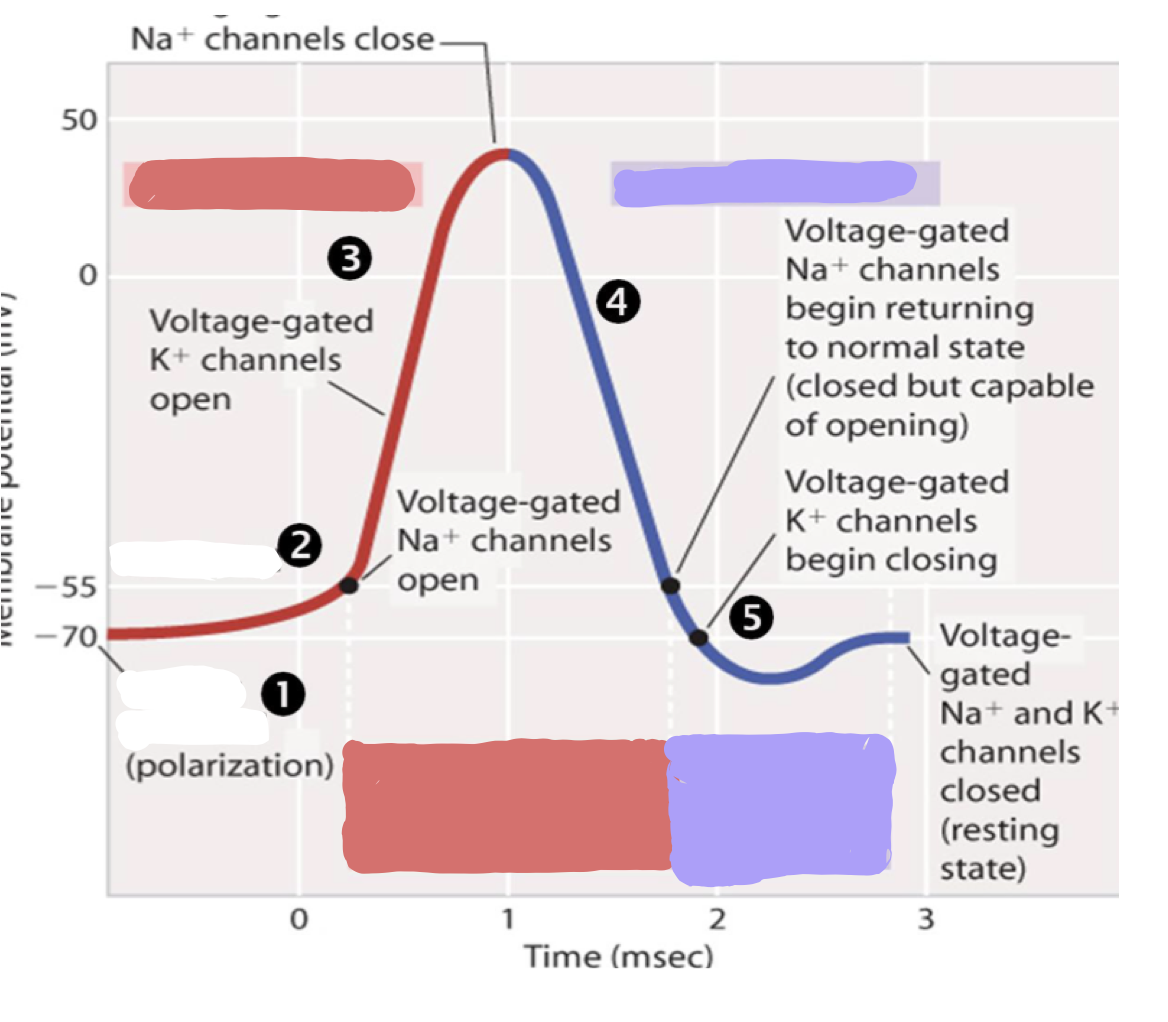
- Adepolarization
- Bhyperpolarization
- Cthreshold
- Dabsolute refractory period
- Erelative refractory period
- FRepolariztion
- GResting potential
- HRelative refractory period
- IAbsolute refractory period
- Jdepolarization
- Krepolarization
- Lthreshold
- Mresting potential
- NHyperpolarization
- Odepolarization
- Pthreshold
- QRepolarization
- RRelative refractory period
- Sabsolute refractory period
- TDepolarization
- UHyperpolarization
- VThreshold
- WResting membrane potential
- XRelative refractory period
- YAbsolute refractory period
- ZRepolarization
24At what point in an action potential do the voltage-gated sodium channels become inactive?
- Adepolarization
- Bthreshold
- Chyperpolarization
- DRepolarization
25When do voltage-gated potassium channels open?
- Amiddle of depolarization
- Bend of depolarization
- Cbeginning of repolarization
- Dduring hyperpolarization
- Eat threshold
26Calcium is more concentrated where?
- Aoutside the cell
- Bin the cytoplasm of the cell
- Cin the presynaptic terminal
- Din the neurotransmitter vesicles
27How can neurotransmitters be removed from the synaptic cleft?
- AThey diffuse into the postsynaptic cell
- Bthey are taken up by glial cells or degraded by enzymes
- Cthey are reabsorbed by the presynaptic cell
- Dthey bind to ligand-gated channels and are removed when a new neurotransmitter takes its place
28What type of synapses is unidirectional?
- Achemical synapse
- Belectrical synapse
- Chormonal synapse
- Dunconventional synapses
29Which neurotransmitter is a common inhibitory neurotransmitter?
- AEndocannabions
- Bglutamate
- CDopamine
- DGABA
30What ionotropic receptors induce depolarization?
- Acation channels
- Banion channels
- CGPCR
- DMetabotropic receptors
31Gap junctions are a form of electrical synapses that are bidirectional and do not interact with chemical synapses
- ATrue
- BFalse
32What part of the neuron does "math" or conducts summation of graded potentials
- Asoma
- Bdendrites
- Caxon hillock
- Daxon
33What is the threshold potential in mV
- A-70
- B-90
- C+60
- D-55
- E-40
34Excitatory postsynaptic potentials do not....
- Adrive the membrane potential to threshold
- Bmake the membrane more positive
- Cform an excitatory synapse
- Dcause Action Potentials
35Inhibitory postsynaptic potentials are associated with>
- Adepolarization
- BRepolarization
- CResting membrane potential
- DHyperpolarization
36What type of summation is induced by different synapses summating in the postsynaptic neuron?
- Asubthreshold summation
- Bspatial summation
- Ctemporal summation
- Dconduction summation
37What type of summation is due to the discharge from a single presynaptic terminal?
- Asubthreshold summation
- Bspatial summation
- Ctemporal summation
- Dconductive summation
38There are ion channels located all along the axon but they are only active in the nodes of Ranvier for myelinated fibers.
- ATrue
- BFalse
Information
- Description
- Quiz on Neurophysiology 4-5b, created by Shaye Antal on 28/06/2019.
- Author
- Shaye Antal
- Language
- English
- Views
- 61
- Rating
- No ratings yet Rate this quiz