
Quiz
AP BIO MIDTERM REVIEW
Create a free account to finish this quiz
Save your progress and see your final score.
Already have an account? Sign in
Questions in this quiz (199)
1Darwinʹs mechanism of natural selection required long time spans in order to modify species. From whom did
Darwin get the concept of Earthʹs ancient age?- AGeorges Cuvier
- BCharles Lyell
- CAlfred Wallace
- DThomas Malthus
- EJohn Henslow
2Charles Darwin was the first person to propose
- Athat evolution occurs.
- Ba mechanism for how evolution occurs.
- Cthat the Earth is older than a few thousand years.
- Da mechanism for evolution that was supported by evidence.
- Ea way to use artificial selection as a means of domesticating plants and animals.
3Which of these conditions should completely prevent the occurrence of natural selection in a population over
time?- AAll variation between individuals is due only to environmental factors.
- BThe environment is changing at a relatively slow rate.
- CThe population size is large.
- DThe population lives in a habitat where there are no competing species present.
4Which of the following represents an idea that Darwin learned from the writings of Thomas Malthus?
- AAll species are fixed in the form in which they are created.
- BPopulations tend to increase at a faster rate than their food supply normally allows.
- CEarth changed over the years through a series of catastrophic upheavals.
- DThe environment is responsible for natural selection.
- EEarth is more than 10,000 years old.
5Given a population that contains genetic variation, what is the correct sequence of the following events, under
the influence of natural selection?
1. Well-adapted individuals leave more offspring than do poorly adapted individuals.
2. A change occurs in the environment.
3. Genetic frequencies within the population change.
4. Poorly adapted individuals have decreased survivorship.- A2 → 4 → 1 → 3
- B4 → 2 → 1 → 3
- C4 → 1 → 2 → 3
- D4 → 2 → 3 → 1
- E2 → 4 → 3 → 1
6To observe natural selectionʹs effects on a population, which of these must be true?
- AOne must observe more than one generation of the population.
- BThe population must contain genetic variation.
- CMembers of the population must increase or decrease the use of some portion of their anatomy.
- DA and C only
- EA and B only
7During drought years on the Galapagos, small, easily eaten seeds become rare, leaving mostly large,
hard-cased seeds that only birds with large beaks can eat. If a drought persists for several years, what should
one expect to result from natural selection?- ASmall birds gaining larger beaks by exercising their mouth parts.
- BSmall birds mutating their beak genes with the result that later-generation offspring have larger beaks.
- CSmall birds anticipating the long drought and eating more to gain weight and, consequently, growing
larger beaks. - DMore small-beaked birds dying than larger-beaked birds. The offspring produced in subsequent
generations have a higher percentage of birds with large beaks. - ELarger birds eating less so smaller birds can survive
8Which of the following must exist in a population before natural selection can act upon that population?
- AGenetic variation among individuals
- BVariation among individuals caused by environmental factors
- CSexual reproduction
- DB and C only
- EA, B, and C
9How many separate species, both extant and extinct, are depicted in this tree?
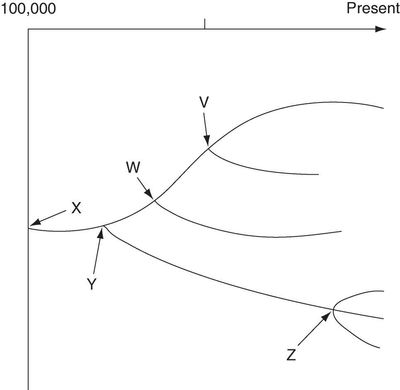
- A2
- B3
- C4
- D5
- E6
10Which of the five common ancestors, labeled V—Z, has given rise to the greatest number of species, both extant
and extinct?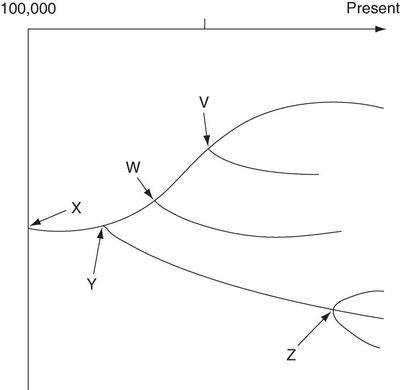
- AV
- BW
- CX
- DY
- EZ
11Evolutionary trees such as this are properly understood by scientists to be
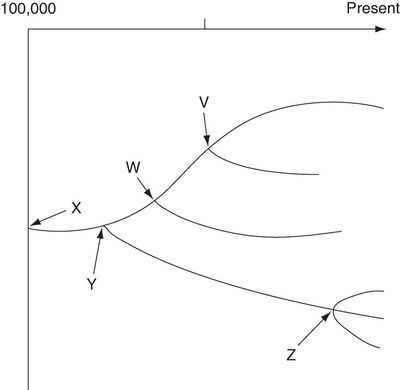
- Atheories.
- Bhypotheses.
- Claws.
- Ddogmas.
- Efacts.
12Which statement best describes the evolution of pesticide resistance in a population of insects?
- AIndividual members of the population slowly adapt to the presence of the chemical by striving to meet
the new challenge. - BAll insects exposed to the insecticide begin to use a formerly silent gene to make a new enzyme that
breaks down the insecticide molecules. - CInsects observe the behavior of other insects that survive pesticide application, and adjust their own
behaviors to copy those of the survivors. - DOffspring of insects that are genetically resistant to the pesticide become more abundant as the
susceptible insects die off.
- AIndividual members of the population slowly adapt to the presence of the chemical by striving to meet
13Some members of a photosynthetic plant species are genetically resistant to an herbicide, while other members
of the same species are not resistant to the herbicide. Which combination of events should cause the most
effective replacement of the non-herbicide-resistant strain of plants by the resistant strain?
1. The presence of the herbicide in the environment
2. The absence of the herbicide from the environment
3. The maintenance of the proper conditions for one generation
4. The maintenance of the proper conditions for many generations- A1 and 3
- B1 and 4
- C2 and 3
- D2 and 4
14Of the following anatomical structures, which is homologous to the wing of a bird?
- ADorsal fin of a shark
- BHindlimb of a kangaroo
- CWing of a butterfly
- DTail fin of a flying fish
- EFlipper of a cetacean
15Structures as different as human arms, bat wings, and dolphin flippers contain many of the same bones, these
bones having developed from very similar embryonic tissues. How do biologists interpret these similarities?- A By identifying the bones as being homologous
- BBy the principle of convergent evolution
- CBy proposing that humans, bats, and dolphins share a common ancestor
- DA and C only
- EA, B, and C
16Which of the following pieces of evidence most strongly supports the common origin of all life on Earth?
- AAll organisms require energy.
- BAll organisms use essentially the same genetic code.
- CAll organisms reproduce.
- DAll organisms show heritable variation.
- EAll organisms have undergone evolution.
17Which of the following statements most detracts from the claim that the human appendix is a completely
vestigial organ?- AThe appendix can be surgically removed with no immediate ill effects.
- BThe appendix might have been larger in fossil hominids.
- CThe appendix has a substantial amount of defensive lymphatic tissue
- DIndividuals with a larger-than-average appendix leave fewer offspring than those with a
below-average-sized appendix. - EIn a million years, the human species might completely lack an appendix.
18Ichthyosaurs were aquatic dinosaurs. Fossils show us that they had dorsal fins and tails, as do fish, even
though their closest relatives were terrestrial reptiles that had neither dorsal fins nor aquatic tails. The dorsal
fins and tails of ichthyosaurs and fish are- Ahomologous.
- Bexamples of convergent evolution.
- Cadaptations to a common environment.
- DA and C only
- E B and C only
19Monkeys of South and Central America have prehensile tails, meaning that their tails can be used to grasp
objects. The tails of African and Asian monkeys are not prehensile. Which discipline is most likely to provide
an evolutionary explanation for how this difference in tails came about?- AAerodynamics
- BBiogeography
- CPhysiology
- DBiochemistry
- EBotany
20Heterozygote advantage should be most closely linked to which of the following?
- Asexual selection
- Bstabilizing selection
- Crandom selection
- Ddirectional selection
- Edisruptive selection
21In a single molecule of water, two hydrogen atoms are bonded to a single oxygen atom by
- Ahydrogen bonds.
- Bnonpolar covalent bonds.
- Cpolar covalent bonds.
- Dionic bonds.
- Evan der Waals interactions.
22An example of a hydrogen bond is the bond between
- AC and H in methane (CH4).
- Bthe H of one water molecule and the O of another water molecule.
- CNa+and Cl- in salt.
- Dthe two hydrogen atoms in a molecule of hydrogen gas (H2).
- EMg+and Cl- in MgCl2.
23What gives rise to the cohesiveness of water molecules?
- Ahydrophobic interactions
- Bnonpolar covalent bonds
- Cionic bonds
- Dhydrogen bonds
- Eboth A and C
24Which of the following takes place as an ice cube cools a drink?
- AMolecular collisions in the drink increase.
- BKinetic energy in the drink decreases.
- CA calorie of heat energy is transferred from the ice to the water of the drink.
- DThe specific heat of the water in the drink decreases.
- EEvaporation of the water in the drink increases.
25The nutritional information on a cereal box shows that one serving of a dry cereal has 200 kilocalories. If one
were to burn one serving of the cereal, the amount of heat given off would be sufficient to raise the temperature
of 20 kg of water how many degrees Celsius?- A0.2°C
- B1.0°C
- C2.0°C
- D10.0°C
- E20.0°C
26Which type of bond must be broken for water to vaporize?
- Aionic bonds
- Bnonpolar covalent bonds
- Cpolar covalent bonds
- Dhydrogen bonds
- Ecovalent bonds
27Hydrophobic substances such as vegetable oil are
- Anonpolar substances that repel water molecules.
- Bnonpolar substances that have an attraction for water molecules.
- Cpolar substances that repel water molecules.
- Dpolar substances that have an affinity for water.
- Echarged molecules that hydrogen-bond with water molecules.
28One mole (mol) of a substance is
- A6.02 × 10^23 molecules of the substance.
- B1 g of the substance dissolved in 1 L of solution.
- Cthe largest amount of the substance that can be dissolved in 1 L of solution.
- Dthe molecular mass of the substance expressed in grams.
- EA and D only
29When an ionic compound such as sodium chloride (NaCl) is placed in water the component atoms of the NaCl
crystal dissociate into individual sodium ions (Na+) and chloride ions (Cl-). In contrast, the atoms of covalently
bonded molecules (e.g., glucose, sucrose, glycerol) do not generally dissociate when placed in aqueous
solution. Which of the following solutions would be expected to contain the greatest number of particles
(molecules or ions)?- A1 L of 0.5 M NaCl
- B1 L of 0.5 M glucose
- C1 L of 1.0 M NaCl
- D1 L of 1.0 M glucose
- EC and D will contain equal numbers of particles.
30The molecular mass of glucose (C6H12O6) is 180 g. Which of the following procedures should you carry out to
make a 0.5 M solution of glucose?- ADissolve 0.5 g of glucose in a small volume of water, and then add more water until the total volume of
solution is 1 L. - BDissolve 90 g of glucose in a small volume of water, and then add more water until the total volume of
the solution is 1 L. - CDissolve 180 g of glucose in a small volume of water, and then add more water until the total volume of
the solution is 1 L. - DDissolve 0.5 g of glucose in 1 L of water.
- EDissolve 180 g of glucose in 1 L of water.
- ADissolve 0.5 g of glucose in a small volume of water, and then add more water until the total volume of
31You have a freshly-prepared 0.1M solution of glucose in water. Each liter of this solution contains how many
glucose molecules?- A6.02 × 10^23
- B3.01 × 10^23
- C6.02 × 10^24
- D12.04 × 10^23
- E6.02 × 10^22
32You have a freshly-prepared 1M solution of glucose in water. You carefully pour out a 100 mL sample of that
solution. How many glucose molecules are included in that 100 mL sample?- A6.02 × 10^23
- B3.01 × 10^23
- C6.02 × 10^24
- D12.04 × 10^23
- E6.02 × 10^22
33Which of the following ionizes completely in solution and is considered to be a strong base (alkali)?
- ANaCl
- BHCl
- CNH3
- DH2CO3
- ENaOH
34What is the pH of a solution with a hydroxyl ion [OH-] concentration of 10-12 M?
- ApH 4
- BpH 2
- CpH 6
- DpH 8
- EpH 10
35Organic chemistry is a science based on the study of
- Afunctional groups.
- Bvital forces interacting with matter.
- Ccarbon compounds.
- Dwater and its interaction with other kinds of molecules.
- Einorganic compounds.
36The experimental approach taken in current biological investigations presumes that
- Asimple organic compounds can be synthesized in the laboratory from inorganic precursors, but complex organic compounds like carbohydrates and proteins can only be synthesized by living organisms.
- Ba life force ultimately controls the activities of living organisms and this life force cannot be studied by physical or chemical methods.
- C although a life force, or vitalism, exists in living organisms, this life force cannot be studied by physical or chemical methods.
- Dliving organisms are composed of the same elements present in nonliving things, plus a few special trace elements found only in living organisms or their products.
- Eliving organisms can be understood in terms of the same physical and chemical laws that can be used to explain all natural phenomena.
37Which of the following people used this apparatus to study the formation of organic compounds?
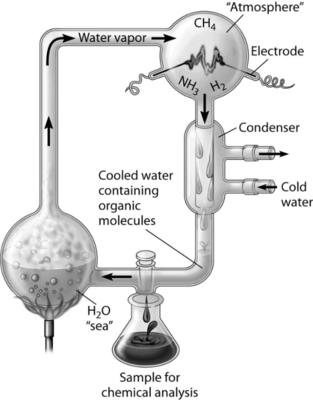
- AStanley Miller
- BJakob Berzelius
- CFriedrich Wohler
- DHermann Kolbe
- EAugust Kekulé
38 Which of the following people synthesized an organic compound, acetic acid, from inorganic substances that had been prepared directly from pure elements?
- A Stanley Miller
- BJakob Berzelius
- CFriedrich Wohler
- DHermann Kolbe
- EAugust Kekulé
39How many electron pairs does carbon share in order to complete its valence shell?
- A1
- B2
- C3
- D4
- E8
40The two molecules shown in the figure above are best described as
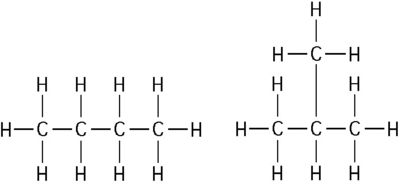
- Aoptical isomers.
- B enantiomers.
- Cstructural isomers.
- Dcis-trans isomers.
- Echain length isomers.
41The two molecules shown in the figure above are best described as
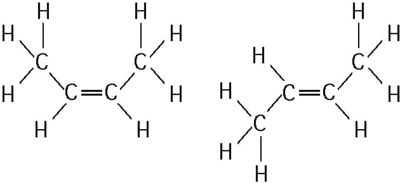
- Aenantiomers.
- Bradioactive isotopes.
- Cstructural isomers.
- Dnonisotopic isomers
- Egeometric isomers
42Which of the following statements best describes the carbon atoms present in all organic molecules?
- AThey were incorporated into organic molecules by plants.
- BThey were processed into sugars through photosynthesis.
- CThey are ultimately derived from carbon dioxide
- DOnly A and C are correct.
- EA, B, and C are correct.
43All of the following are part of a prokaryotic cell except:
- ADNA.
- Ba cell wall
- Ca plasma membrane.
- Dribosomes.
- Ean endoplasmic reticulum.
44Large numbers of ribosomes are present in cells that specialize in producing which of the following molecules?
- Alipids
- Bglycogen
- Cproteins
- Dcellulose
- Enucleic acids
45Which type of organelle or structure is primarily involved in the synthesis of oils, phospholipids, and steroids?
- Aribosome
- Blysosome
- Csmooth endoplasmic reticulum
- Dmitochondrion
- Econtractile vacuole
46The fact that the outer membrane of the nuclear envelope has bound ribosomes allows one to most reliably conclude that
- Aat least some of the proteins that function in the nuclear envelope are made by the ribosomes on the nuclear envelope
- Bthe nuclear envelope is not part of the endomembrane system
- Cthe nuclear envelope is physically separated from the endoplasmic reticulum.
- Dsmall vesicles from the Golgi fuse with the nuclear envelope
- Enuclear pore complexes contain proteins
47Tay-Sachs disease is a human genetic abnormality that results in cells accumulating and becoming clogged with very large and complex lipids. Which cellular organelle must be involved in this condition?
- Athe endoplasmic reticulum
- Bthe Golgi apparatus
- Cthe lysosome
- Dmitochondria
- Emembrane-bound ribosomes
48Which of the following produces and modifies polysaccharides that will be secreted?
- Alysosome
- Bvacuole
- Cmitochondrion
- DGolgi apparatus
- Eperoxisome
49Which of the following contains hydrolytic enzymes?
- Alysosome
- Bvacuole
- Cmitochondrion
- DGolgi apparatus
- Eperoxisome
50Which organelle often takes up much of the volume of a plant cell?
- Alysosome
- Bvacuole
- Cmitochondrion
- DGolgi apparatus
- Eperoxisome
51Which plant cell organelle contains its own DNA and ribosomes?
- Aglyoxysome
- Bvacuole
- Cmitochondrion
- DGolgi apparatus
- Eperoxisome
52Which animal cell organelle contains enzymes that transfer hydrogen from various substrates to oxygen?
- Alysosome
- Bvacuole
- Cmitochondrion
- DGolgi apparatus
- Eperoxisome
53The chemical reactions involved in respiration are virtually identical between prokaryotic and eukaryotic cells. In eukaryotic cells, ATP is synthesized primarily on the inner membrane of the mitochondria. In light of the endosymbiont theory for the evolutionary origin of mitochondria, where is most ATP synthesis likely to occur in prokaryotic cells?
- Ain the cytoplasm
- Bon the inner mitochondrial membrane
- Con the endoplasmic reticulum
- Don the inner plasma membrane
- Eon the inner nuclear envelope
54Which of the following are capable of converting light energy to chemical energy?
- Achloroplasts
- Bmitochondria
- Cleucoplasts
- Dperoxisomes
- EGolgi bodies
55A cell has the following molecules and structures: enzymes, DNA, ribosomes, plasma membrane, and
mitochondria. It could be a cell from- Aa bacterium.
- Ban animal, but not a plant.
- Ca plant, but not an animal.
- Da plant or an animal.
- Eany kind of organism.
56According to the fluid mosaic model of cell membranes, which of the following is a true statement about membrane phospholipids?
- AThey can move laterally along the plane of the membrane.
- BThey frequently flip-flop from one side of the membrane to the other.
- CThey occur in an uninterrupted bilayer, with membrane proteins restricted to the surface of the membrane.
- DThey are free to depart from the membrane and dissolve in the surrounding solution.
- EThey have hydrophilic tails in the interior of the membrane
57Which of the following would likely move through the lipid bilayer of a plasma membrane most rapidly?
- ACO2
- Ban amino acid
- Cglucose
- DK+
- Estarch
58Which of the following statements is correct about diffusion?
- AIt is very rapid over long distances.
- BIt requires an expenditure of energy by the cell.
- CIt is a passive process in which molecules move from a region of higher concentration to a region of lower concentration.
- DIt is an active process in which molecules move from a region of lower concentration to one of higher concentration.
- EIt requires integral proteins in the cell membrane.
59If a membrane protein in an animal cell is involved inthe cotransport of glucose and sodiumions into the cell, which of the following is most likely true?
- AThe sodium ions are moving down their electrochemical gradient while glucose is moving up.
- BGlucose is entering the cell along its concentration gradient.
- CSodium ions can move down their electrochemical gradient through the cotransporter whether or not glucose is present outside the cell.
- DPotassium ions move across the same gradient as sodium ions.
- EA substance that blocked sodium ions from binding to the cotransport protein would also block the transport of glucose.
60Which of the following statements about xylem is incorrect?
- AIt conducts material upward.
- BIt conducts materials within dead cells.
- CIt transports mainly sugars and amino acids.
- D It has a lower water potential than soil does.
- ENo energy input from the plant is required for xylem transport.
61Root hairs are most important to a plant because they
- Aanchor a plant in the soil
- Bstore starches.
- Cincrease the surface area for absorption.
- Dprovide a habitat for nitrogen-fixing bacteria.
- Econtain xylem tissue.
62What is the role of proton pumps in root hair cells?
- Aestablish ATP gradients
- Bacquire minerals from the soil
- Cpressurize xylem transport
- Deliminate excess electrons
- EA and D only
63A water molecule could move all the way through a plant from soil to root to leaf to air and pass through a living cell only once. This living cell would be a part of which structure?
- Athe Casparian strip
- Ba guard cell
- Cthe root epidermis
- D the endodermis
- Ethe root cortex
64What is the main force by which most of the water within xylem vessels moves toward the top of a tree?
- Aactive transport of ions into the stele
- Batmospheric pressure on roots
- Cevaporation of water through stoma
- Dthe force of root pressure
- Eosmosis in the root
65Which of the following are defenses that some plants use against herbivory?
- Aproduction of the unusual amino acid canavanine
- Brelease of volatile compounds that attract parasitoid wasps
- Cassociation of plant tissues with mycorrhizae
- DA and B only
- EA, B, and C
66Plants are affected by an array of pathogens. Which of the following is not a plant defense against disease?
- Acells near the point of infection destroying themselves to prevent the spread of the infection
- Bproduction of chemicals that kill pathogens
- Cacquiring gene-for-gene recognition that allows specific proteins to interact so that the plant can produce defenses against the pathogen
- Da waxy cuticle that pathogens have trouble penetrating
- EAll of the above are plant defenses against disease.
67The transduction pathway that activates systemic acquired resistance in plants is initially signaled by
- Aantisense RNA.
- BPfr phytochrome.
- Csalicylic acid.
- Dabscisic acid.
- Ered, but not far-red, light.
68A short-day plant exposed to nights longer than the minimum for flowering but interrupted by short flashes of light will flower.
- ATrue
- BFalse
69A long-day plant will flower only when the night is longer than a critical value.
- ATrue
- BFalse
70An example of a properly functioning homeostatic control system is seen when
- Athe level of glucose in the blood is abnormally high whether or not a meal has been eaten.
- Ba blood cell shrinks when placed in a solution of salt and water.
- Cthe core body temperature of a runner rises gradually from 37°C to 45°C.
- Dthe kidneys excrete salt into the urine when dietary salt levels rise.
- Ethe blood pressure increases in response to an increase in blood volume.
71Positive feedback has occurred when
- Aan increase in blood sugar increases the secretion of a hormone that stimulates the movement of sugar out of the blood.
- Ba decrease in blood sugar increases the secretion of a hormone that increases the conversion of glycogen to glucose.
- Cuterine contractions needed for the birthing process are expedited by the pressure of a moving baby in its mother's uterus.
- Dan increase in calcium concentration increases the secretion of a hormone that promotes the storage of calcium in bone.
- Ea decrease in blood calcium increases the amount of the hormone that causes the release of calcium from bone.
72In a survivably cold environment, an ectotherm is more likely to survive an extended period of food deprivation than would an equally sized endotherm because the ectotherm
- Ainvests little energy in temperature regulation.
- Bhas greater insulation on its body surface.
- Cmaintains a higher basal metabolic rate.
- Dmetabolizes its stored energy more readily than can the endotherm.
- Eexpends more energy per kg of body mass than does the endotherm.
73Humans can lose, but cannot gain, heat through the process of
- Aconduction.
- Bevaporation.
- Cradiation.
- Dmetabolism.
- Econvection.
74An example of an ectothermic organism that has few or no behavioral options when it comes to its ability to adjust its body temperature is a
- Asea star, a marine invertebrate.
- Bbluefin tuna, a predatory fish.
- Cterrestrial lizard.
- Dhoneybee in a hive.
- Ehummingbird.
75Endothermy
- Ais only seen in mammals
- Bis a term equivalent to "cold-blooded."
- Cinvolves the production of heat through metabolism
- Dis only seen in insects
- Eis a characteristic of most animals
76An example of an organism that has only behavioral controls over its body temperature is the
- Agreen frog.
- Bpenguin.
- Cbluefin tuna
- Dhouse sparrow.
- Egray wolf.
77The temperature-regulating center of vertebrate animals is located in the
- Amedulla oblongata.
- Bthyroid gland.
- Chypothalamus.
- Dsubcutaneous layer of the skin.
- Eliver
78Ingested foods inside the digestive tract of snakes are typically digested by
- Abiosynthesis.
- Benzymatic hydrolysis
- Curic acid.
- Dchemiosmosis.
- Emetabolic heat.
79What does the difference in temperature between arteries and veins in the goose's legs indicate?
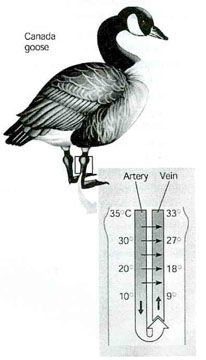
- AThe legs need to be kept cool so that muscles will function well.
- BThe feet need to be kept very warm so they do not freeze in water.
- CHeat loss is proportional to the difference in temperature inside and outside, so minimizing the difference means the goose will lose less heat.
- DArterial blood helps return heat to the core of the goose.
- EWarm venous blood is necessary to keep the goose's feet from freezing.
80Both the eye and the respiratory tract are protected against infections by which of the
following?- Athe secretion of lysozyme onto their surface
- Bthe mucous membranes that cover their surface
- Cthe secretion of complement proteins
- Dthe release of slightly acidic secretions
- E interferons produced by immune cells
81Which statement about the complement system is true?
- AThese proteins are involved in innate immunity and not acquired immunity.
- BThese proteins are secreted by cytotoxic T cells and other CD8 cells.
- CThis group of proteins includes interferons and interleukins.
- DThese proteins are one group of antimicrobial proteins acting together in cascade fashion.
- EThese proteins act individually to attack and lyse microbes.
82Which cells and which signaling molecules are responsible for initiating an inflammatory response?
- Aphagocytes: lysozymes
- Bphagocytes: chemokines
- Cdendritic cells: interferons
- Dmast cells: histamines
- Elymphocytes: interferons
83Septic shock, a systemic response including high fever and low blood pressure, is a response to
- Aspecific forms of viruses.
- Bcertain bacterial infections.
- Cthe presence of natural killer cells.
- Da fever of >103°F in adults.
- Eincreased production of neutrophils
84If a newborn were accidentally given a drug that destroyed the thymus, what would most likely happen?
- AHis cells would lack class I MHC molecules on their surface.
- BHis immune system would not function.
- CGenetic rearrangement of antigen receptors would not occur.
- DHis T cells would not mature and differentiate appropriately.
- EHis B cells would be reduced in number.
85The clonal selection theory is an explanation for how
- Aa single type of stem cell can produce both red blood cells and white blood cells.
- BV gene and J gene segments are rearranged
- Can antigen can provoke development of very few cells to result in production of high levels of specific antibodies.
- DHIV can disrupt the immune system.
- Emacrophages can recognize specific T cells and B cells.
86When would B cells produce effector cells?
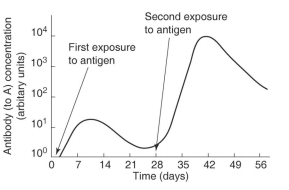
- Abetween 0 and 7 days
- Bbetween 7 and 14 days
- C between 28 and 35 days
- D A and B
- EA and C
87When would memory cells be produced?
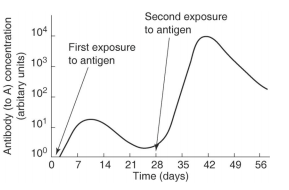
- Abetween 0 and 7 days
- Bbetween 7 and 14 days
- Cbetween 28 and 35 days
- Dbetween 35 and 42 days
- Eboth A and C
88Which of the following differentiates T cells and B cells?
- AT cells but not B cells are stimulated to increase the rate of their cell cycles.
- BOnly B cells are produced from stem cells of the bone marrow.
- CT cells but not B cells can directly attack and destroy invading pathogens.
- DT cells but not B cells have surface markers.
- EOnly B cells take part in cell-mediated immunity.
89The MHC is important in a T cell's ability to
- Arecognize specific parasitic pathogens.
- B distinguish self from nonself.
- C identify specific bacterial pathogens.
- Didentify specific viruses.
- Erecognize differences among types of cancer.
90The following events occur when a mammalian immune system first encounters a
pathogen. Which shows the correct sequence in which they occur?
I. Pathogen is destroyed.
II. Lymphocytes secrete antibodies.
III. Antigenic determinants from pathogen bind to antigen receptors on lymphocytes.
IV. Lymphocytes specific to antigenic determinants from pathogen become numerous.
V. Only memory cells remain.- AI → III → II → IV → V
- BIII → II → I → V → IV
- C II → I → IV → III → V
- DIV → II → III → I → V
- E III → IV → II → I → V
91Which cell type interacts with both the humoral and cell-mediated immune
pathways?- Aplasma cells
- Bhelper T cells
- Cnatural killer cells
- DCD8 cells
- Ecytotoxic T cells
92Which of the following is accounted for by immunological memory?
- A the human body's ability to distinguish self from nonself
- Bthe observation that some strains of the pathogen that causes dengue fever cause worse
disease than others - Cthe ability of a helper T cell to signal B cells via cytokines
- Dthe ancient observation that someone who had recovered from the plague could safely care
for those newly diseased - Ethe ability of the immune system to present antigen fragments in association with MHC
antigens
93An otherwise healthy student in your class is infected with EBV, the virus that causes infectious
mononucleosis. The same student had already been infected when she was a child, and she had
merely experienced a mild sore throat and swollen lymph nodes in her neck. This time, though
infected, she does not get sick. The EBV antigen fragments will be presented by the virus-infected cells along with which of
the following?- Acomplement
- Bantibodies
- Cclass I MHC molecules
- Dclass II MHC molecules
- EDendritic cells
94A nonfunctional CD4 protein on a helper T cell would result in the helper T cell being unable
to- Arespond to T-independent antigens.
- Blyse tumor cells.
- Cstimulate a cytotoxic T cell.
- Dinteract with a class I MHC-antigen complex
- Einteract with a class II MHC-antigen complex.
95Naturally acquired passive immunity would involve the
- A injection of vaccine.
- Bingestion of interferon.
- Cplacental transfer of antibodies.
- Dabsorption of pathogens through mucous membranes.
- Einjection of antibodies.
96What accounts for antibody switching (i.e., the switch of one B cell from producing one class
of antibody to another antibody class that is responsive to the same antigen)?- Amutation in the genes of that B cell, induced by exposure to the antigen
- Bthe rearrangement of V region genes in that clone of responsive B cells
- C a switch in the kind of antigen-presenting cell that is involved in the immune response
- Da patient's reaction to the first kind of antibody made by the plasma cells
- Ethe shuffling of exons for one C region type to another attached to the V-J transcript
97In which of the cases could the mother exhibit an anti-Rh-factor reaction to the
developing fetus?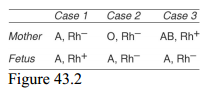
- ACase 1 only
- BCase 3 only
- C Cases 1 and 2 only
- DCases 1, 2, and 3
- EIt cannot be determined from the data given.
98When an individual is subject to short-term starvation, most available food is used to provide energy(metabolism) rather than building blocks (growth and repair). Which hormone would be particularly active intimes of food shortage?
- Aepinephrine
- Bglucagon
- Coxytocin
- Dantidiuretic hormone
- Einsulin
99Based on their effects, which pair below could be considered antagonistic?
- Aprostaglandin F and nitric oxide
- Bgrowth hormone and ecdysone
- Cendocrine and exocrine glands
- Dhormones and target cells
- Eneurosecretory cells and neurotransmitters
100For this pair of items, choose the option that best describes their relationship.
(A) The number of purines in the DNA strand 5ʹ-AAGAGGAGAAA-3ʹ
(B) The number of pyrimidines in the DNA strand 5ʹ-AAGAGGAGAAA-3ʹ- AItem (A) is greater than item (B).
- BItem (A) is less than item (B).
- CItem (A) is exactly or very approximately equal to item (B).
- DItem (A) may stand in more than one of the above relations to item (B).
101Which of the following is not a polymer?
- Aglucose
- B starch
- Ccellulose
- Dchitin
- E DNA
102The molecular formula for glucose is C6H12O6. What would be the molecular formula for a
molecule made by linking three glucose molecules together by dehydration reactions?- AC18H36O18
- BC18H30O15
- CC6H10O5
- D C18H10O15
- EC3H6O3
103Which of the following descriptors is true of the molecule shown in Figure 5.1?
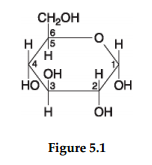
- Ahexose
- Bfructose
- Cglucose
- DA and B only
- EA and C only
104Which of the following statements is true regarding the molecule illustrated in Figure 5.2?
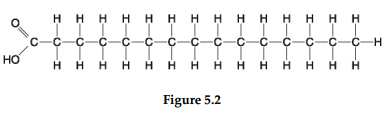
- A It is a saturated fatty acid.
- BA diet rich in this molecule may contribute to atherosclerosis.
- CMolecules of this type are usually liquid at room temperature.
- D A and B only
- EA, B and C
105Which of the following statements is true regarding the molecule illustrated in Figure 5.3?
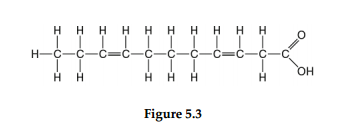
- AIt is a saturated fatty acid.
- BA diet rich in this molecule may contribute to atherosclerosis.
- CMolecules of this type are usually liquid at room temperature
- DA and B only
- EA, B and C
106What is the structure shown in Figure 5.4?
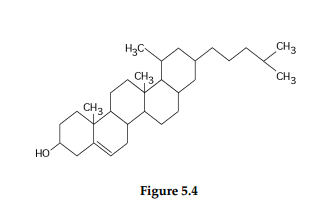
- Astarch molecule
- Bprotein molecule
- Csteroid molecule
- Dcellulose molecule
- Ephospholipid molecule
107At which bond would water need to be added to achieve hydrolysis of the peptide, back to
its component amino acid?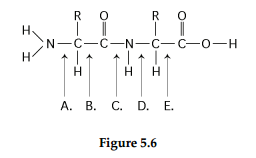
- AA
- BB
- CC
- DD
- EE
108Which bond is a peptide bond?
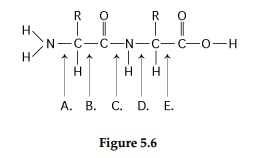
- AA
- BB
- CC
- DD
- EE
109Which bond is closest to the N-terminus of the molecule?
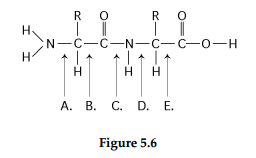
- AA
- BB
- CC
- DD
- EE
110The structure depicted in Figure 5.7 shows the
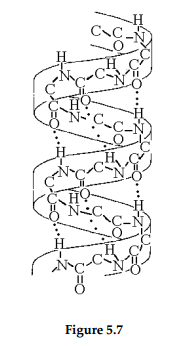
- A1-4 linkage of the α glucose monomers of starch
- B1-4 linkage of the β glucose monomers of cellulose.
- Cdouble helical structure of a DNA molecule.
- Dα helix secondary structure of a polypeptide.
- Eβ pleated sheet secondary structure of a polypeptide
111Which of the following best describes the flow of information in eukaryotic cells?
- ADNA → RNA → proteins
- BRNA → proteins → DNA
- Cproteins → DNA → RNA
- DRNA → DNA → proteins
- EDNA → proteins → RNA
112 If a DNA sample were composed of 10% thymine, what would be the percentage of
guanine?- A10
- B20
- C40
- D80
- E impossible to tell from the information given
113 If one strand of a DNA molecule has the sequence of bases 5ʹATTGCA3ʹ, the other
complementary strand would have the sequence- A5ʹTAACGT3ʹ
- B3ʹTAACGT5ʹ.
- C5ʹUAACGU3ʹ
- D3ʹUAACGU5ʹ.
- E5ʹUGCAAU3ʹ.
114Large numbers of ribosomes are present in cells that specialize in producing which of the following molecules?
- Alipids
- Bstarches
- Cproteins
- Dsteroids
- Eglucose
115Under which of the following conditions would you expect to find a cell with a majority of "free" ribosomes (not connected to the ER)?
- A a cell that is secreting proteins
- Ba cell that is producing cytoplasmic enzymes
- Ca cell that is constructing its cell wall or extracellular matrix
- Da cell that is digesting food particles
- Ea cell that is enlarging its vacuole
116Which type of organelle is primarily involved in the synthesis of oils, phospholipids, and steroids?
- Asmooth endoplasmic reticulum
- Blysosome
- Cribosome
- Dmitochondrion
- Econtractile vacuole
117The Golgi apparatus has a polarity or sidedness to its structure and function. Which of the following statements CORRECTLY describes this polarity?
- ATransport vesicles fuse with one side of the Golgi and leave from the opposite side.
- BProteins in in the membrane of the Golgi may be sorted and modified as they move from one side of the Golgi to the other.
- CLipids in the membrane of the Golgi may be sorted and modified as they move from one side of the Golgi to the other.
- DSoluble proteins in the cisternae (interior) of the Golgi may be sorted and modified as they move from one side of the Golgi to the other.
- E All of the above correctly describe polar characteristics of the Golgi function.
118Which structure is the site of the synthesis of proteins that may be exported from the cell?
- Arough ER
- Blysosomes
- Cplasmodesmata
- DGolgi vesicles
- Efree cytoplasmic ribosomes
119In animal cells, hydrolytic enzymes are packaged to prevent general destruction of cellular components. Which of the following organelles functions in this compartmentalization?
- A chloroplast
- Blysosome
- Ccentral vacuole
- Dperoxisome
- Eglyoxysome
120Which of the following is a compartment that often takes up much of the volume of a plant cell?
- Alysosome
- Bvacuole
- Cmitochondrion
- DGolgi apparatus
- Eperoxisome
121Which is one of the main energy transformers of cells?
- Alysosome
- Bvacuole
- Cmitochondrion
- DGolgi apparatus
- Eperoxisome
122Which of the following contains enzymes that transfer hydrogen from various substrates to oxygen?
- Alysosome
- Bvacuole
- Cmitochondrion
- DGolgi apparatus
- E peroxisome
123Grana, thylakoids, and stroma are all components found in
- Avacuoles.
- Bchloroplasts.
- Cmitochondria.
- Dlysosomes.
- Enuclei.
124A cell has the following molecules and structures: enzymes, DNA, ribosomes, plasma membrane, and mitochondria. It could be a cell from
- Aa bacterium.
- Ban animal, but not a plant.
- Ca plant, but not an animal.
- Da plant or an animal
- Eany kind of organism
125Reactants capable of interacting to form products in a chemical reaction must first overcome a thermodynamic barrier known as the reaction's
- Aentropy
- Bactivation energy.
- Cequilibrium point.
- Dendothermic level.
- Efree-energy content.
126Which curve represents the behavior of an enzyme taken from a bacterium that lives in hot springs at temperatures of 70oC or higher?
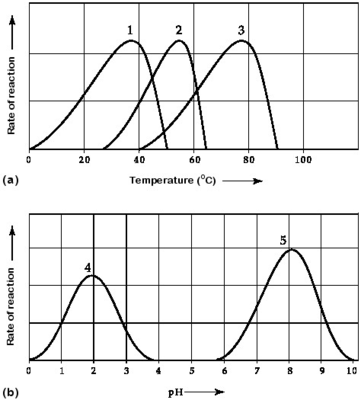
- A1
- B2
- C3
- D4
- E5
127Which curve was most likely generated from analysis of an enzyme form a human stomach where conditions are strongly acidic?
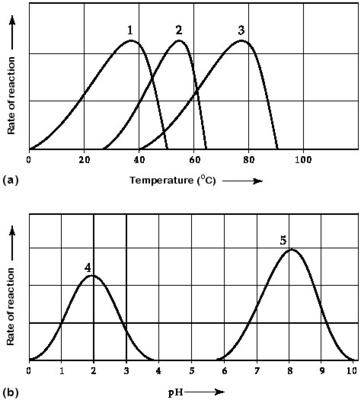
- A1
- B2
- C3
- D4
- E5
128Which of the following terms best describes the forward reaction in Figure 8.1?
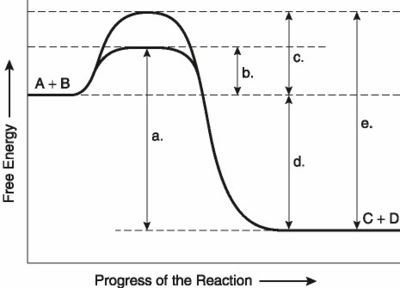
- A endergonic, ∆G > 0
- Bexergonic, ∆G < 0
- Cendergonic, ∆G < 0
- Dexergonic, ∆G > 0
- Echemical equilibrium, ∆G = 0
129Assume that the reaction in Figure 8.1 has a ΔG of -5.6 kcal/mol. Which of the following would be true?
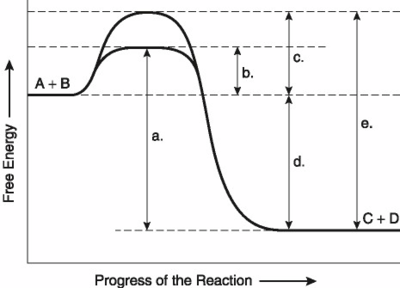
- AThe reaction could be coupled to power an endergonic reaction with a ΔG of +6.2 kcal/mol.
- BThe reaction could be coupled to power an exergonic reaction with a ΔG of +8.8 kcal/mol.
- CThe reaction would result in a decrease in entropy (S) and an increase in the total energy content (H) of the system.
- DThe reaction would result in an increase in entropy (S) and a decrease in the total energy content (H) of the system.
- EThe reaction would result in products (C + D) with a greater free-energy content than in the initial reactants (A + B).
130Paracrine signaling
- Ainvolves secreting cells acting on nearby target cells by discharging a local regulator into the extracellular fluid.
- Brequiresnerve cells to release a neurotransmitter into the synapse
- Coccurs only in paracrine yeast cells.
- Dhas been found in plants but not animals.
- Einvolves mating factors attaching to target cells and causing production of new paracrine cells.
131What would be true for the signaling system in an animal cell that lacks the ability to produce GTP?
- AIt would not be able to activate and inactivate the G protein on the cytoplasmic side of the plasma membrane.
- BIt could activate only the epinephrine system.
- CIt would be able to carry out reception and transduction, but would not be able to respond to a signal.
- DOnly A and C are true.
- E A, B, and C are true.
132Up to 60% of all medicines used today exert their effects by influencing what structures in the cell membrane?
- Atyrosine-kinases receptors
- Bligand-gated ion channel receptors
- Cgrowth factors
- DG proteins
- Echolesterol
133Which of the following are chemical messengers that pass through the plasma membrane of cells & have receptor molecules in the cytoplasm?
- AInsulin
- BTestosterone
- CcAMP
- DEphinephrine
134A major group of G protein-coupled receptors contains seven transmembrane α helices. The amino end of the protein lies at the exterior of the plasma membrane. Loops of amino acids connect the helices either at the exterior face or on the cytosol face of the membrane. The loop on the cytosol side between helices 5 and 6 is usually substantially longer than the others.
Where would you expect to find the carboxyl end?- Aat the exterior surface
- B at the cytosol surface
- C connected with the loop at H5 and H6
- Dbetween the membrane layers
135One of the major categories of receptors in the plasma membrane reacts by forming dimers, adding phosphate groups, and then activating relay proteins. Which type does this?
- AG protein-coupled receptors
- Bligand-gated ion channels
- Csteroid receptors
- Dreceptor tyrosine kinases
136Sutherland discovered that epinephrine signals
- Aa decrease in levels of cAMP as a result of bypassing the plasma membrane.
- Blower blood glucose by binding to liver cells.
- Cinteractions with insulin inside muscle cells.
- Dinteractions directly with glycogen phosphorylase.
- Eelevation of cytosolic concentrations of cyclic AMP.
137Which of the following describes cell communication systems?
- ACell signaling evolved more recently than systems such as the immune system of vertebrates.
- BCommunicating cells are usually close together.
- CMost signal receptors are bound to the outer membrane of the nuclear envelope.
- DLipid phosphorylation is a major mechanism of signal transduction.
- EIn response to a signal, the cell may alter activities by changes in cytosol activity or intranscription of RNA.
138Which of the following most likely would be an immediate result of growth factor binding to its receptor?
- Aprotein kinase activity
- Badenylyl cyclase activity
- CGTPase activity
- D protein phosphatase activity
- Ephosphorylase activity
139Adenylyl cyclase has the opposite effect of which of the following?
- Aprotein kinase
- Bprotein phosphatase
- Cphosphodiesterase
- Dphosphorylase
- EGTPase
140If a pharmaceutical company wished to design a drug to maintain low blood sugar levels, oneapproach might be to
- Adesign a compound that blocks epinephrine receptor activation.
- Bdesign a compound that inhibits cAMP production in liver cells.
- Cdesign a compound that inhibits phosphorylase activity.
- Ddesign a compound to block G-protein activity in liver cells.
- EAll of the above are possible approaches.
141Which of the following statements is true?
- AWhen signal molecules first bind to receptor tyrosine kinases, the receptors phosphorylate anumber of nearby molecules
- BIn response to some G-protein-mediated signals, a special type of lipid molecule associated with the plasma membrane is cleaved to form IP3 and calcium.
- CIn most cases, signal molecules interact with the cell at the plasma membrane and then enter the cell and eventually the nucleus.
- DToxins such as those that cause botulism and cholera interfere with the ability of activated G proteins to hydrolyze GTP to GDP, resulting in phosphodiesterase activity in the absence of an appropriate signal molecule.
- EProtein kinase A activation is one possible result of signal molecules binding to G protein-linked receptors.
142One inhibitor of cGMP is Viagra. It provides a signal that leads to dilation of blood vesselsand increase of blood in the penis, facilitating erection. cGMP is inhibited, therefore the signal isprolonged. The original signal that is now inhibited would have
- Ahydrolyzed cGMP to GMP.
- Bhydrolyzed GTP to GDP
- Cphosphorylated GDP.
- Ddephosphorylated cGMP.
- Eremoved GMP from the cell.
143The nucleus and most of the organelles in a neuron are located in the
- Adendritic region.
- Baxon hillock.
- Caxon.
- Dcell body.
- Eaxon terminals
144For a neuron with an initial membrane potential at -70 mV, an increase in the movement of potassium ions out of that neuron's cytoplasm would result in
- Athe depolarization of the neuron
- B the hyperpolarization of the neuron
- Cthe replacement of potassium ions with sodium ions.
- Dthe replacement of potassium ions with calcium ions
- Ethe neuron switching on its sodium-potassium pump to restore the initial conditions
145Although the membrane of a "resting" neuron is highly permeable to potassium ions, its membrane potential does not exactly match the equilibrium potential for potassium because the neuronal membrane is also
- Afully permeable to sodium ions.
- Bslightly permeable to sodium ions
- Cfully permeable to calcium ions.
- Dimpermeable to sodium ions
- Ehighly permeable to chloride ions.
146The operation of the sodium-potassium "pump" moves
- Asodium and potassium ions into the cell.
- B sodium and potassium ions out of the ce
- Csodium ions into the cell and potassium ions out of the cell.
- Dsodium ions out of the cell and potassium ions into the cell.
- Esodium and potassium ions into the mitochondria.
147A "resting" motor neuron is expected to
- Arelease lots of acetylcholine.
- Bhave high permeability to sodium ions.
- C be equally permeable to sodium and potassium ions.
- Dexhibit a resting potential that is more negative than the "threshold" potential.
- Ehave a higher concentration of sodium ions on the inside of the cell than on the outside
148The "threshold" potential of a membrane
- Ais the point of separation from a living to a dead neuron.
- B is the lowest frequency of action potentials a neuron can produce.
- Cis the minimum hyperpolarization needed to prevent the occurrence of action potentials.
- Dis the minimum depolarization needed to operate the voltage-gated sodium and potassium channels.
- Eis the peak amount of depolarization seen in an action potential.
149A toxin that binds specifically to voltage-gated sodium channels in axons would be expected to
- Aprevent the hyperpolarization phase of the action potential.
- Bprevent the depolarization phase of the action potential.
- Cprevent graded potentials
- Dincrease the release of neurotransmitter molecules.
- Ehave most of its effects on the dendritic region of a neuron.
150After the depolarization phase of an action potential, the resting potential is restored by
- Athe opening of sodium activation gates.
- Bthe opening of voltage-gated potassium channels and the closing of sodium channels.
- Ca decrease in the membrane's permeability to potassium and chloride ions.
- Da brief inhibition of the sodium-potassium pump
- Ethe opening of more voltage-gated sodium channels.
151 The membrane potential is closest to the equilibrium potential for potassium at label
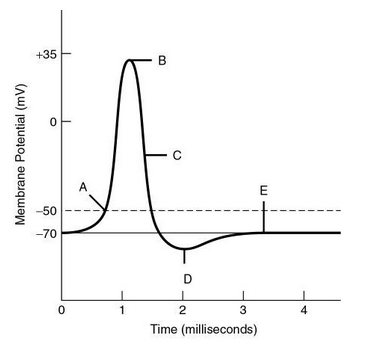
- AA
- BB
- CC
- DD
- EE
152The membrane's permeability to sodium ions is at its maximum at label
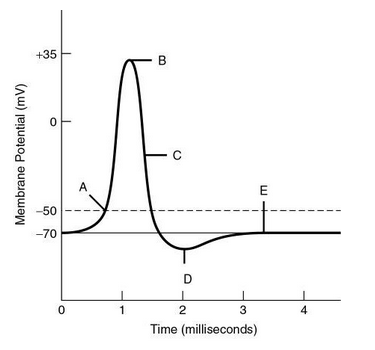
- AA
- BB
- CC
- DD
- EE
153The minimum graded depolarization needed to operate the voltage-gated sodium and potassium channels is indicated by the label
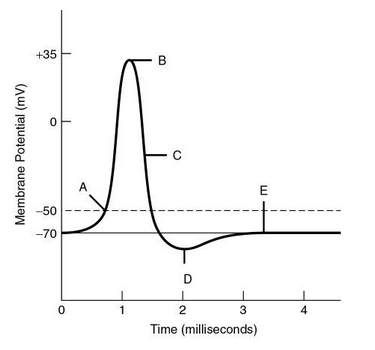
- AA
- BB
- CC
- DD
- EE
154The cell is not hyperpolarized; however, repolarization is in progress, as the sodium channels are closing or closed, and many potassium channels have opened at label
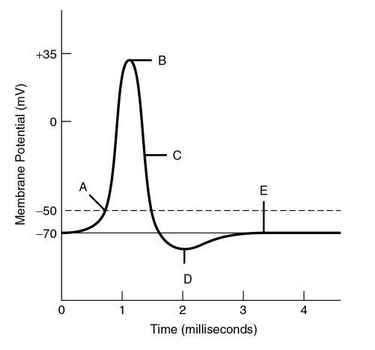
- AA
- BB
- CC
- DD
- EE
155The neuronal membrane is at its resting potential at label
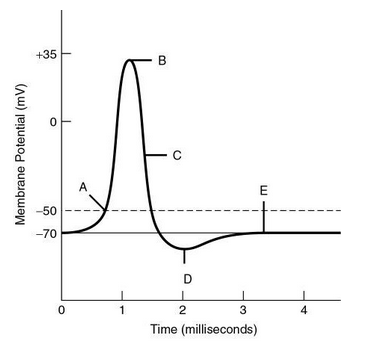
- AA
- BB
- CC
- DD
- EE
156In the sequence of permeability changes for a complete action potential, the first of these events that occurs is
- Athe activation of the sodium-potassium "pump."
- Bthe inhibition of the sodium-potassium "pump."
- Cthe opening of voltage-gated sodium channels.
- Dthe closing of voltage-gated potassium channels.
- Ethe opening of voltage-gated potassium channels.
157Neurotransmitters are released from axon terminals via
- Aosmosis.
- Bactive transport.
- Cdiffusion.
- Dtranscytosis.
- Eexocytosis.
158The observation that the acetylcholine released into the junction between a motor neuron and a skeletal muscle binds to a sodium channel and opens it is an example of
- Aa voltage-gated sodium channel.
- B a voltage-gated potassium channel.
- Ca ligand-gated sodium channel.
- Da second-messenger-gated sodium channel.
- Ea chemical that inhibits action potentials.
159An inhibitory postsynaptic potential (IPSP) occurs in a membrane made more permeable to
- Apotassium ions.
- Bsodium ions.
- Ccalcium ions.
- DATP.
- Eall neurotransmitter molecules.
160The activity of acetylcholine in a synapse is terminated by
- Aits active transport across the presynaptic membrane.
- Bits diffusion across the presynaptic membrane.
- Cits active transport across the postsynaptic membrane
- D its diffusion across the postsynaptic membrane.
- Eits degradation by a hydrolytic enzyme on the postsynaptic membrane
161When several EPSPs arrive at the axon hillock from different dendritic locations, depolarizing the postsynaptic cell to threshold for an action potential, this is an example of
- Atemporal summation.
- Bspatial summation.
- Ctetanus.
- Dthe refractory state.
- Ean action potential with an abnormally high peak of depolarization.
162 Functionally, which cellular location is the neuron's "decision-making site" as to whether or not an action potential will be initiated?
- Aaxonal membranes
- Baxon hillocks
- Cdendritic membranes
- Dmitochondrial membranes
- Epresynaptic membranes
163Which of the following types of reactions would decrease the entropy within a cell?
- Arespiration
- Bdehydration reactions
- C hydrolysis
- Dcatabolism
- Edigestion
164Which of the following is an example of potential rather than kinetic energy?
- Athe muscle contractions of a person mowing grass
- Bwater rushing over Niagara Falls
- Clight flashes emitted by a firefly
- Da molecule of glucose
- Ethe flight of an insect foraging for food
165Which of the following is true of metabolism in its entirety in all organisms?
- AMetabolism depends on a constant supply of energy from food.
- BMetabolism depends on an organism's adequate hydration.
- CMetabolism uses all of an organism's resources.
- DMetabolism is a property of organismal life.
- EMetabolism manages the increase of entropy in an organism.
166What is the change in free energy of a system at chemical equilibrium?
- Aslightly increasing
- Bgreatly increasing
- Cslightly decreasing
- Dgreatly decreasing
- E no net change
167Chemical equilibrium is relatively rare in living cells. Which of the following could be an example of a reaction at chemical equilibrium in a cell?
- Aa reaction in which the free energy at equilibrium is higher than the energy content at any point away from equilibrium
- Ba chemical reaction in which the entropy change in the reaction is just balanced by an opposite entropy change in the cell's surroundings
- Can endergonic reaction in an active metabolic pathway where the energy for that reaction is supplied only by heat from the environment
- Da chemical reaction in which both the reactants and products are not being produced or used in any active metabolic pathway
- Eno possibility of having chemical equilibrium in any living cell
168When glucose monomers are joined together by glycosidic linkages to form a cellulose polymer, the changes in free energy, total energy, and entropy are as follows:
- A+ΔG, +ΔH, +ΔS.
- B+ΔG, +ΔH, -ΔS.
- C+ΔG, -ΔH, -ΔS.
- D-ΔG, +ΔH, +ΔS.
- E-ΔG, -ΔH, -ΔS
169Which of the following best describes enthalpy (H)?
- A the total kinetic energy of a system
- Bthe heat content of a chemical system
- Cthe system's entropy
- Dthe cell's energy equilibrium
- Ethe condition of a cell that is not able to react
170When 10,000 molecules of ATP are hydrolyzed to ADP and Pi in a test tube, about twice as much heat is liberated as when a cell hydrolyzes the same amount of ATP. Which of the following is the best explanation for this observation?
- ACells are open systems, but a test tube is a closed system.
- B Cells are less efficient at heat production than nonliving systems.
- CThe hydrolysis of ATP in a cell produces different chemical products than does the reaction in a test tube.
- DThe reaction in cells must be catalyzed by enzymes, but the reaction in a test tube does not need enzymes.
- EReactant and product concentrations in the test tube are different from those in the cell.
171What term is used to describe the transfer of free energy from catabolic pathways to anabolic pathways?
- Afeedback regulation
- Bbioenergetics
- Cenergy coupling
- Dentropy
- Ecooperativity
172When chemical, transport, or mechanical work is done by an organism, what happens to the heat generated?
- AIt is used to power yet more cellular work.
- BIt is used to store energy as more ATP.
- CIt is used to generate ADP from nucleotide precursors.
- DIt is lost to the environment.
- EIt is transported to specific organs such as the brain.
173A number of systems for pumping across membranes are powered by ATP. Such ATP-powered pumps are often called ATPases although they don't often hydrolyze ATP unless they are simultaneously transporting ions. Small increases in calcium ions in the cytosol trigger a number of different intracellular reactions, so the cells must keep the calcium concentration quite low. Muscle cells also transport calcium from the cytosol into the membranous system called the sarcoplasmic reticulum (SR). If a muscle cell cytosol has a free calcium ion concentration of 10-7 in a resting cell, while the concentration in the SR can be 10-2, then how is the ATPase acting?
- AThe ATP must be powering an inflow of calcium from the outside of the cell into the SR
- BATP must be transferring Pi to the SR to enable this to occur.
- CATPase activity must be pumping calcium from the cytosol to the SR against the concentration gradient.
- DThe calcium ions must be diffusing back into the SR along the concentration gradient.
- EThe route of calcium ions must be from SR to the cytosol, to the cell's environment.
174What is the term for metabolic pathways that release stored energy by breaking down complex molecules?
- Aanabolic pathways
- Bcatabolic pathways
- Cfermentation pathways
- D thermodynamic pathways
- Ebioenergetic pathways
175Which of the following statements describes the results of this reaction?
C₆H₁₂O₆ + 6 O₂ → 6 CO₂ + 6 H₂O + Energy- AC₆H₁₂O₆ is oxidized and O₂ is reduced.
- BO₂ is oxidized and H₂O is reduced.
- CCO₂ is reduced and O₂ is oxidized
- DC₆H₁₂O₆ is reduced and CO₂ is oxidized.
- EO₂ is reduced and CO₂ is oxidized
176Where does glycolysis take place in eukaryotic cells?
- Amitochondrial matrix
- Bmitochondrial outer membrane
- Cmitochondrial inner membrane
- Dmitochondrial intermembrane space
- Ecytosol
177Which step in Figure 9.1 shows a split of one molecule into two smaller molecules?
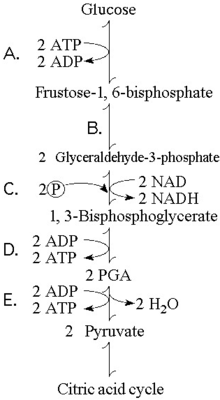
- AA
- BB
- CC
- DD
- EE
178Starting with one molecule of glucose, the "net" products of glycolysis are
- A2 NAD⁺, 2 pyruvate, and 2 ATP
- B2 NADH, 2 pyruvate, and 2 ATP
- C2 FADH₂, 2 pyruvate, and 4 ATP
- D6 CO₂, 2 ATP, and 2 pyruvate.
- E6 CO₂, 30 ATP, and 2 pyruvate
179Why is glycolysis described as having an investment phase and a payoff phase?
- AIt both splits molecules and assembles molecules
- BIt attaches and detaches phosphate groups.
- CIt uses glucose and generates pyruvate.
- D It shifts molecules from cytosol to mitochondrion.
- EIt uses stored ATP and then forms a net increase in ATP
180In the presence of oxygen, the three-carbon compound pyruvate can be catabolized in the citric acid cycle. First, however, the pyruvate (1) loses a carbon, which is given off as a molecule of CO₂, (2) is oxidized to form a two-carbon compound called acetate, and (3) is bonded to coenzyme A.
These three steps result in the formation of- Aacetyl CoA, O₂, and ATP.
- Bacetyl CoA, FADH₂, and CO₂
- Cacetyl CoA, FAD, H₂, and CO₂.
- Dacetyl CoA, NADH, H⁺, and CO₂.
- Eacetyl CoA, NAD⁺, ATP, and CO₂
181How many molecules of carbon dioxide (CO2) would be produced by five turns of the citric acid cycle?
- A 2
- B5
- C10
- D12
- E60
182Which of the following describes the sequence of electron carriers in the electron transport chain, starting with the least electronegative?
- Aubiquinone (Q), cytochromes (Cyt), FMN, Fe•S
- B cytochromes (Cyt), FMN, ubiquinone, Fe∙S
- CFe•S, FMN, cytochromes (Cyt), ubiquinone
- DFMN, Fe•S, ubiquinone, cytochromes (Cyt)
- Ecytochromes (Cyt), Fe•S, ubiquinone, FMN
183Where does the Calvin cycle take place?
- Astroma of the chloroplast
- Bthylakoid membrane
- Ccytoplasm surrounding the chloroplast
- Dinterior of the thylakoid (thylakoid space)
- Eouter membrane of the chloroplast
184When oxygen is released as a result of photosynthesis, it is a direct by-product of
- Areducing NADP⁺.
- Bsplitting water molecules.
- Cchemiosmosis.
- Dthe electron transfer system of photosystem I
- Ethe electron transfer system of photosystem II.
185Figure 10.1 shows the absorption spectrum for chlorophyll a and the action spectrum for photosynthesis. Why are they different?
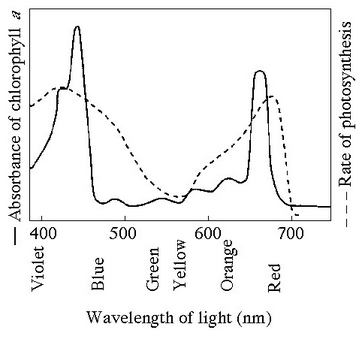
- AGreen and yellow wavelengths inhibit the absorption of red and blue wavelengths.
- BBright sunlight destroys photosynthetic pigments.
- COxygen given off during photosynthesis interferes with the absorption of light.
- DOther pigments absorb light in addition to chlorophyll a.
- EAerobic bacteria take up oxygen, which changes the measurement of the rate of photosynthesis.
186Assume a thylakoid is somehow punctured so that the interior of the thylakoid is no longer separated from the stroma. This damage will have the most direct effect on which of the following processes?
- Athe splitting of water
- Bthe absorption of light energy by chlorophyll
- C the flow of electrons from photosystem II to photosystem I
- Dthe synthesis of ATP
- Ethe reduction of NADP⁺
187In mitochondria, chemiosmosis translocates protons from the matrix into the intermembranespace, whereas in chloroplasts, chemiosmosis translocates protons from
- Athe stroma to the photosystem II.
- Bthe matrix to the stroma.
- Cthe stroma to the thylakoid space.
- Dthe intermembrane space to the matrix.
- EATP synthase toNADP+ reductase.
188In thylakoids, protons travel through ATP synthase from the stroma to the thylakoid space.Therefore the catalytic "knobs" of ATP synthase would be located
- Aon the side facing the thylakoid space
- Bon the ATP molecules themselves.
- Con the pigment molecules of PSI and PSII.
- Don the stroma side of the membrane.
- Ebuilt into the center of the thylkoid stack (granum).
189Compare the light reactions with the Calvin cycle of photosynthesis in plants.
Produces NADH:- Alight reactions alone
- B the Calvin cycle alone
- Cboth the light reactions and the Calvin cycle
- Dneither the light reactions nor the Calvin cycle
- Eoccurs in the chloroplast but is not part of photosynthesis
190Compare the light reactions with the Calvin cycle of photosynthesis in plants.
Requires glucose:- Alight reactions alone
- Bthe Calvin cycle alone
- Cboth the light reactions and the Calvin cycle
- Dneither the light reactions nor the Calvin cycle
- Eoccurs in the chloroplast but is not part of photosynthesis
191The sugar that results from three "turns" of the Calvin cycle is glyceraldehyde-3-phosphate
(G3P). Which of the following is a consequence of this?- AFormation of a moleculeof glucose would require 9 "turns."
- BG3P more readily forms sucrose and other disaccharides than it does monosaccharides.
- CSome plants would not taste sweet to us.
- DThe formation of starch in plants involves assembling many G3P molecules, with or without further rearrangements.
- EG3P is easier for a plant to store.
192If ATP used by this plant is labeled with radioactive phosphorus, which molecules will the radioactivity be measurable after one "turn" of the cycle?
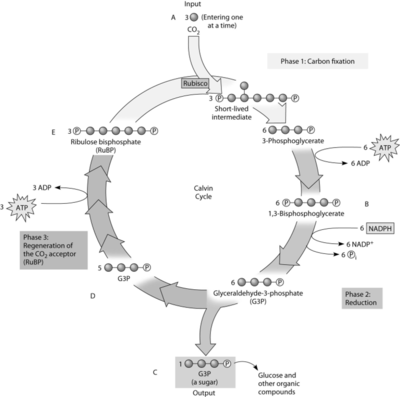
- AB only
- BB and C only
- CB, C, and D only
- DB and E only
- EB, C, D, and E
193If the carbon atom of the incoming CO₂ molecule is labeled with a radioactive isotope of carbon, which organic molecules will be radioactively labeled after one cycle?
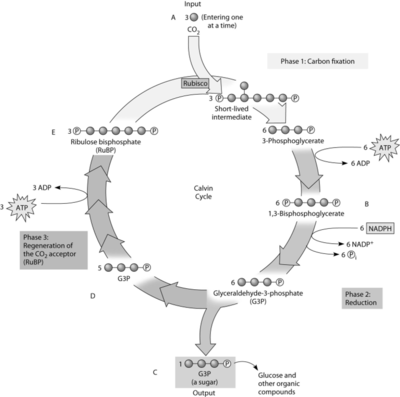
- AE only
- BB, C, D, and E
- CC, D, and E only
- DB and C only
- EB and D only
194Which molecule(s) of the Calvin cycle is (are) also found in glycolysis?
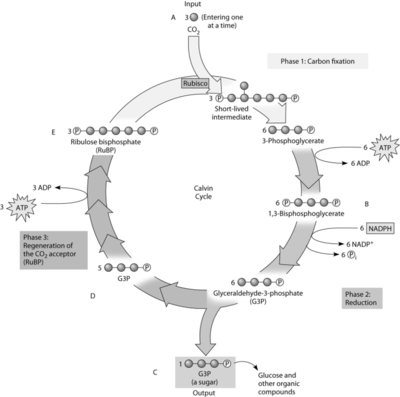
- AA only
- BC and D only
- CA, B, C, and E
- DB, C, and E
- EE only
195Evolutionary adaptations that help diverse animals directly exchange matter between cells and the environment include
- Aa gastrovascular activity, a two-layered body, and a torpedo-like body shape.
- Ban external respiratory surface, a small body size, and a two-cell-layered body.
- Ca large body volume; a long, tubular body; and a set of wings.
- Dcomplex internal structures, a small body size, and a large surface area.
- Ean unbranched internal surface, a small body size, and thick covering.
196Hibernation and estivation are both examples of
- Aacclimatization.
- Btorpor.
- Cevaporative cooling
- Dnonshivering thermogenesis.
- Eshivering thermogenesis.
197If you gently twist your earlobe, it does not remain distorted because it contains
- Acollagenous fibers.
- Belastin fibers.
- Creticular fibers.
- Dadipose tissue.
- Eloose connective tissue.
198Endothermy
- Ais a characteristic of most animals
- Binvolves the production of heat through metabolism
- Cis only seen in insects
- Dis a term equivalent to "cold-blooded"
- Eis only seen in mammals
199 The best time to measure the metabolic rate is when the animal
- Ais resting and has not eaten its first meal of the day.
- Bis resting and has just completed its first meal of the day.
- Chas recently eaten a sugar-free meal.
- Dhas not consumed any water for at least 48 hours.
- Ehas just completed 30 minutes of vigorous exercise.
Information
- Description
- Quiz on AP BIO MIDTERM REVIEW, created by rweston17 on 18/01/2015.
- Author
- rweston17
- Language
- English
- Views
- 108
- Rating
- No ratings yet Rate this quiz