
Quiz
Windows Server 2016 70-740 - Simulado V
This quiz has a time limit, so it opens in the usual player.
Questions in this quiz (50)
1Question #01
HOTSPOT -
You have two Hyper-V hosts named Server1 and Server2 that run Windows Server 2016. Server1 and Server2 connect to the same network.
Server1 and Server2 have virtual switches configured as shown in the following table.
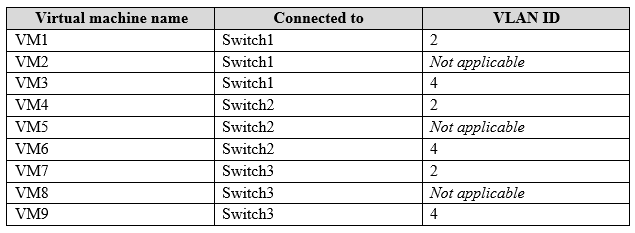
You have nine virtual machines configured as shown in the following table.
All of the virtual machines are configured to have IP addresses from the same network segment. The firewall on each of the virtual machines is configured to allow network connectivity.
To which virtual machines can you connect from VM1 and VM2? To answer, select the appropriate options in the answer area.
Hot Area:
Obs: Não marcar as imagens, só estão pra ajudar na ilustração, e na formulação da questão e da resposta.
- A
- B
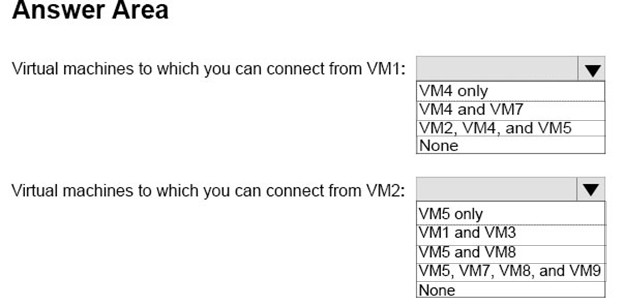
- CFrom VM1: VM4 and VM7
- DFrom VM2: VM1 and VM3
- EFrom VM1: VM2, VM4, and VM5
- FFrom VM2: VM5, VM7, VM8, and VM9
- GFrom VM1: none
- HFrom VM2: none
- IFrom VM1: only VM4
- JFrom VM2: only VM5
- A
2Question #02
Note: This question is part of a series of questions that use the same scenario. For your convenience, the scenario is repeated in each question. Each question presents a different goal and answer choices, but the text of the scenario is exactly the same in each question in this series.
A company named Contoso, Ltd. has several servers that run Windows Server 2016. Contoso has a Hyper-V environment that uses failover clustering and
Windows Server Update Services (WSUS). The environment contains several Windows containers and several virtual machines.
The WSUS deployment contains one upstream server that is located on the company's perimeter network and several downstream servers located on the internal network. A firewall separates the upstream server from the downstream servers.
You plan to deploy a human resources application to a new server named HRServer5. HRServer5 contains a FAT32-formatted data volume.
The CIO of Contoso identifies the following requirements for the company's IT department:
Deploy a failover cluster to two new virtual machines.
✑ Store all application databases by using Encrypted File System (EFS).
✑ Ensure that each Windows container has a dedicated IP address assigned by a DHCP server.
✑ Produce a report that lists the processor time used by all of the processes on a server named Server1 for five hours.
✑ Encrypt all communication between the internal network and the perimeter network, including all WSUS communications.
✑ Automatically load balance the virtual machines hosted in the Hyper-V cluster when processor utilization exceeds 70 percent.
Which networking mode should you configure for the Windows containers?- A12tunnel
- B12bridge
- Cnetwork address translation (NAT)
- Dtransparent
3Question #03
DRAG DROP -
Note: This question is part of a series of questions that use the same scenario. For your convenience, the scenario is repeated in each question. Each question presents a different goal and answer choices, but the text of the scenario is exactly the same in each question in this series.
A company named Contoso, Ltd. has several servers that run Windows Server 2016. Contoso has a Hyper-V environment that uses failover clustering and
Windows Server Update Services (WSUS). The environment contains several Windows containers and several virtual machines.
The WSUS deployment contains one upstream server that is located on the company's perimeter network and several downstream servers located on the internal network. A firewall separates the upstream server from the downstream servers.
You plan to deploy a human resources application to a new server named HRServer5. HRServer5 contains a FAT32-formatted data volume.
The CIO of Contoso identifies the following requirements for the company's IT department:
✑ Deploy a failover cluster to two new virtual machines.
✑ Store all application databases by using Encrypted File System (EFS).
✑ Ensure that each Windows container has a dedicated IP address assigned by a DHCP server.
✑ Produce a report that lists the processor time used by all of the processes on a server named Server1 for five hours.Encrypt all communication between the internal network and the perimeter network, including all WSUS communications.
✑ Automatically load balance the virtual machines hosted in the Hyper-V cluster when processor utilization exceeds 70 percent.
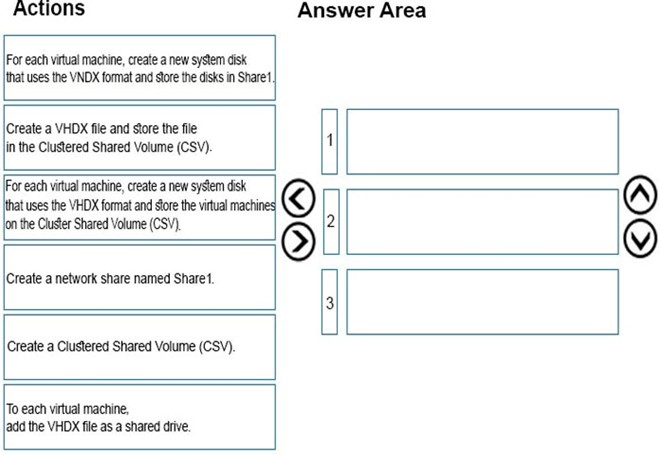
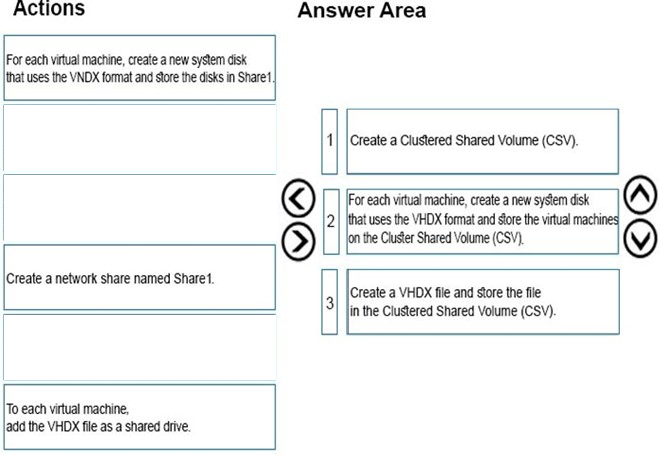
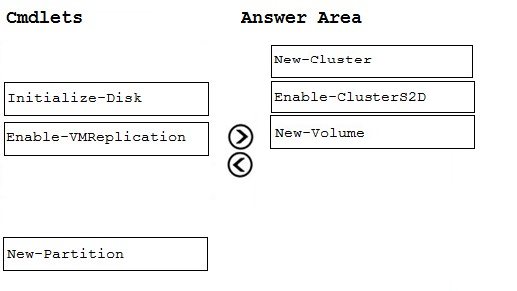
You need to configure the storage solution for the planned failover cluster.
You create two new generations 2 virtual machines on two separate Hyper-V hosts named VM11 and VM12.
Which three actions should you perform in sequence next? To answer, move the appropriate actions from the list of actions to the answer area and arrange them in the correct order.
Select and Place:- A
- B
- A
4Question #04
DRAG DROP -
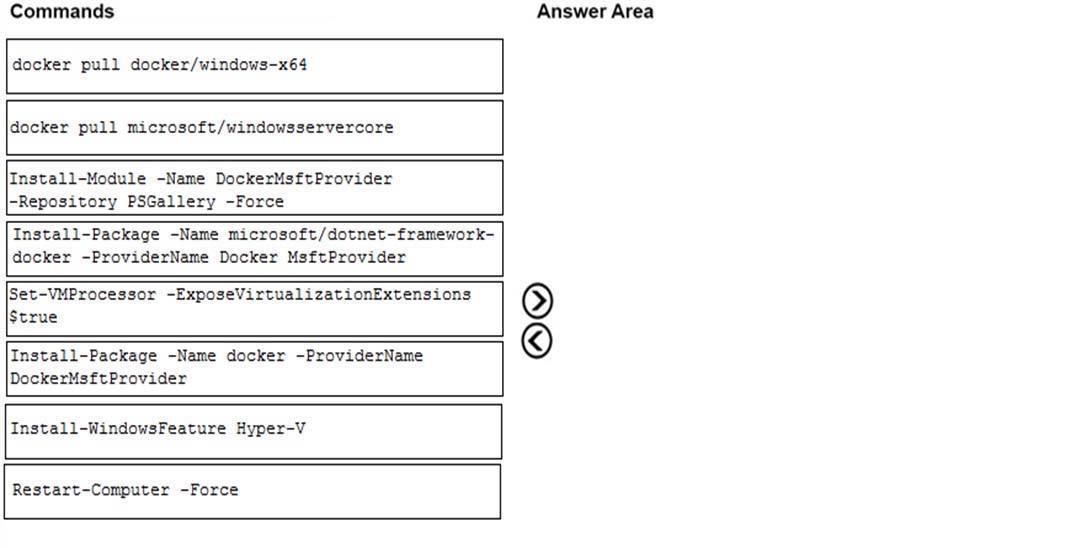
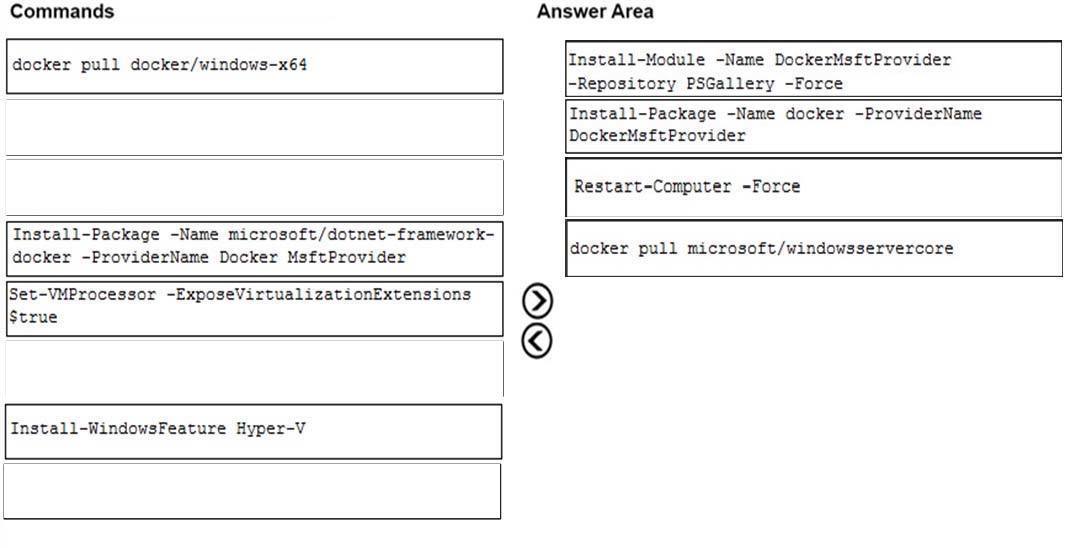
On a new server, you install Windows Server 2016, and then you install the Hyper-V server role.
You need to ensure that you can deploy Windows containers that use an image of the Server Core installation of Windows Server.
Which four commands should you use in sequence? To answer, move the appropriate commands from the list of commands to the answer area and arrange them in the correct order.
Select and Place:- A
- B
- A
5Question #05
HOTSPOT -
You have a server named Server1 that runs Windows Servers 2016. Server1 has a storage array that contains multiple storage enclosures. The storage hardware supports enclosure awareness.
You need to implement Storage Spaces on Server1. Storage Spaces must remain available if two enclosures fail. The solution must minimize the number of enclosures required and must provide the fastest possible write performance.
Which configurations should you use? To answer, select the appropriate options in the answer area.
NOTE: Each correct selection is worth one point.
Hot Area: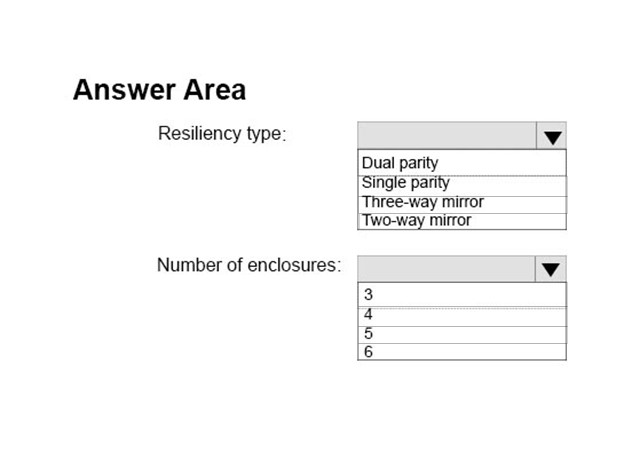
- AResiliency type: Dual parity
Number of cnclosures: 3 - BResiliency type: Single parity
Number of cnclosures: 4 - CResiliency type: Three-way mirror
Number of cnclosures: 5 - DResiliency type: two-way mirror
Number of cnclosures: 6 - EResiliency type: Three-way mirror
Number of cnclosures: 3 - FResiliency type: two-way mirror
Number of cnclosures: 4
- AResiliency type: Dual parity
6Question #06
HOTSPOT -
You have a server named Server1 that runs Windows Server 2016.
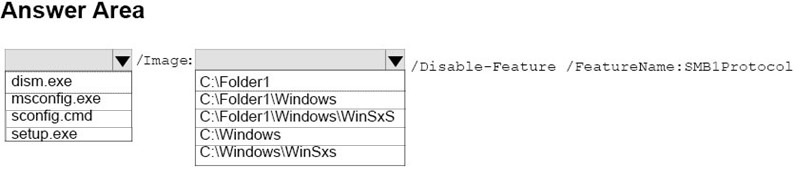
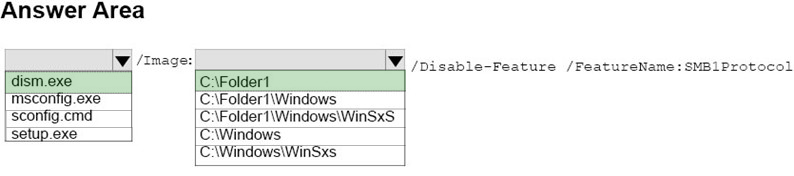
You mount an image of Windows Server 2016 to C:\Folder1\.
You need to disable support for SMB 1.0 in the image.
Which command should you run? To answer, select the appropriate options in the answer area.
NOTE: Each correct selection is worth one point.
Hot Area:- A
- B
- A
7Question #07
Your network contains an Active Directory domain named contoso.com. All server run Windows Server 2016.
As a domain administrator, you log on to a server named Server2 and open Windows PowerShell.
You need to establish an interactive PowerShell session to a server named Server1.
Which command should you run?- ANew-PSSession ""Name Server1
- BEnter-PSSession ""ComputerName Server1
- CEnable-PSRemoting Server1
- DSet-PSSession Configuration ""AccessMode Remote ""Name Server1
8Question #08
HOTSPOT -
You have a server named Server1 that runs Windows Server 2016.
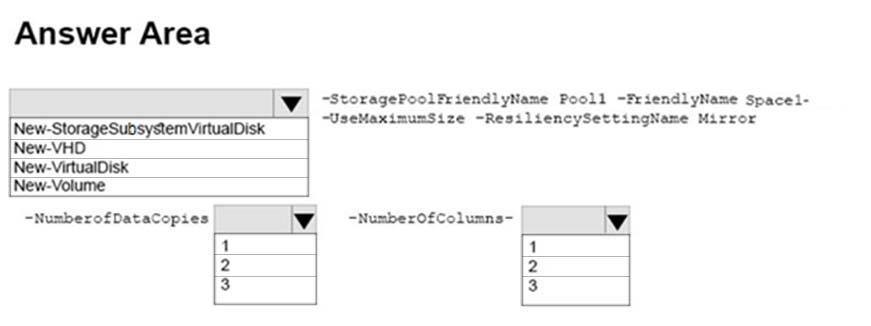
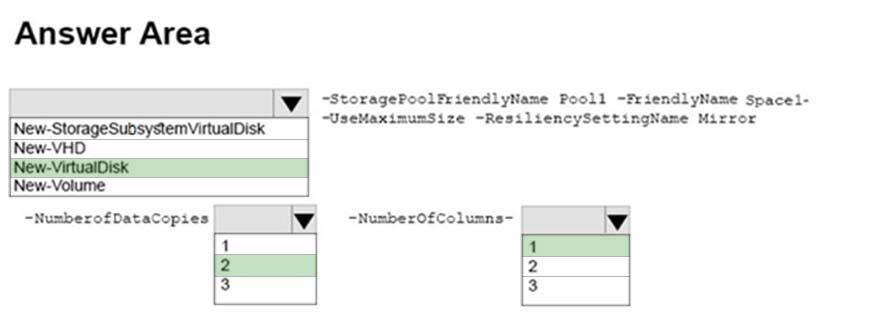
You create a storage pool named Pool1. Pool1 contains three disks.
You need to create a two-way mirror storage space from the disks in Pool1.
Which command should you run? To answer, select the appropriate options in the answer area.
NOTE: Each correct selection is worth one point.
Hot Area:- A
- B
- A
9Question #09
You have two servers named Server1 and Server2 that run Windows Server 2016.
Server1 and Server2 are nodes in a Network Load Balancing (NLB) cluster. The Web Server role is installed on each node.
Users report that when they submit web form data, sometimes the data is not stored, and they must fill in the form again.
You need to resolve the issue. The solution must ensure that connections are load balanced between Server1 and Server2.
What should you do in the NLB cluster?- AModify the existing port rules.
- BModify the Cluster operation mode.
- CAdd the Microsoft Load Balancing/Failover Provider service to all of the network adapters.
- DAdd an IP address.
10Question #10
You have a Windows Server 2106 failover cluster named Cluster1 that contains four nodes named Server1, Server2, Server3, and Server4. Cluster1 hosts 40 virtual machines that are distributed evenly across the nodes.
Server1 and Server2 are located in a data center in Madrid. Server3 and Server4 are located in a data center in Barcelona.
You need to ensure that when you pause a node, the clustered virtual machines will always attempt to move automatically to another node in the same data center before attempting to move to a node in the other data center.
Which two actions should you perform? Each correct answer presents part of the solution.- ARun the New-ClusterFaultDomain cmdlet.
- BRun the Add-ClusterGroup cmdlet.
- CConfigure a file share witness for each data center.
- DRun the Set-ClusterFaultDomain cmdlet.
- ECreate an Active Directory site for each data center.
- FChange the quorum configuration of the cluster to Node Majority.
11Question #11
You have a Hyper-V host named Server1 that runs Windows Server 2016. Server1 hosts a virtual machine named VM1. VM1 has the following settings:
✑ Nested virtualization is enabled.
✑ Dynamic Memory is disabled.
VM1 is currently running.
You need to adjust the amount of memory assigned to VM1 as quickly as possible.
What should you do first?- AChange the memory buffer setting of VM1.
- BPause VM1.
- CShut down VM1.
- DEnable Dynamic Memory for VM1.
12Question #12
Note: This question is part of a series of questions that use the same scenario. For your convenience, the scenario is repeated in each question. Each question presents a different goal and answer choices, but the text of the scenario is exactly the same in each question in this series.
A company named Contoso, Ltd. has several servers that run Windows Server 2016. Contoso has a Hyper-V environment that uses failover clustering and
Windows Server Update Services (WSUS). The environment contains several Windows containers and several virtual machines.
The WSUS deployment contains one upstream server that is located on the company's perimeter network and several downstream servers located on the internal network. A firewall separates the upstream server from the downstream servers.
You plan to deploy a human resources application to a new server named HRServer5. HRServer5 contains a FAT32-formatted data volume.
The CIO of Contoso identifies the following requirements for the company's IT department:
✑ Deploy a failover cluster to two new virtual machines.
✑ Store all application databases by using Encrypted File System (EFS).
✑ Ensure that each Windows container has a dedicated IP address assigned by a DHCP server.
✑ Produce a report that lists the processor time used by all of the processes on a server named Server1 for five hours.
✑ Encrypt all communication between the internal network and the perimeter network, including all WSUS communications.
✑ Automatically load balance the virtual machines hosted in the Hyper-V cluster when processor utilization exceeds 70 percent.
Which two actions should you perform to meet the encryption requirement for WSUS? Each correct answer presents part of the solution.- ARequire SSL on the Inventory virtual directory.
- BRequire SSL on the ClientWebService virtual directory.
- CCreate a firewall rule to allow TCP port 443.
- DCreate a firewall rule to allow TCP port 8531.
13Question #13
Note: This question is part of a series of questions that present the same scenario. Each question in the series contains a unique solution that might meet the stated goals. Some question sets might have more than one correct solution, while others might not have a correct solution.
After you answer a question in this section, you will NOT be able to return to it. As a result, these questions will not appear in the review screen.
You have two servers that run Windows Server 2016.
You plan to create a Network Load Balancing (NLB) cluster that will contain both servers.
You need to configure the network cards on the servers for the planned NLB configuration.
Solution: You configure the network cards to be on a separate subnet and to have static IP addresses. You configure the cluster to use unicast.
Does this meet the goal?- ATrue
- BFalse
14Question #14
Note: This question is part of a series of questions that present the same scenario. Each question in the series contains a unique solution that might meet the stated goals. Some question sets might have more than one correct solution, while others might not have a correct solution.
After you answer a question in this section, you will NOT be able to return to it. As a result, these questions will not appear in the review screen.
You have a server named Server1 that runs Windows Server 2016. Server1 has the Hyper-V server role and Docker installed.
You pull the Microsoft/iis Docker image to Server1.
You need to view the available space in the Microsoft/iis Docker image.
Solution: You run the command docker run ""d Microsoft/iis.
You open Disk Management on Server1.
Does this meet the goal?- ATrue
- BFalse
15Question #15
Note: This question is part of a series of questions that present the same scenario. Each question in the series contains a unique solution that might meet the stated goals. Some question sets might have more than one correct solution, while others might not have a correct solution.
After you answer a question in this section, you will NOT be able to return to it. As a result, these questions will not appear in the review screen.
You have two servers that run Windows Server 2016.
You have a server named Server1 that runs Windows Server 2016. Server1 has the Hyper-V server role and Docker installed.
You pull the Microsoft/iis Docker image to Server1.
You need to view the available space in the Microsoft/iis Docker image.
Solution: You run the following commands.
docker run ""name container1 ""isolation hyperv ""d Microsoft/iis docker exec ""i container1 cmd.exe dir
Does this meet the goal?- ATrue
- BFalse
16Question #16
Note: This question is part of a series of questions that present the same scenario. Each question in the series contains a unique solution that might meet the stated goals. Some question sets might have more than one correct solution, while others might not have a correct solution.
After you answer a question in this section, you will NOT be able to return to it. As a result, these questions will not appear in the review screen.
You have two servers that run Windows Server 2016.
You have a server named Server1 that runs Windows Server 2016. Server1 has the Hyper-V server role and Docker installed.
You pull the Microsoft/iis Docker image to Server1.
You need to view the available space in the Microsoft/iis Docker image.
Solution: You run the following commands.
docker run ""name container1 ""d Microsoft/iis
docker exec ""i container1 cmd.exe
dir
Does this meet the goal?- ATrue
- BFalse
17Question #17
DRAG DROP -
You have a server named Server1 that runs Windows Server 2016.
You open a command prompt on Server1 and run the following commands.
You back up the data on Disk 1.
You plan to convert Disk 1 to a GPT disk, and then to restore the data to Disk 1.
Which four DiskPart commands should you run in sequence before you restore the data? To answer, move the appropriate commands from the list of commands to the answer area and arrange them in the correct order.
Select and Place:- Aselect disk 1
Clean
Convert GPT
Create partition primary - Bselect disk 1
Convert GPT
Create partition primary
Format fs=ntfs - CClean
Convert Dynamic
Create partition primary
Format fs=ntfs - DClean
Convert GPT
Create partition primary
Format fs=ntfs
- Aselect disk 1
18Question #18
You have four servers named Server1, Server2, Server3, and Server4 that run Windows Server 2016. Server1 and Server2 have the Hyper-V server role installed.
Server1 hosts a virtual machine named VM1. Server2 hosts a virtual machine named VM2. Server3 hosts the disks and the configurations of both virtual machines on an SMB share named VMShare. All servers are joined to an Active Directory domain.
You use Server4 to manage Hyper-V operations on Server1 and Server2.
From Server4, you attempt to perform a live migration of VM1 and VM2, but you receive the following error message: "No credentials are available in the security package".
You need to ensure that you can perform the live migration of VM1 and VM2 between Server1 and Server2 while signed in to Server4.
What should you do?- AFrom Active Directory Users and Computers, modify the properties of Server4. Configure the delegation settings to trust the computer for delegation of cifs.
- BFrom Windows PowerShell on Server3, run the remove-SMBMultiChannelConstraint cmdlet, and then assign Server4 Full Control permissions to VMShare.
- CFrom Active Directory Users and Computers, modify the properties of Server1 and Server2. Configure the Delegation settings to trust the computers for delegation of the Microsoft Virtual System Migration Service.
- DFrom Active Directory Users and Computers, modify the properties of your user account. Modify the Account is sensitive and cannot be delegated setting.
19Question #19
You have a server that runs Windows Server 2016 Standard.
You create a new three-way mirror storage space. You format the storage space by using ReFS.
Which two features can you use on the new storage space? Each correct answer presents a complete solution.- Afile and folder permissions
- Bdisk quotas
- CEncrypting File System (EFS)
- Dlong file names
- EData Deduplication
- FShrink volume
20Question #20
HOTSPOT -
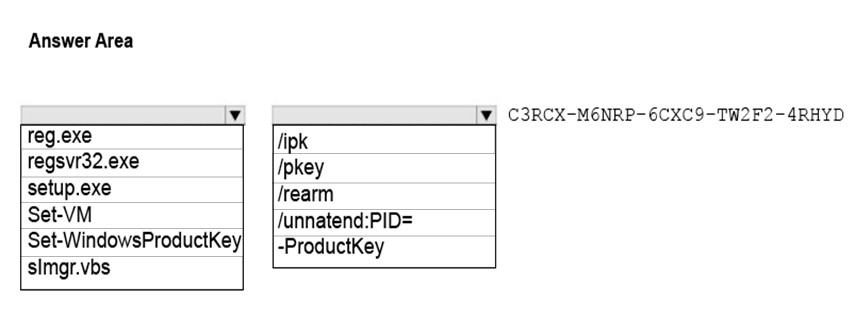
You have a Hyper-V host named Server1 that runs Windows Server 2016 datacenter. Server1 is activated.
On Server1, you deploy a virtual machine named VM1 that has a Server Core installation of Windows Server 2016 Standard.
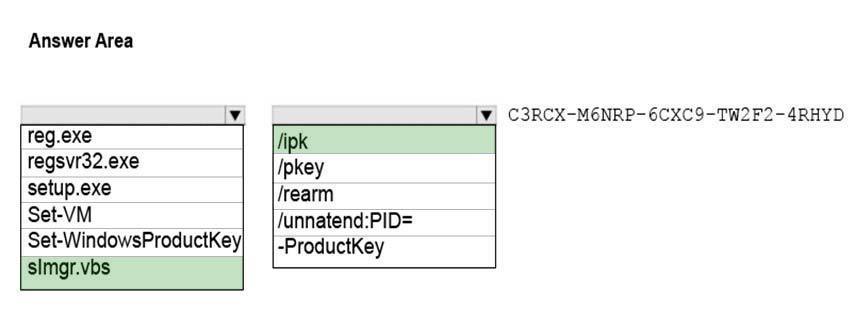
You need to activate VM1 by using Automatic Virtual Machine Activation (AVMA).
Which command should you run? To answer, select the appropriate options in the answer area.
NOTE: Each correct selection is worth one point.
Hot Area:- A
- B
- A
21Question #21
Note: This question is part of a series of questions that present the same scenario. Each question in the series contains a unique solution that might meet the stated goals. Some question sets might have more than one correct solution, while others might not have a correct solution.
After you answer a question in this section, you will NOT be able to return to it. As a result, these questions will not appear in the review screen.
You network contains an Active Directory forest named contoso.com. The forest contains a child domain named eu.contoso.com.
You plan to implement live migration between two Hyper-V hosts that run Windows Server 2016. The hosts are configured as shown in the following table.
You need to ensure that you can perform a live migration of VM1 from Host1 to Host2.
Solution: You replace the processor in Host1 with a processor that is identical to the processor in Host2.
Does meet the goal?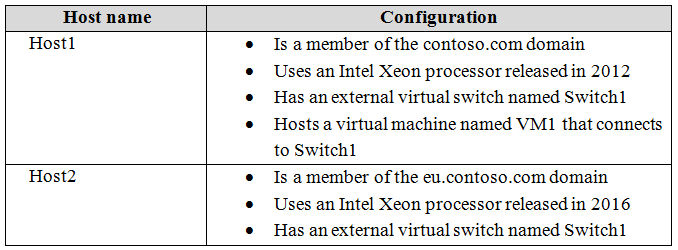
- ATrue
- BFalse
22Question #22
Note: This question is part of a series of questions that present the same scenario. Each question in the series contains a unique solution that might meet the stated goals. Some question sets might have more than one correct solution, while others might not have a correct solution.
After you answer a question in this section, you will NOT be able to return to it. As a result, these questions will not appear in the review screen.
You have a server named Server1 that runs Windows Server 2016. Server1 has the Hyper-V server role and Docker installed.
You pull the Microsoft/iis Docker image to Server1.
You need to view the available space in the Microsoft/iis Docker image.
Solution: You run the command docker run ""isolation hyperv -d microsoft/iis.
You open Disk Management on Server1.
Does this meet the goal?- ATrue
- BFalse
23Question #23
You have a Hyper-V host named Server1 that runs Windows Server 2016. Server1 hosts a virtual machine named VM1 that runs Windows Server 2016.
On VM1, Dynamic Memory is disabled, MAC spoofing is enabled for the virtual network adapter, and checkpoints are disabled.
You need to ensure that you can install the Hyper-V server role on VM1.
What should you do?- AShut down VM1, enable Dynamic Memory on VM1, and then start VM1.
- BShut down VM1, run the Set-VMProcessor cmdlet, and then start VM1.
- CDisable Hyper-V integration services for VM1, and then restart VM1.
- DConfigure VM1 to use standard checkpoints.
24Question #24
You have a Nano Server named Nano1.
Nano1 is configured to perform real-time protection scans by using Windows Defender.
You need to ensure that all of the files located in D:\App1\Data are excluded from the real-time protection scans.
What should you do?- ARun the Add-MpPreference cmdlet and specify the –ExclusionPath
- BRun the Import-ShieldingDataFile cmdlet and specify the –ShieldingDataFilePath
- CRun the Protect-ShieldingDataFile cmdlet and specify the –ShieldingDataFilePath
- DRun the Get-ChildItem cmdlet and specify the –Exclude
- EFrom the properties of the D:\App1\Data folder, enable the Hidden attribute.
- FFrom the properties of the D:\App1\Data folder, modify the permissions.
- GFrom a command prompt, run the attrib command and specify the –s
25Question #25
You have a server named Server1 that runs Windows Server 2016 and has the File and Storage Services server role installed.
Server1 has an ReFS-formatted volume named Volume1 that is 512 GB. Volume1 is mounted as C:\App1\temp.
You need to ensure that you can enable deduplication of Volume1.
What should you do?- AFormat Volume1
- BUnmount Volume1.
- CInstall a Windows feature.
- DInitialize the physical disk that contains Volume1.
26Question #26
You plan to deploy three servers that will run Windows Server 2016. The servers will be configured as shown in the following table.
You need to ensure that you can use all of the available space on each disk.
What is one of the disks that you must initialize as a GPT disk?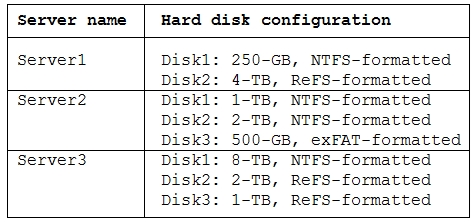
- ADisk3 on Server3
- BDisk1 on Server2
- CDisk2 on Server2
- DDisk1 on Server3
- EDisk2 on Server3
- FDisk1 on Server1
- GDisk3 on Server2
27Question #27
You have two Hyper-V hosts named Server1 and Server2 that run Windows Server 2012 R2. The servers are nodes in a failover cluster named Cluster1.
You perform a rolling upgrade of the cluster nodes to Windows Server 2016.
You need to ensure that you can implement the Virtual Machine Load Balancing feature.
Which cmdlet should you use?- AUpdate-ClusterNetWorkNameResource
- BSet-ClusterGroupSet
- CSet-CauClusterRole
- DUpdate-ClusterFunctionalLevel
28Question #28
You have a Windows Server 2016 failover cluster named Cluster1 that contains four nodes named Server1, Server2, Server3, and Server4.
You need to configure Cluster 1 to use directly attached storage to store several virtual machines.
You run the Enable-ClusterStorageSpacesDirect cmdlet on Server1.
What should you do next?- ARun the Enable-ClusterStorageSpacesDirect cmdlet on the other three nodes.
- BCreate volumes.
- CCreate a storage pool.
- DRun the Add-ClusterResource cmdlet on all of the nodes.
29Question #29
You have a Hyper-V server named Server1 that runs Windows Server 2012 R2.
Server1 hosts a virtual machine named VM1 that runs Windows Server 2016. VM1 connects to an external virtual switch named Switch1.
You can ping VM1 from Server1.
You upgrade Server1 to Windows Server 2016.
You need to ensure that you can connect to VM1 by using PowerShell Direct.
What should you do?- AConfigure the firewall rules on Server1.
- BEnable the Hyper-V extensible switch extensions on Server1.
- CUpgrade the configuration version of VM1.
- DConfigure the firewall rules on VM1.
30Question #30
DRAG DROP -
Your network contains an Active Directory domain named adatum.com. The domain contains four member servers that run Windows Server 2016.
On each server, you locally attach three disks and install the Failover Clustering feature.
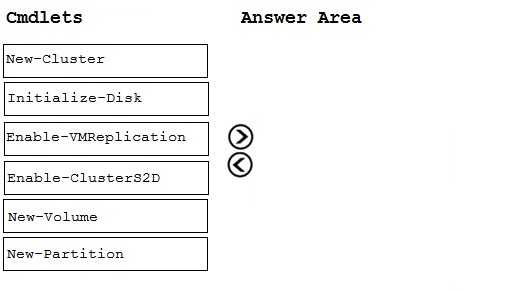
You need to create a volume that uses all the disks. The volume must be highly available.
Which three cmdlets should you run in sequence? To answer, move the appropriate cmdlets from the list of cmdlets to the answer area and arrange them in the correct order.
Select and Place:- A
- B
- A
31Question #31
You have a server named Server1 that runs Windows Server 2016. Windows Defender is enabled on Server1.
Server1 runs an application named App1 that stores various types of files in Microsoft OneDrive for Business, MicrosoftOneDrive, and Microsoft SharePoint
Online. App1 also interacts with several local services.
You need to prevent Windows Defender from scanning any files opened by App1.
What should you do on Server1?- AFrom the Windows Defender settings, configure a file exclusion.
- BRun the New-CiPolicy cmdlet.
- CModify the real-time protection settings in Windows Defender.
- DFrom the Windows Defender settings, configure a process exclusion.
- ERun the Set-ExecutionPolicy cmdlet.
- FRun the New-AppLockerPolicy cmdlet.
32Question #32
You have a server named Server1 that runs Windows Server 2016. Server1 has two network adapters that support single root I/O virtualization (SR-IOV). The network adapters are from two different vendors.
You plan to install the Hyper-V server role on Server1, and then to create a virtual machine named VM1 that runs Windows Server 2016. VM1 will use SR-IOV.
You need to ensure that VM1 can use both network adapters for load balancing and failover.
What should you do?- AOn Server1, create two virtual switches without embedded teaming. On VM1, create one NIC team.
- BOn Server1, create one virtual switch without embedded teaming. On VM1, create one NIC team.
- COn Server1, create one NIC team. On VM1, create one NIC team.
- DOn Server1, create one virtual switch that has embedded teaming. On VM1, create two NIC teams.
33Question #33
You have a server named Server1 that runs Windows Server 2016.
Server1 is a Docker host.
You are creating a Dockerfile to build a Docker image.
You need to add a file named File1.txt from Server1 to C:\Folder1\ in the Docker image.
What are two possible commands that you can use to achieve the goal? Each correct answer presents a complete solution.
NOTE: Each correct selection is worth one point.- ACOPY file1.txt c:/folder1/
- Bcopy-item file1.txt folder1\file1.txt
- CROBOCOPY file.txt \folder1\
- DXCOPY file1.txt c:\folder1\
- EADD file1.txt /folder1/
34Question #34
Note: This question is part of a series of questions that present the same scenario. Each question in the series contains a unique solution that might meet the stated goals. Some question sets might have more than one correct solution, while others might not have a correct solution.
After you answer a question in this section, you will NOT be able to return to it. As a result, these questions will not appear in the review screen.
You are a server administrator at a company named Contoso, Ltd.
Contoso has a Windows Server 2016 Hyper-V environment configured as shown in the following table.
All of the virtual switches are of the external type.
You need to ensure that you can move virtual machines between the hosts without causing the virtual machines to disconnect from the network.
Solution: You implement live migration by using Host1 and Host3.
Does this meet the goal?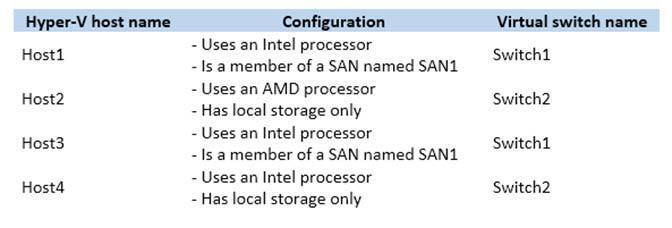
- ATrue
- BFalse
35Question #35
HOTSPOT -
You have a server named VM1. VM1 is a virtual machine on a Hyper-V host that runs Windows Server 2016.
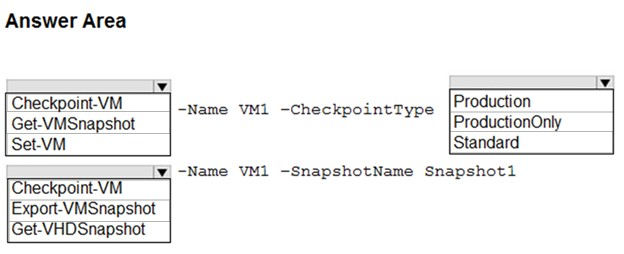
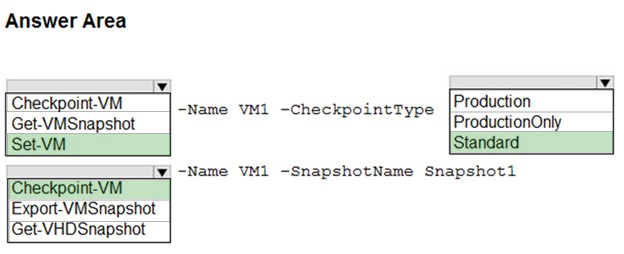
You need to create a checkpoint that includes the virtual machine memory state of VM1.
What command should you run? To answer, select the appropriate options in the answer area.
Hot Area:- A
- B
- A
36Question #36
You plan to deploy three servers that will run Windows Server 2016. The servers will be configured as shown in the following table.
You need to ensure that you can use all of the available space on each disk.
What is one of the disks that you must initialize as a GPT disk?- ADisk2 on Server1
- BDisk1 on Server2
- CDisk1 on Server1
- DDisk3 on Server3
- EDisk2 on Server2
- FDisk2 on Server3
37Question #37
You have a server named Server1 that runs Windows Server 2016.
You need to install the DNS Server role on Server1.
What should you run?- Athe dnscmd.exe command
- Bthe Enable-WindowsOptionalFeature cmdlet
- Cthe dns.exe command
- Dthe setup.exe command
- Ethe Install-Package cmdlet
- Fthe optionalfeatures.exe command
38Question #38
Your network contains an Active Directory domain named adatum.com. The domain contains a Network Load Balancing (NLB) cluster as shown in the exhibit.
(Click the Exhibit button.)
Which hosts will respond to requests sent to nlb.adatum.com?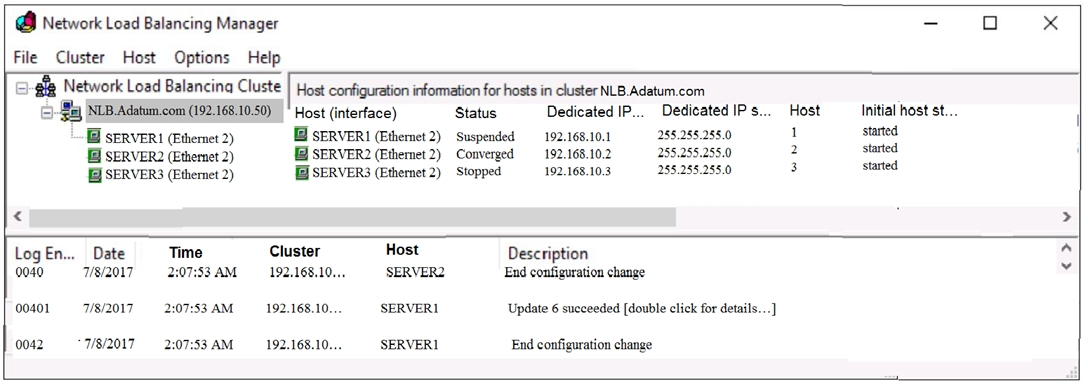
- AServer1 only
- BServer2 only
- CServer1 and Server2 only
- DServer1, Server2, and Server3
39Question #39
You have a server named Server1 that runs Windows Server 2016.
The server has an application named App1. App1 writes entries to the Application event log when errors are encountered. The events have IDs of either 111 or
112.
You need to restart the service whenever either of these events is logged.
What should you do?- AFrom Windows PowerShell, run the Get-SMServerEvent cmdlet and pipe the output to the Start-NetEventSession cmdlet.
- BFrom Event Viewer, create a subscription that has a filter for the event IDs.
- CFrom Event Viewer, use the Create Basic Task Wizard for each event ID.
- DFrom Windows PowerShell, run the Get-Event cmdlet and pipe the output to the cmdlet. Start-NetEventSession parameter.
- EFrom Event Viewer, create a custom view that has a filter for the event IDs.
- FFrom Performance Monitor, add an Event Trace Session data collector that uses the Microsoft-Windows-Eventlog provider.
40Question #40
You have a Network Load Balancing (NLB) cluster that contains two nodes named Server1 and Server2. The nodes run Windows Server 2016.
The NLB cluster has the following configuration.
You deploy the Web Server (IIS) server role identically to both servers.
You need to configure NLB to load balance requests between the web servers. HTTP requests must be stateless. HTTPS requests must be stateful.
What should you do? Each correct answer presents part of the solution- AModify the Cluster operation mode.
- BSuspend the cluster.
- CDrainstop the cluster.
- DAdd a new port rule.
- EEdit the existing port rule.
41Question #41
DRAG DROP -
Your network contains an Active Directory domain named contoso.com. The domain contains two servers named Server1 and Server2 that run Windows Server
2016. Server1 and Server2 have multiple local disks attached.
You need to create a storage pool by using Storage Spaces Direct.
Which three actions should you perform in sequence? To answer, move the appropriate actions from the list of actions to the answer area and arrange them in the correct order.
Select and Place:- A
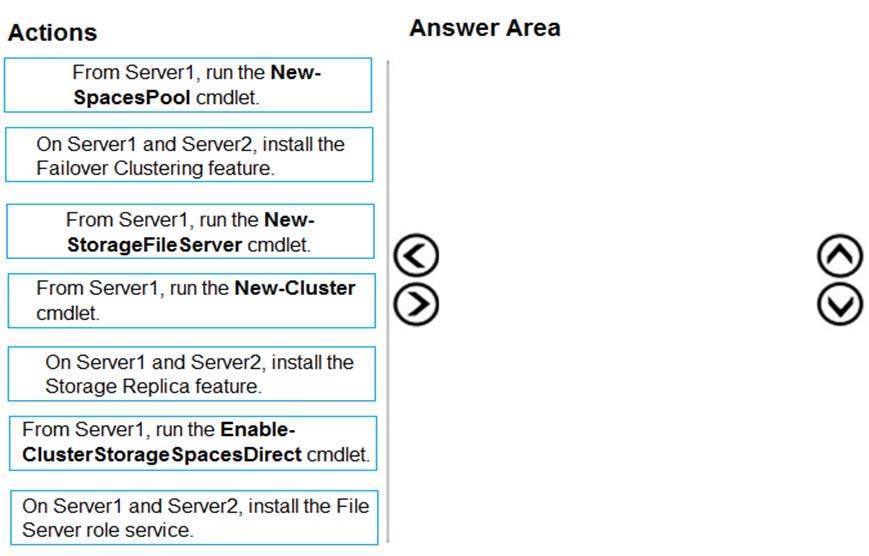
- B
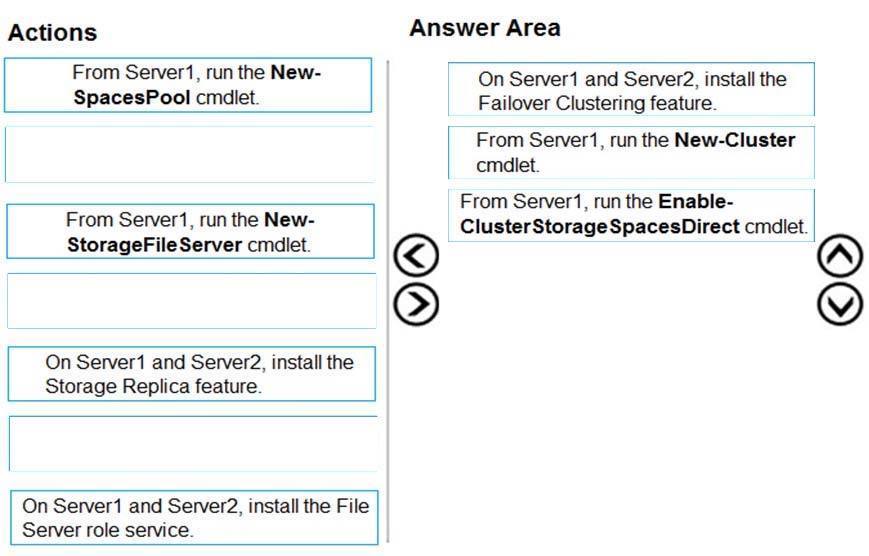
- A
42Question #42
You have a server named Server1 that runs Windows Server 2016. Windows Defender is enabled on Server1.
Server1 runs an application named App1 that stores various types of files in Microsoft OneDrive for Business, MicrosoftOneDrive, and Microsoft SharePoint
Online. App1 also interacts with several local services.
You need to prevent Windows Defender from scanning any files opened by App1.
What should you do on Server1?- ARun the Set-ExecutionPolicy cmdlet.
- BRun the New-AppLockerPolicy cmdlet.
- CModify the real-time protection settings in Windows Defender.
- DRun the Add-MpPreference cmdlet.
- EModify the cloud-based protection settings in Windows Defender.
- FRun the New-CiPolicy cmdlet.
43Question #43
You have a server named Server1. Server1 contains a drive named D hat has Data Deduplication enabled.
You delete 1 TB of files from drive D.
You need to ensure that you can use all the disk space that was used by the deleted files as soon as possible.
What should you run?- Athe Update-DedupStatus cmdlet
- Bthe ThroughputOptimization task from the Task Scheduler
- Cthe WeeklyGarbageCollection task from the Task Scheduler
- Dthe Set-DedupVolume cmdlet
44Question #44
You have a server named Server1 that runs Windows Server 2016.
You need to install the DNS Server role on Server1.
What should you run?- Athe Add-WindowsPackage cmdlet
- Bthe dnscmd.exe command
- Cthe optionalfeatures.exe command
- Dthe Add-WindowsFeature cmdlet
- Ethe dnscmd command
- Fthe dns.exe command
45Question #45
You have a Windows Server 2016 Server Core named Server1.
Server1 is configured to perform real-time protection scans by using Windows Defender.
You need to ensure that all of the files located in D:\App1\Data are excluded from the real-time protection scans.
What should you do?- ARun the Set-MpPreference cmdlet and specify the –ExclusionPath
- BRun the Get-ChildItem cmdlet and specify the –Exclude
- CFrom the properties of the D:\App1\Data folder, modify the permissions
- DFrom a command prompt, run the attrib command and specify the –s
- EFrom the properties D:\App1\Data folder, enable the Hidden attribute.
- FRun the Import-ShieldingDataFile cmdlet and specify the parameter
- GRun the Protect-ShieldingDataFile cmdlet and specify the parameter.
46Question #46
You have a Hyper-V host named Server1 that runs Windows Server 2016. Server1 hosts a virtual machine named VM1 that runs Windows Server 2012. VM1 has the following configuration.
You discover that when you back up Server1, VM1 temporarily pauses.
You need to ensure that you can back up Server1 without causing downtime on VM1.
What should you do?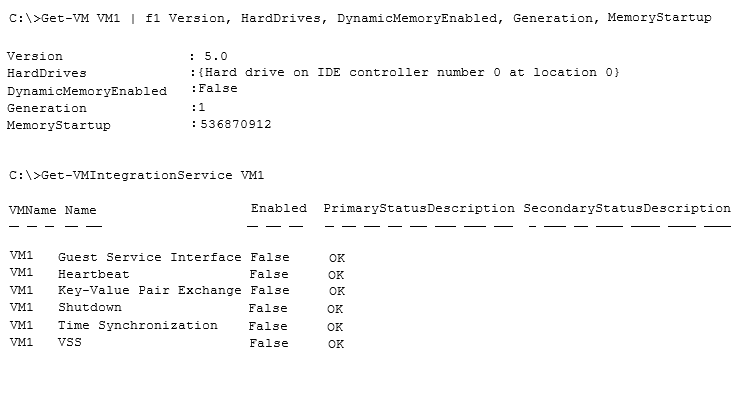
- AIncrease the memory on VM1
- BConnect the hard disk drive of VM1 to an SCSI controller
- CUpdate the virtual machine version of VM1
- DUpgrade VM1 to Windows Server 2016
- EEnable the VSS integration service on VM1
47Question #47
You have a server named Server1 that runs Windows Server 2016. The Docker daemon runs on Server1. You need to configure the Docker daemon to accept connections only on TCP port 64500.
What should you do?- AModify the routing table on Server1
- BRun the Set-Service Windows PowerShell cmdlet
- CEdit the configuration.json file
- DRun the sc config command
- ERun the Set-NetFirewallPortFilter cmdlet
- FRun the New-NetFirewallRule cmdlet
- GRun the sc control command
48Question #48
You have two servers named Server1 and Server2 that run Windows Server 2016.
You plan to implement Storage Replica to replicate the contents of volumes on Server1 to Server2.
You need to ensure that the replication traffic between the servers is limited to a maximum of 100 Mbps.
Which cmdlet should you run?- ANew-NetQosPolicy
- BSet-StorageQosPolicy
- CSet-NetTCPSetting
- DSet-NetUDPSetting
49Question #49
You have a server named Server1. Server1 contains a drive named D hat has Data Deduplication enabled.
You delete 1 TB of files from drive D.
You need to ensure that you can use all the disk space that was used by the deleted files as soon as possible.
What should you run?- Athe BackgroundOptimization task from the Task Scheduler
- Bthe WeeklyScrubbing task from the Task Scheduler parameter
- Cthe Start-DedupJob cmdlet and the –Type GarbageCollection
- Dthe Set-DedupVolume cmdlet parameter
- Ethe Start-DedupJob cmdlet and the –Type Optimization
50Question #50
Your network contains an on-premises Active Directory domain. The domain contains 25 servers that run Windows Server 2016.
You have a hybrid deployment of Microsoft Azure Active Directory (Azure AD).
You plan to manage the servers by using Windows Admin Center.
You install Windows Admin Center on one of the servers.
You need to ensure that connections to Windows Admin Center are authenticated by using multi-factor authentication (MFA).
What should you do first?- AInstall an extension to Windows Admin Center
- BConfigure Allowed groups
- CRegister the gateway to Azure AD
- DImport a certificate by using Windows Admin Cent
Information
- Description
- Simulado do exame em ingles para realização da certificação do windows server 2016 MCSA e MCSE.
- Author
- gabriel ribeiro
- Language
- Português
- Views
- 75
- History
- Created on 13 Apr 2020 · updated on 3 May 2020
- Tags
- Rating
- No ratings yet Rate this quiz