
Quiz
Somatic Symptom Disorders
Create a free account to finish this quiz
Save your progress and see your final score.
Already have an account? Sign in
Questions in this quiz (26)
1Test 1 Question 11. You are talking to one of your colleagues from surgery. He tells you about a postoperative patient that he is covering who keeps complaining of pain. He tells you that the patient was originally on intramuscular meperidine and was switched to the same dose of oral meperidine just yesterday. The patient has been complaining constantly and is getting the nursing staff upset. What do you think is responsible for this situation?
- AThe patient has low pain tolerance
- BThe patient has borderline personality disorder and is splitting the staff
- CThe patient has an intractable pain disorder
- DThe analgesic potency of oral meperidine is less than that of intramuscular meperidine
- EThe patient has a conversion disorder (functional neurological symptom disorder)
2Test 1 Question 56. A patient comes into your practice after referral from his primary care physician. He is convinced that he has cancer. He thinks that it hasn’t been found yet, but is convinced that it is there. He remains convinced despite a full workup with negative results. Despite further reassurance by his doctors, he remains convinced that he has cancer. Which is the most appropriate diagnosis?
- AConversion disorder (functional neurological symptom disorder
- BIllness anxiety disorder
- CBody dysmorphic disorder
- DSomatic symptom disorder
- EBriquet’s syndrome
3Test 1 Question 81. Which one of the following is true regarding conversion disorder (functional neurological symptom disorder)?
- AIt is intentionally produced
- BIt consists of complaints in multiple organ systems
- CIt involves neurologic symptoms
- DIt can be limited to pain
- EIt can be limited to sexual dysfunction
4Test 1 Question 122. Which one of the following disorders presents with the patient being preoccupied with having a given illness based on misinterpretation of bodily sensations?
- APseudocyesis
- BFactitious disorder
- CConversion disorder (functional neurological symptom disorder)
- DSomatic symptom disorder with predominant pain
- EIllness anxiety disorder
5Test 1 Question 145. A 75-year-old woman is referred to your practice by an internist for depression. On initial examination you discover that the patient has recently recovered from a heart attack. Which one of the following medications would be the best choice for this patient?
- AAmitriptyline
- BDoxepin
- CBupropion
- DMethylphenidate
- ECitalopram
6Test 2 Question 19. Which of the following would fall under the heading of Other Specified Somatic Symptom and Related Disorders?
- AA patient with pain in one or more areas that is thought to be significantly mediated by psychological factors
- BA patient with a persistent belief that he or she has cancer despite reassurance by his or her physician that nothing is wrong
- CA patient who develops a motor deficit following significant psychological stressors
- DA patient who feels that she is pregnant and presents with amenorrhea, enlarged abdomen, and breast engorgement, but a negative pregnancy test
- EA patient with medical complaints involving pain, gastrointestinal complaints, neurological complaints, and sexual complaints, but no medical explanation can be found for these symptoms
7Test 2 Question 134. Which one of the following is not an example of secondary gain?
- AGetting money
- BGetting medical help
- CGetting out of having to work
- DGetting out of family responsibilities
- EGetting drugs of abuse
8Test 3 Question 82. A patient who is not malingering, but is believed to be producing the symptoms and signs of confusion or dementia involuntarily or unconsciously and believes that the symptoms are real, is thought to have which one of the following conditions?
- AConversion disorder (functional neurological symptom disorder
- BGanser’s syndrome
- CCapgras syndrome
- DIllness anxiety disorder
- EFolie-à-deux
9Test 3 Question 109. A psychiatrist is consulted on a medical unit because there is a patient with a substance abuse history who is in need of pain control. Which one of the following answer choices would be the best way to treat this patient’s pain?
- ALarge doses of opiates
- BA mixture of opiates and benzodiazepines
- CPatient-controlled analgesia
- DNo opiates of any kind
- EPRN (as needed) buprenorphine
10Test 3 Question 120. Which one of the following is not a feature of malingering?
- AFindings are compatible with self-inflicted injuries
- BMedical records may have been tampered with or altered
- CFamily members are able to verify the consistency of symptoms
- DSymptoms are vague or ill defined
- EHistory and examination do not yield complaints or problems
11Test 4 Question 23. A 29-year-old patient is admitted to the neurology unit for evaluation of seizures. Workup is negative and there has not been any seizure activity captured on electroencephalogram during his seizure episodes. Neurological examination is negative. The patient is noted to be very sad, and a psychiatric consult is called. Nurses have noted conflict between the patient and his wife during her visits. As the consultant, which one of the following would be the highest on your list of differential diagnoses?
- AObsessive–compulsive disorder
- BConversion disorder (functional neurological symptom disorder)
- CSomatic symptom disorder
- DSocial phobia
- EPanic disorder
12Test 4 Question 73. Of the following disorders, which one has the best prognosis?
- ASomatic symptom disorder
- BBody dysmorphic disorder
- CSomatic symptom disorder with predominant pain
- DIllness anxiety disorder
- EConversion disorder (functional neurological symptom disorder)
13Test 5 Question 5. Which of the following must be present to meet Diagnostic and Statistical Manual of Mental Disorders, fifth edition (DSM 5), criteria for somatic symptom disorder?
- APreoccupation with acquiring a serious illness
- BTwo sexual symptoms
- CThree pseudoneurological symptoms
- DMaladaptive thoughts, feelings, or behaviors in response to the symptoms
- EThe illness must begin after age 30
14Test 5 Question 49. A depressed patient comes to you with brittle hair, weight gain, muscle weakness, dry skin, constipation, and cold intolerance. Which is the most appropriate next step in management?
- AStart sertraline
- BRefer the patient for a head CT
- CCheck thyroid-stimulating hormone (TSH) level
- DCheck serum glucose
- EPrescribe sertraline plus Colace
15Test 5 Question 97. Which of the following choices is a risk factor for developing conversion disorder (functional neurological symptom disorder)?
- AHigh socioeconomic status
- BLittle education
- CHigh intelligence
- DUrban setting
- ELack of military service
16Test 5 Question 104. Which of the following is not one of the psychiatric symptoms that can result from adrenal insufficiency?
- ADelirium
- BPsychosis
- CMania
- DDepression
- EIrritability
17Test 5 Question 139. A new patient comes to you asking for help with depression. She states that she has had a very low mood recently and has been feeling overwhelmed. She has a 2-month-old daughter at home and keeping up with a new baby has been hard for her. She reports constant fatigue, listlessness, and weight loss. She states that her libido is down and she is very upset because she could not breastfeed her baby owing to lack of milk production. Her concentration is normal. She bursts into tears and states that she doesn’t think she can be a good mother. Which of the following would be the most appropriate next step in the management of this case?
- AStart psychotherapy only
- BStart an antidepressant
- CStart a benzodiazepine
- DSend patient for endocrine blood work
- EReport the case to child protective services
18Test 5 Question 141. Which one of the following is not a possible psychiatric manifestation of acute intermittent porphyria?
- AAnxiety
- BDementia
- CDepression
- DPsychosis
- EDelirium
19Test 6 Question 41. Which of the following is the most important factor in distinguishing somatic symptom disorder with predominant pain from chronic pain syndromes?
- AThe pain is severe enough to warrant clinical attention
- BThe patient suffers disability from the pain
- CNo physical lesion is found on imaging studies
- DSubstance abuse and character pathology may complicate the picture
- EThe pain is attributed to psychological factors
20Test 6 Question 49. A man in his 30s is convinced that he has Lou Gehrig’s disease. Despite negative evaluations by several physicians he is still convinced that he has it. He comes to you convinced that the proper diagnosis has been missed. Your workup is negative but he remains convinced that he has the disease despite your efforts at reassurance. What is the most appropriate diagnosis?
- ASomatic symptom disorder
- BFactitious disorder
- CMalingering
- DIllness anxiety disorder
- ELou Gehrig’s disease
21Test 6 Question 144. Which of the following medical conditions can present with panic attacks, elevated blood pressure, flushing, and tremulousness?
- ACrohn’s disease
- BRaynaud’s phenomenon
- CHypothyroidism
- DHyperparathyroidism
- EPheochromocytoma
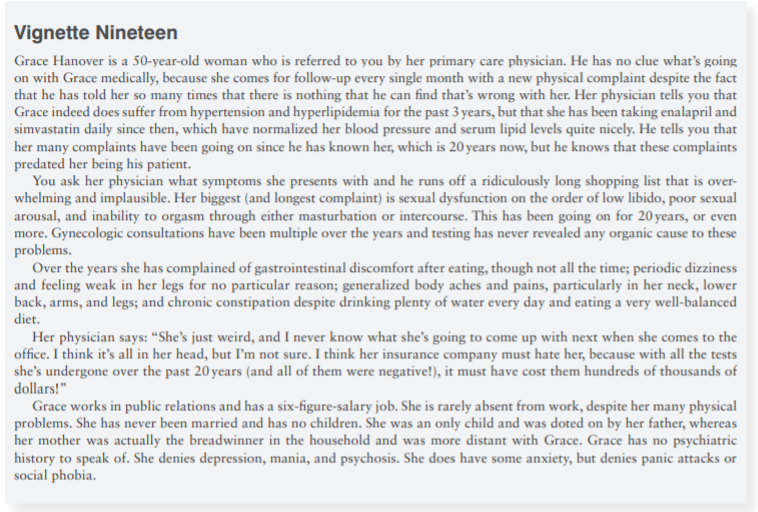
221. Which of the following symptoms would push your differential diagnosis away from a conversion disorder (functional neurological symptom disorder) in Grace’s case? (Pick three of seven)
- ABackaches
- BHeadaches
- CAnorgasmia
- DDizziness
- EConstipation
- FGastrointestinal discomfort
- GArm and leg pain
232. Which of the following etiological theories are believed to be possible contributors to Grace’s primary problem? (Pick three
of six)- AAbnormal regulation of the cytokine system
- BOnly personality disordered patients have Grace’s disorder
- CDecreased metabolism in the frontal lobes and nondominant hemisphere
- DApoptosis and gliosis of brain-stem neurons
- ECatecholaminergic deficits or imbalance in the CNS
- FGenetic predisposition of the disorder in first-degree female relatives of probands of patients with Grace’s disorder
24Vignette 19 Question 3. Which of the following statements about the epidemiology of Grace’s primary disorder are not true? (Pick three of six)
- AMen outnumber women with the disorder by about 5 to 20 times
- BThe lifetime prevalence of somatic symptom disorder among women is about 1% to 2%
- CThe disorder occurs more frequently in patients of upper class and higher socioeconomic status
- DThe disorder usually begins in adulthood after the age of 30
- EConcomitant personality traits associated with somatic symptom disorder include obsessive–compulsive, paranoid, and avoidant features
- FBipolar I disorder and substance abuse occur no more frequently in somatic symptom disorder patients than in the general population at large
25Vignette 19 Question 4. Which of the following facts are true about the course and prognosis of Grace’s primary disorder? (Pick three of six)
- AThe course of the disorder is typically acute and static in its presentation
- BPatients with the disorder have a 20% chance of being diagnosed with this disorder 5 years later
- CPatients with the disorder are no more likely to develop another medical illness in the next 20 years than people without the disorder
- DThe disease rarely remits completely
- EIt is unusual for a patient with the disorder to be free of symptoms for greater than 1 year
- FThe overall prognosis of the disorder is good to excellent in most cases
265. The only treatment maneuver for Grace’s primary disorder that seems to be able to decrease personal health care expenditure
by about 50% is:- AAtypical antipsychotics
- BAntidepressant medications
- CElectroshock therapy
- DGroup and individual psychotherapy
- EMood stabilizers like lithium and divalproex sodium
- FOpioid antagonists like naltrexone
Information
- Description
- Test I: 11, 56, 81, 122, 145 Test II: 19, 134 Test III: 82, 109, 120 Test IV: 23, 73 Test V: 5, 49, 97, 104, 139, 141 Test VI: 41, 49, 144 Vignette 19
- Author
- Eleanor garvey
- Language
- English
- Views
- 136
- Tags
- Rating
- No ratings yet Rate this quiz