
Quiz
Chapter 6 Quiz: The Reformation
Questions in this quiz (29)
1Within the growing number of wealthy American families after the Civil War, the expected role for women was to
- Ainvest and safeguard the family's money.
- Bconsume and display the family's wealth.
- Cuse modern advances to do more of the housework.
- Dshape the family's moral life to guard against materialism.
2What was a distinctive component of American cultural life for middle-class women in the late nineteenth century?
- AMembership in a women's club
- BMembership in a health club
- CEnrollment at an all-women's college
- DAdvocacy of woman suffrage
3How did the Knights of Labor and the American Federation of Labor (AFL) treat working women in the late 1800s?
- AThe Knights welcomed women workers; AFL leaders believed that women should stay at home.
- BBoth unions organized skilled laborers, which allowed garment workers and other women in skilled trades to join.
- CThe Knights of Labor were more successful and longer lasting than the AFL but did not allow women.
- DThe Knights of Labor would not support strikes by women, but the AFL would.
4How were the requirements for operating a typewriter different from operating a sewing machine?
- ASewing machine operators had to attend trade schools and were considered skilled labor; typists learned their craft on the job.
- BThe work of typists was much easier, but sewing machine operators had better job security and wages.
- CMost office managers preferred male typists, while sewing machine operators were mostly women.
- DTypists were required to have an education and a command of the English language; operating sewing machines required little formal training.
5Why did "homosocial" relationships come under attack in the late nineteenth century?
- AToo many women were rejecting marriage for the comfort of female companionship.
- BCritics cited them as one more negative aspect of giving women the right to vote.
- CHomosocial relationships of working women were seen as a negative socialist influence.
- DPhysicians characterized the relationships as "unnatural" or "abnormal."
6Why did most black families choose sharecropping over other forms of agricultural labor during Reconstruction?
- AWhite landowners refused to hire freedmen as day laborers or use them in gang labor.
- BSharecropping allowed black farmers to make significant profits.
- CSharecropping allowed black families to work independently without direct white oversight.
- DBlack workers preferred to work the land under white supervision than toil in factories.
7How did the woman suffrage movement respond to the congressional debates over the Fourteenth and Fifteenth Amendments?
- AWomen split over whether to endorse the Fifteenth Amendment, which omitted the word "gender."
- BWomen gained the Supreme Court's support for the argument that women could not be denied the vote on the basis of gender.
- CThe suffrage movement collapsed after rejection of its goals by Congress and disappeared for the next fifty years.
- DFrustrated by failure to win the vote, the movement shifted to focus on getting women admitted to colleges in greater numbers.
8What was the argument about woman suffrage advanced by the New Departure theory of the suffrage movement?
- AThe right to privacy undergirded women's right to vote, but a constitutional amendment would be advantageous.
- BWomen were persons under the Fourteenth Amendment and thus, as citizens, had the right to vote.
- CWomen over the age of twenty-one were adults, and all American adults had a fundamental right to vote.
- DThe best way for women to win the right to vote was by petitioning Congress for an equal rights amendment.
9The Supreme Court's decision in Minor v. Happersett
- Athrew the question of woman suffrage back to the states.
- Bestablished that voting was a privilege, not a right of citizenship.
- Cheld that women should not have voting rights because most were not educated.
- Druled that the Fifteenth Amendment did not apply to women.
10Many freedwomen responded to the defeat of the Confederacy by
- Aleading armed rebellions against their former masters.
- Btraveling in large numbers to the North to work in textile factories.
- Ctaking to the road or advertising to find lost spouses and family members.
- Ddemanding to be paid for past labor in hopes of educating their children.
11Black codes were laws passed by
- Athe Freedmen's Bureau to protect newly freed slaves.
- BCongress that legalized sharecropping.
- Csouthern states to limit the freedom of freedmen.
- Dsouthern states to outlaw child labor in the South.
12Why did many poor white women who worked in southern textile mills in the 1880s consider this work a privilege?
- AThe pay in southern factories was better than salaries paid in the North.
- BThey preferred factory work to working as domestics.
- CIt was the first opportunity that southern women had to work outside the home.
- DFactories hired only white women, which made the work seem to be a racial privilege.
13Why did white southern groups such as the Ku Klux Klan charge that black men were sexual predators who sought access to white women?
- ATo assert control over African American men in the aftermath of slavery
- BTo win sympathy for the plight of women in northern newspapers
- CTo protest the growing rate of interracial marriage that cost them potential marriage partners
- DTo hide their shame over their inability to attract suitable marriage partners
14What did the U.S. Supreme Court rule in Plessy v. Ferguson?
- AJim Crow laws were unconstitutional.
- BSegregation was legal and compatible with the Fourteenth Amendment.
- CAfrican American men could be denied the right to vote.
- DPublic transportation could not be segregated.
15A common criticism of working women in the late nineteenth century was that they
- Awere not as committed to their work as men.
- Bjoined unions in greater numbers than men.
- Cwere overpaid for the meager work they performed.
- Dtook jobs away from male breadwinners.
16By the late nineteenth century, what gains in women's rights had been realized?
- AThe New York legislature had given women the right to vote.
- BThe Supreme Court had ruled that women had the right to vote in all elections.
- CAfrican American women had the right to vote.
- DWomen had the right to vote in territorial and local elections in Wyoming and Utah.
17The National Women Suffrage Society was formed by Elizabeth Cady Stanton and Susan B. Anthony in response to
- Athe need to get more women enrolled in college after the Civil War.
- Bdemands by African American women in the South to win the right to vote.
- CCongress not including the word "gender" in the Fifteenth Amendment.
- Dlack of interest in woman suffrage after the Civil War.
18Susan B. Anthony demonstrated the New Departure theory when she
- Apetitioned the U.S. Supreme Court to declare the Fourteenth Amendment unconstitutional.
- Bdeclared that women had the right to petition Congress for an equal rights amendment.
- Cenrolled in classes at Harvard University and earned her doctoral degree.
- Dconvinced election officials in Rochester, New York, to allow her vote.
19How were elite white southern women affected by Reconstruction?
- ATo counteract the freedmen's vote, southern legislators gave elite white women the right to vote.
- BFor the first time, elite white southern women had to cook and launder for their own households.
- CElite white southern women advertised for and hired Irish servants to replace slave labor.
- DElite white southern women worked to end sharecropping to be able to hire black women as servants.
20What was the danger that African American men faced in the reconstructed South for the slightest suspicion of disrespect to a white woman?
- AArrest and a lengthy trial
- BHeavy fines
- CLynching by a mob
- DDeportation to the North
21Ida B. Wells was significant because she
- Acampaigned to stop lynching.
- Bcriticized Radical Reconstruction in the South.
- Cwrote articles exposing the folly of sharecropping.
- Dorganized unions for black women workers.
22Which of the following describes the progress of Reconstruction in the South between 1865 and 1900?
- AAfter southern white resistance was broken down by military occupation, African Americans gradually won the right to vote in local elections.
- BAfter the U.S. Army withdrew from the defeated southern states, white-dominated legislatures reestablished white supremacy and instituted segregation.
- CThe reign of the Ku Klux Klan was only temporary because its excesses were condemned by southern legislatures, most of which had accepted African American suffrage by 1900.
- DAfter the defeat of the Democratic Party by mixed-race coalitions in the 1870s and 1880s, the Republican Party emerged as the dominant southern party by 1900.
23How did the sewing machine affect women's labor in the textile industry?
- ABecause they had attended training classes, women who operated sewing machines were considered skilled labor.
- BWomen who operated sewing machines were paid hourly and at higher wages than women running power looms.
- CClothing manufacturing was divided into discrete tasks, and a single worker no longer made an entire piece of clothing.
- DSewing machine operators had steadier work and shorter hours than other women in the textile industries.
24What was justified by the "family wage" concept of the late nineteenth century?
- APaying men higher wages while paying women significantly less
- BHiring children in textile mills to help immigrants support their families
- CAllowing parents and children to work in the same area in factories
- DThe "sweating" system, which kept mothers at home to tend to their children
25What was Harriot Stanton Blatch encouraging women to do when she advocated "voluntary motherhood"?
- AHire nurses to watch their children so they would have more free time
- BAdopt working-class children to give them a better life
- CChoose when and how often to become pregnant
- DUse the new birth control devices developed in Holland
26What did the endorsement of woman suffrage by the WCTU convince Susan B. Anthony to do?
- AForm one national organization of all women's groups that supported suffrage
- BDisband the NWSA and join the WCTU
- CFollow the model of the WCTU and allow African American women to join the NWSA
- DMake prohibition part of the NWSA's political platform
27The image of the "New Woman" emphasized "women's work," a term that meant women
- Awere best suited to consume goods, while men produced goods
- Bshould be exclusively dedicated to motherhood.
- Cshould participate in paid labor or public service.
- Dshould be paid less than men for their less demanding jobs.
28Read the following historic image and then choose the statement that best applies.
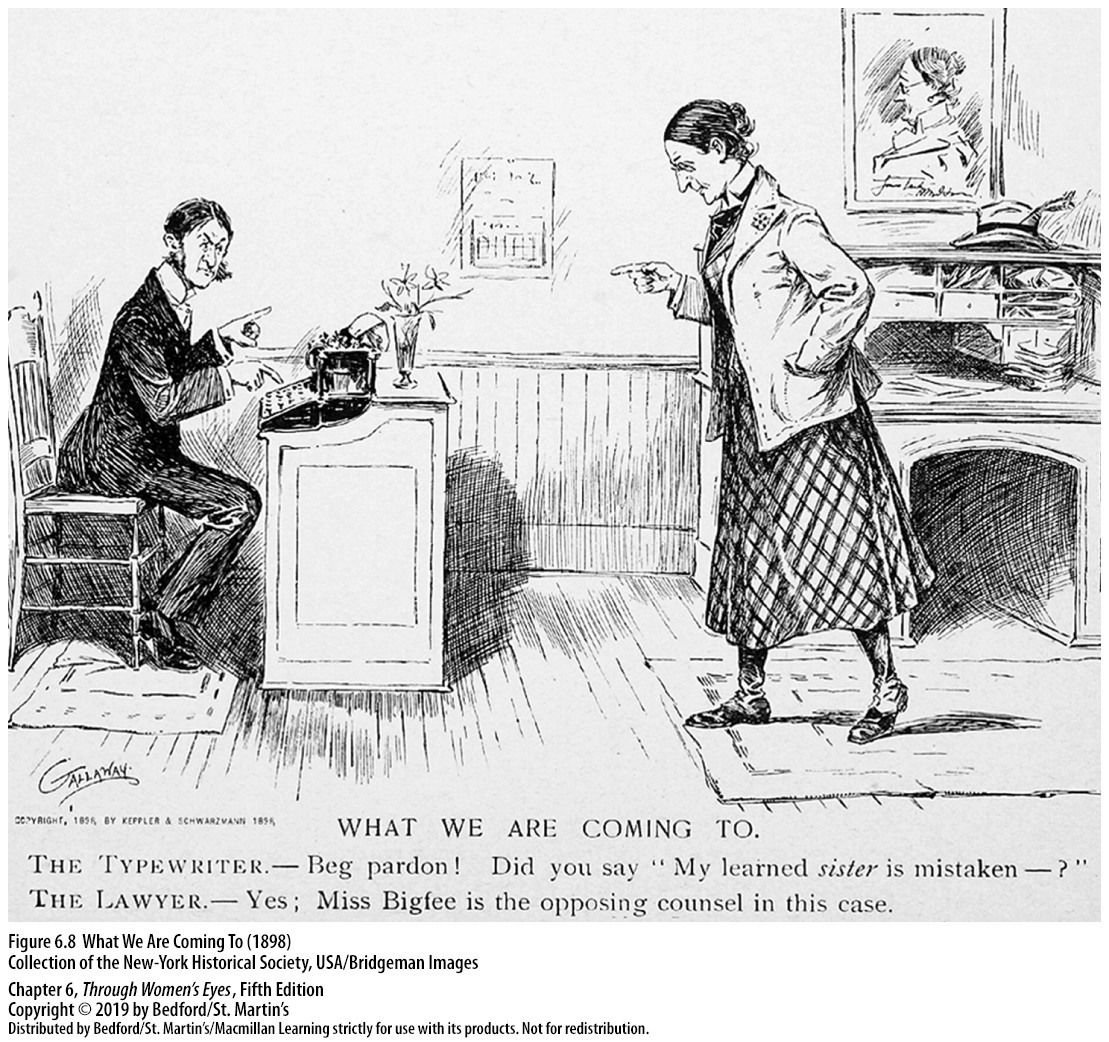
- AThe artist portrays the man in this image as “unmanned” or effeminate because he is portrayed as the typewriter, an office tool that was associated with women.
- BThe artist supports the idea of professional women.
- CFemale suffragettes would approve of the message in this political cartoon.
- DFrom the signature on this historical image we know the artist was “Gibson” who was famous for his “Gibson Girl” images.
29Read the following historic image and then choose the statement that best applies.
- AA shocking revelation in this historical image is that the opposing counsel in the case is a woman.
- BThis document is a private document.
- CThe artist of this political cartoon is demonstrating how professional women will positively change society.
- DThe New Woman in this image is idealized and portrayed as attractive.
Information
- Description
- The Era of Reconstruction
- Author
- Sarahy Perez
- Language
- English
- Views
- 45
- History
- Created on 12 Oct 2022 · updated on 13 Oct 2022
- Tags
- Rating
- No ratings yet Rate this quiz