
Quiz
Physical Assessment Final Review
This quiz has question types that open in the usual player.
Questions in this quiz (67)
1The foundation of patient centered care is built through [blank_start]Collaboration[blank_end], [blank_start]Communication[blank_end], and [blank_start]Documentation[blank_end].
- ACollaboration
- BCommunication
- CDocumentation
2The five steps of the Pharmacist's Patient Care Process in order are:
[blank_start]Collect[blank_end]
[blank_start]Assess[blank_end]
[blank_start]Plan[blank_end]
[blank_start]Implement[blank_end]
and [blank_start]Follow Up[blank_end]- ACollect
- BAssess
- CPlan
- DImplement
- EFollow Up
3Communication is the MOST important in this step of the PPCP.
- AImplement
- BCollect
- CAssess
- DPlan
- EFollow Up
4Physical Assessment is the MOST important in this step of the PPCP.
- AImplement
- BCollect
- CAssess
- DPlan
- EFollow Up
5When evaluating a patient's medication, you use AESA which stands for:
[blank_start]Appropriateness[blank_end]
[blank_start]Effectiveness[blank_end]
[blank_start]Safety[blank_end]
[blank_start]Adherence[blank_end]- AAppropriateness
- BEffectiveness
- CSafety
- DAdherence
6Collaborative Practice Agreements (CPA) allows for prescriptive authority under supervision of a physician according to a protocol.
- ATrue
- BFalse
7Responsible provision of drug therapy for the purpose of achieving definite outcomes that improve a patient’s quality of life. These outcomes are:
- Acuring of a disease
- Beliminating or reducing a patient’s symptoms
- Carresting or slowing a disease process
- Dpreventing a disease or symptoms
- Emaintaining the state of the disease
8Appropriate behavior in the assessment room includes being calm, confident, explaining what you are going to do, and asking for permission before doing an assessment.
- ATrue
- BFalse
9Get to know your patients by
- AAsking Questions
- BActively Listening
- CNot Making Assumptions
- DWatching Verbal/Nonverbal Cues
- EComparing Your Experiences to Theirs
10[blank_start]Ethnocentrism[blank_end] – the belief in the superiority of one’s own culture.
[blank_start]Stereotyping[blank_end] – fixed perceptions of a group that reject alterations from that group
[blank_start]Prejudice[blank_end] – fixed perception of another person based on direct/indirect experiences- AEthnocentrism
- BStereotyping
- CPrejudice
11Provide Culturally Competent Care through "LEARN" which stands for
[blank_start]Listen[blank_end]
[blank_start]Explain[blank_end]
[blank_start]Acknowledge[blank_end]
[blank_start]Recommend[blank_end]
[blank_start]Negotiate[blank_end]- AListen
- BExplain
- CAcknowledge
- DRecommend
- ENegotiate
12Blood pressure is the force of blood pushing against arterial walls which includes [blank_start]Systolic[blank_end] and [blank_start]Diastolic[blank_end] readings.
- ASystolic
- BDiastolic
13Which of these factors can influence an inaccurate blood pressure reading?
- ACuff Size
- BTemperature
- CArm Position
- DAnxiety
- EDiet
14A normal blood pressure range is systolic being <[blank_start]120mmHg[blank_end] and diastolic being <[blank_start]80mmHg[blank_end]
While an elevated blood pressure is systolic being [blank_start]120-129mmHg[blank_end] and diastolic being <[blank_start]80mmHg[blank_end]- A120mmHg
- B80mmHg
- C120-129mmHg
- D80mmHg
15A silent interval between the systolic and diastolic BP is called
- AAuscultatory Gap
- BSystolic Silence
- CArrhythmia
- DAtherosclerosis
16Hypertension can result in
- ACardiovascular Disease
- BStoke
- CRenal Disease
- DVision Loss
- EInterior Artery Disease
17The American Heart Association (AHA) recommends an automatic, cuff-style, wrist monitor.
- ATrue
- BFalse
18A normal radial pulse is [blank_start]60-100bpm[blank_end] rate, [blank_start]2+[blank_end] Amplitude, and [blank_start]RRR[blank_end] pulse rhythm.
- A60-100bpm
- B2+
- CRRR
19Label the locations for arterial pulse assessment.
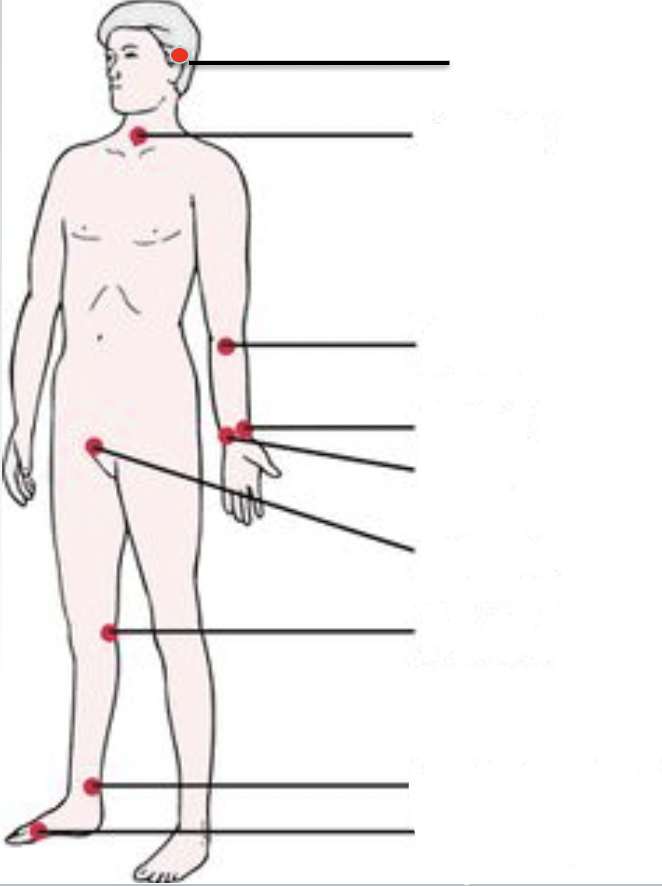
- ATemporal
- BCarotid
- CBrachial
- DRadial
- EUlnar
- FFemoral
- GPopliteal
- HPosterior Tibial
- IDorsalis Pedis
20A normal adult respiratory rate is [blank_start]12-20rpm[blank_end].
- A12-20rpm
21A normal skin turgor is around "2+ skin turgor"
- ATrue
- BFalse
22Match the site of measurement with it's normal temperature range.
Rectal [blank_start]97.9 - 100.4 *F[blank_end]
Oral [blank_start]95.9 - 99.5 *F[blank_end]
Axillary [blank_start]94.5 - 99.3 *F[blank_end]
Tympanic [blank_start]96.3 - 100.0 *F[blank_end]
Temporal [blank_start]97.9 - 100.1 *F[blank_end]- A97.9 - 100.4 *F
- B95.9 - 99.5 *F
- C94.5 - 99.3 *F
- D96.3 - 100.0 *F
- E97.9 - 100.1 *F
- F95.9 - 99.5 *F
- G97.9 - 100.4 *F
- H94.5 - 99.3 *F
- I96.3 - 100.0 *F
- J97.9 - 100.1 *F
- K94.5 - 99.3 *F
- L97.9 - 100.4 *F
- M95.9 - 99.5 *F
- N96.3 - 100.0 *F
- O97.9 - 100.1 *F
- P96.3 - 100.0 *F
- Q97.9 - 100.4 *F
- R95.9 - 99.5 *F
- S94.5 - 99.3 *F
- T97.9 - 100.1 *F
- U97.9 - 100.1 *F
- V97.9 - 100.4 *F
- W95.9 - 99.5 *F
- X94.5 - 99.3 *F
- Y96.3 - 100.0 *F
23You can use a rectal thermometer orally after throughly disinfecting it.
- ATrue
- BFalse
24This is an example of a visual analog pain scale.
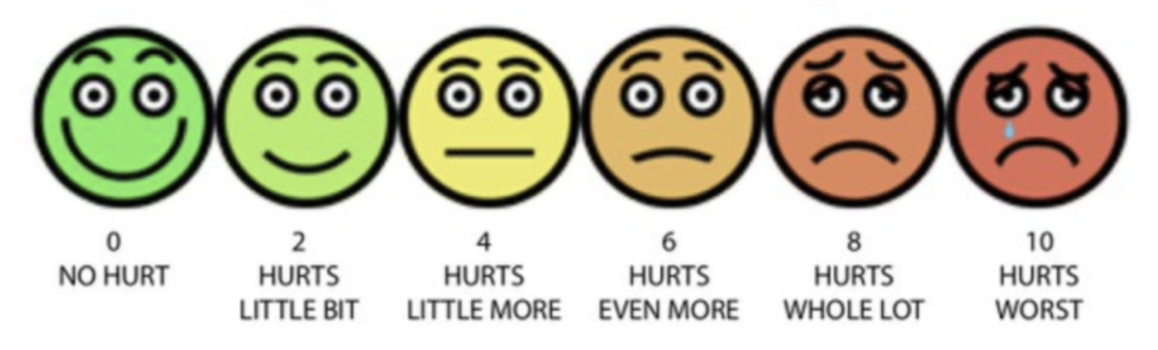
- ATrue
- BFalse
25This is an example of a Wisconsin Pain Questionnaire.
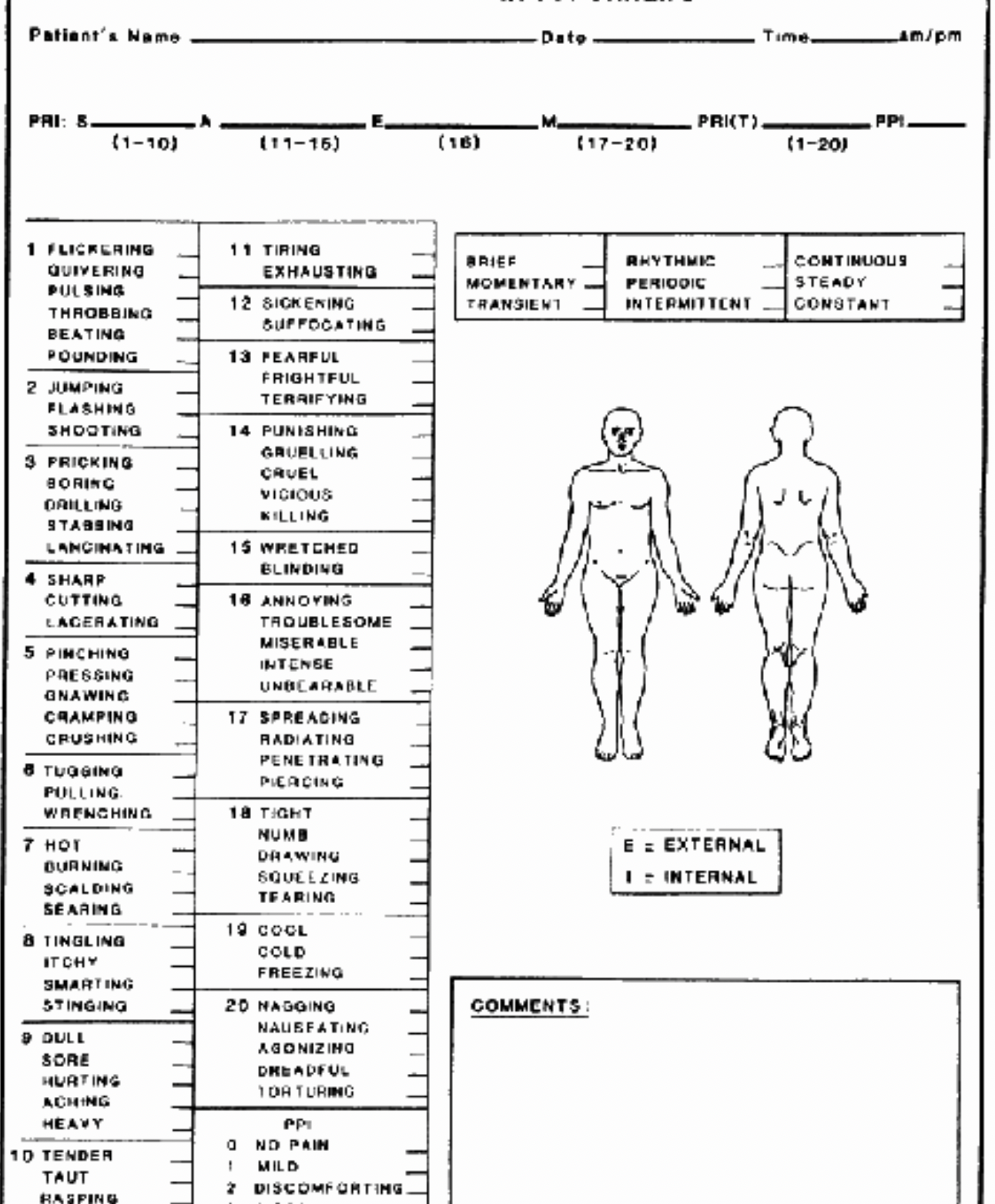
- ATrue
- BFalse
26Label the quadrants correctly.
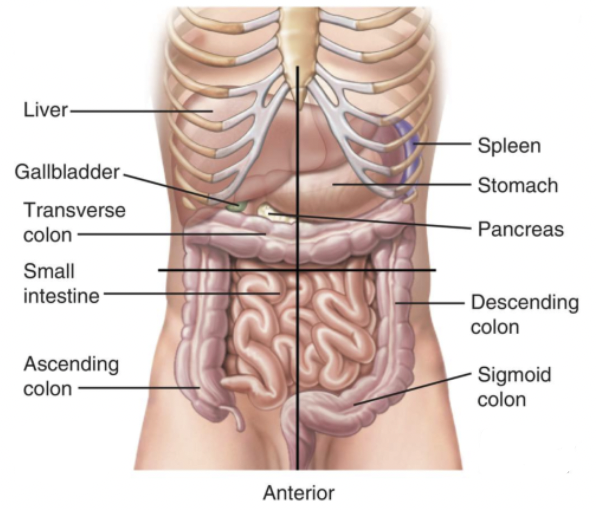
- ARight Upper Quadrant
- BLeft Upper Quadrant
- CRight Lower Quadrant
- DLeft Lower Quadrant
27When recommending vaccines that are needed (SHARE):
•[blank_start]Share[blank_end] the reasons for that specific patient
•[blank_start]Highlight[blank_end] positive experiences
•[blank_start]Address[blank_end] patient questions/concerns
•[blank_start]Remind[blank_end] patients that vaccines protect them and their loved ones
•[blank_start]Explain[blank_end] potential costs of getting the disease- AShare
- BHighlight
- CAddress
- DRemind
- EExplain
28Which of these are Viral vaccines?
- ACOVID
- BDengue
- CDiphtheria
- DMeasles, mumps, rubella
- EPneumococcal
29Checking a patient's height and weight provides you information on:
- ANutritional Status
- BMedications
- CMedical Conditions
- DFluid Intake
30A Recumbent Measuring Board is used to measure
- AHeight of Infants
- BWeight of Infants
- CHeight of Paralyzed Patients
- DWeight of Paralyzed Patients
- EWeight of Amputated Patients
31BMI can be calculated with this equation.
- Aweight kg/ height m^2
- Bweight lb/ height inches^2
- C(weight kg/ height m^2) x 703
- D(weight kg x 703)/ height m^2
32For adults, a healthy BMI 25-29.9
- ATrue
- BFalse
33The physical examination process proceeds in this order:
[blank_start]Inspection[blank_end] -> [blank_start]Palpation[blank_end] -> [blank_start]Percussion[blank_end] -> [blank_start]Auscultation[blank_end]- AInspection
- BPalpation
- CPercussion
- DAuscultation
34When doing an inspection during a physical assessment you are looking for:
- ALocation
- BSize
- CColor
- DAppearance
- EVibration
- FSwelling
35Percussion consists of Touching or feeling with the hand.
- ATrue
- BFalse
36Assessment of movement of blood in the cardiovascular system is considered to be part of [blank_start]Auscultation[blank_end] in physical assessment.
- AAuscultation
37[blank_start]Diaphragm[blank_end]: Used for high-pitched sounds
[blank_start]Bell[blank_end]: Used for low-pitched sounds- ADiaphragm
- BBell
- CBell
- DDiaphragm
38At least how many pieces of gum should a patient use in a day for the first 6 weeks of therapy to have the highest chance of smoking cessation success?
- A9
- B10
- C6
- D24
- E12
39The sequence of a physical exam should go from head to toe.
- ATrue
- BFalse
40[blank_start]Documentation[blank_end] is the process of entering and storing information in the patient’s medical record.
- ADocumentation
41Proper documentation enhances our ability to [blank_start]evaluate[blank_end] care, [blank_start]plan[blank_end] treatment, and [blank_start]monitor[blank_end] care over time; Ensures [blank_start]effective communication[blank_end] and [blank_start]continuity of care[blank_end] among members of the health care team; and Improves the [blank_start]quality of care[blank_end] provided to our patients.
- Aevaluate
- Bplan
- Cmonitor
- Deffective communication
- Econtinuity of care
- Fquality of care
42Benefits of documentation in electronic health records include:
- ABeing more time efficient
- BAids in claim reviews and payment
- CCan ensure adherence to clinical practice guidelines
- DCan eliminate medication errors and adverse drug events
- EAids in monitoring and evaluating quality of care and
outcomes
43Also called a progress note, "SOAP" note stands for
[blank_start]Subjective[blank_end]
[blank_start]Objective[blank_end]
[blank_start]Assessment[blank_end]
[blank_start]Plan[blank_end]- ASubjective
- BObjective
- CAssessment
- DPlan
44Sort the data into Subjective or Objective information.
(Fair warning the system will only grade it as correct if it is in a specific order so don't freak out if it says you got it "wrong". The correct order will be there when you review the question.)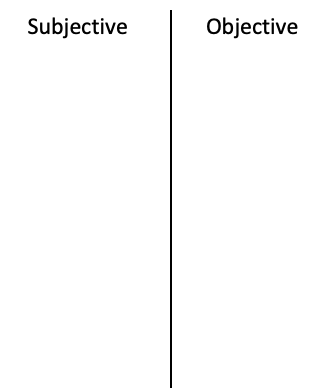
- AA telling of the patient’s story
- BReported medical conditions + diagnoses
- CSocial or Family History
- DPatient-reported answers questionnaire
- EChief Complaint
- FPhysical Exam
- GDiagnostic Tests
- HTemperature
- ICreatinine Clearance
- JBasic Metabolic Panel
45Match the description with its definition.
[blank_start]Assessment[blank_end]: The “WHY”; Provides our rationale to the next step of the process
[blank_start]Subjective[blank_end]: Information that cannot be otherwise be confirmed with by concrete data
[blank_start]Plan[blank_end]: Addresses "WHAT" we are going to do for our patient
[blank_start]Objective[blank_end]: Facts and physical findings;Data that is measurable and tangible- AAssessment
- BSubjective
- CPlan
- DObjective
- ESubjective
- FAssessment
- GPlan
- HObjective
- IPlan
- JAssessment
- KSubjective
- LObjective
- MObjective
- NAssessment
- OSubjective
- PPlan
46A patient says “It feels like something is squeezing my skull". What section do you record this in a SOAP note?
- ASubjective
- BObjective
- CAssessment
- DPlan
47You take the vitals of a patient and they are:
T 98.7F
P 70 bpm
BP146/88 mmHg
RR 16 breaths/min
Where do you record this in a SOAP note?- ASubjective
- BObjective
- CAssessment
- DPlan
48When writing down "Goals of therapy include relief of heartburn symptoms and prevention of complications", where in a SOAP note is this recorded?
- ASubjective
- BObjective
- CAssessment
- DPlan
49When writing down "Advise patient to engage in healthy non-pharmacological interventions, such as obtaining the public-health recommended 150 minutes of moderate-intensity exercise each week", where in a SOAP note does this go?
- ASubjective
- BObjective
- CAssessment
- DPlan
50Match the type of prevention with its description.
[blank_start]Secondary[blank_end]: Action taken to reduce the recurrence of a disease or event that has already occurred
[blank_start]Primary[blank_end]: Action taken to prevent the development of a disease or event
[blank_start]Tertiary[blank_end]: Action taken to soften the impact of an ongoing disease or event that has lasting effects- ASecondary
- BPrimary
- CTertiary
- DPrimary
- ESecondary
- FTertiary
- GTertiary
- HPrimary
- ISecondary
51If a patient is 35 years old, has a balanced diet, and regularly exercises, how often should they be screened for hypertension?
- AAnnually
- BEvery Other Year
- CEvery 3-5 Years
- DEvery 10 Years
52If a patient is 70 years old with hypertension, what should his goal blood pressure be?
- A<140/90 mmHg according to ACC/AHA
- B<130/80 mmHg according to ACC/AHA
- C<120/80 mmHg according to JNC8 guidelines
- D<140/80 mmHg JNC8 guidelines
53Testing for diabetes should be considered in adults who are overweight or obese and who have one or more of the following risk factors:
- AHypertension
- BWomen with PCOS
- CPatients who engage in regular physical activity
- DHistory of CVD
54Which of these groups should be tested annually for diabetes?
- APre-DM
- BWomen w/ GDM
- CAge 45 years and older
- DHIV patients
55Common Hyperglycemia symptoms include:
- APolyuria
- BPolydipsia
- CPolyphagia
- DPolyphonia
56The ASCVD risk calculator uses these risk factors:
- AAge
- BRace
- CCholesterol Levels
- DDiastolic Blood Pressure
- ESmoking Status
- FDiet
57A patient is in the High Risk ASCVD Risk Category if their percentage is:
- A>25%
- B>20%
- C>50%
- D>60%
58[blank_start]Aspirin[blank_end] is well established for secondary prevention of ASCVD.
- AAspirin
59Which of these patients should MOST likely be screened for Osteoporosis?
- AFemale; 59 years old; Vegan Diet
- BMale; 65 years old; Regularly Exercises
- CFemale; 55 years old; Post-menopause
- DMale; 60 years old; High Cholesterol Levels
60A [blank_start]T-score[blank_end] is the difference of your bone density from the average bone density of healthy young adults.
- AT-score
61Screening for ovarian, pancreatic, prostate, testicular, and thyroid cancers has been shown to reduce deaths from those cancers.
- ATrue
- BFalse
62Women may CHOOSE to start annual mammograms around the age of:
- A40-44 years old
- B45-54 years old
- C>55 years old
- D30-34 years old
63Risk factors for Glaucoma include:
- AAdvanced Age
- BFamily History
- CDiabetes
- DHypertension
- EHigh Cholesterol
- FLimited Physical Activity
64Medicare covers glaucoma screenings every 12 months for beneficiaries who are at high risk.
- ATrue
- BFalse
65The annual screening questionnaire for depression is:
- APHQ - 9
- BMHQ - 9
- CC - SSRS
- DD - SSRS
66Patients with a history of suicide risk should get a safety assessment every month.
- ATrue
- BFalse
67A Complete Assessment of a patient includes:
- AGeneral Assessment
- BVital Signs
- CPatient Interview
- DPhysical Examination
- EPlan
- FFollow Up
Information
- Description
- Quizlet Containing Medical Abbreviations: https://quizlet.com/739589992/med-abbreviations-flash-cards/
- Author
- Monica Werner
- Language
- English
- Views
- 24
- Tags
- Rating
- No ratings yet Rate this quiz